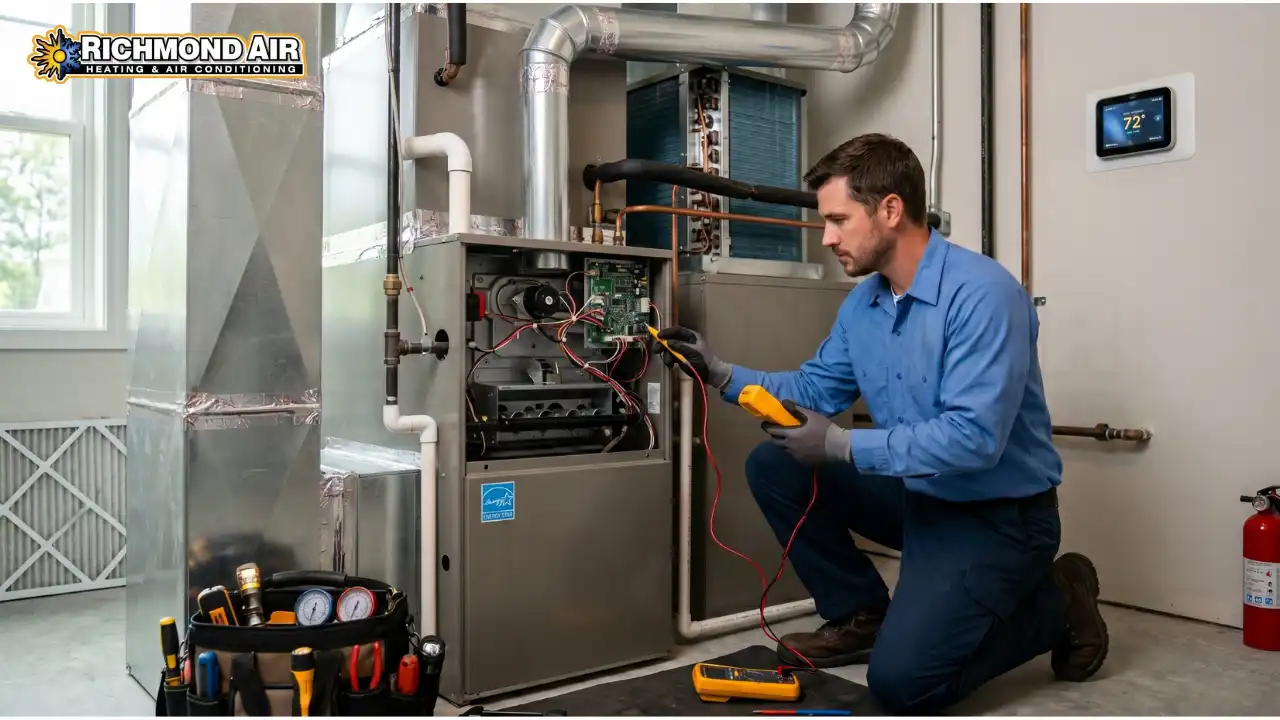
You walk into your home after a hot summer day, and it feels cool, fresh, and just right. That feeling? That’s your HVAC system doing its job. Heating, ventilation, and air conditioning work together every single day to keep your home comfortable, your air clean, and your family healthy, and most of us never think twice about it.
What Is Heating, Ventilation, and Air Conditioning (HVAC)?
HVAC stands for Heating, Ventilation, and Air Conditioning. It is the system that keeps your home warm in winter, cool in summer, and full of fresh, clean air all year long. Think of it as your home’s lungs and temperature controller, all in one.
It is not just one machine. It is a group of parts, like your furnace, air conditioner, ductwork, and thermostat, all working together to give you thermal comfort and good indoor air quality.
Is HVAC the Same as Air Conditioning?
Honestly, this is one of the most common mix-ups I hear. No, they are not the same thing.
Air conditioning is just one part of the full HVAC system. Think of it this way, AC is to HVAC what an engine is to a car. The engine matters a lot, but the car has many other parts too.
Your AC handles cooling and dehumidifying the air. But HVAC also includes your heating system, your ventilation, the compressor, the condenser, and much more. So every AC is part of HVAC, but HVAC is much bigger than just AC.
Where Did HVAC Come From? A Brief History
Well, comfort engineering has a surprisingly long history, and most people have no idea.
Back in 1899, Coyne College became the first school to teach HVAC training. Then in 1902, a man named Willis Carrier designed one of the first real air conditioning systems, for the New York Stock Exchange, of all places. That was a big deal.
By the 1950s, regular families in the US started getting residential AC in their homes. What started as a tool for big buildings slowly became something every home wanted. The science behind it all, thermodynamics and mechanical engineering, had finally made its way into everyday life.
Breaking Down Each Component of an HVAC System
Your HVAC system has three big jobs, heating, ventilating, and cooling. Each one plays a different role, but they all work together as a team. Let me break each one down in simple words.
Heating, Keeping Spaces Warm in Cold Months
I remember the first winter I truly understood how important a good heating system is. The furnace broke down in January, and wow, the house got cold fast.
The “H” in HVAC is all about warmth. Most homes use a furnace, which can run on natural gas, electricity, or propane, to make heat. Some homes use boilers, which heat water and send it through radiators or underfloor heating systems. Others use a heat pump, which pulls warm air from outside even when it feels cold out.

The heat moves through your home by convection, radiation, or conduction, through ductwork, radiators, or even the floor beneath your feet, which is called hydronics.
One thing worth knowing, always check your system’s AFUE rating. That tells you how efficiently your heater turns fuel into warm air. The higher the number, the less energy it wastes and the lower your energy bills.
If you need a heating check or install, you can reach out to Richmond Air’s heating services team we can help you find the right fit for your home.
Ventilation, The Unsung Hero of Indoor Air Quality
To be fair, ventilation never gets the credit it deserves. Most people think about heating or cooling, but ventilation is quietly doing some of the most important work.
The “V” in HVAC means replacing old, dirty air inside your home with fresh air from outside. There are two ways this happens, natural ventilation (like opening a window) and mechanical ventilation (using fans and ducts built into your system).
Good ventilation removes things you really do not want in your air, moisture, odors, carbon dioxide, airborne bacteria, dust, smoke, and volatile organic compounds. Without it, all of that stays trapped inside and you breathe it in all day.
Two great tools for this are the ERV (Energy Recovery Ventilator) and the HRV (Heat Recovery Ventilator). Both bring in fresh air without wasting the energy you already used to heat or cool your home.
Proper ventilation also stops mold from growing, because mold loves damp, still air. Following ASHRAE standards for indoor air quality (IAQ) helps make sure your home’s air is safe and clean year-round.
How Does an HVAC System Work?
A lot of people think the HVAC system is just one big box that blows air. Honestly, I thought the same thing for a long time. But once you see the steps, it all makes perfect sense.
Here is how it works, step by step:
Step 1: Air Intake: Your system pulls air in from inside your home through return vents.
Step 2: Filtration: That air passes through an air filter, which catches dust, allergens, and other particles before anything else happens.
Step 3: Heating or Cooling: The clean air then moves through either a furnace or an evaporator coil, depending on the season. This is where the refrigeration cycle happens for cooling, the refrigerant absorbs heat from your indoor air and carries it outside, leaving cool air behind.
Step 4: Distribution: The conditioned air travels through your ductwork and comes out through vents into each room.
Step 5: Return: Stale air gets pulled back into the system, and the whole cycle starts again.
The thermostat is the brain of the whole operation. You set the temperature you want, and it tells every part of the system when to turn on or off. Simple, right?
The Role of the Thermostat and Ductwork
The funny part is, most people upgrade their furniture before they ever think about their thermostat. But a good thermostat can actually save you real money.
A smart thermostat learns your schedule and adjusts the temperature on its own. It can even do zoned cooling and zoned heating, meaning different rooms get different temperatures. No more fighting over the thermostat with your family.
Your ductwork is just as important. It is the road your air travels through. Here is what makes it up:
- Supply ducts: carry conditioned air from the system into your rooms
- Return air ducts: pull old air back to be filtered and reconditioned
- Registers and grilles: the vents you see on your walls or floors
- Blower motor: pushes the air through the whole network
Good airflow balance means every room gets the right amount of air, not too much, not too little. And always check your system’s SEER rating, it tells you how energy-efficient your cooling is. Higher SEER means lower bills.
Ductwork can last 20 to 30 years, but only if it is well maintained. Leaky ducts waste a lot of energy without you even knowing.
Key Parts Working Behind the Scenes
Your HVAC system has several parts you never see but really should know about. Each one has a job, and when one stops working, you feel it fast.
Here are the key players:
- Evaporator coil: sits inside your home and absorbs heat from the air to cool it down
- Condenser coil: sits outside and releases that heat into the outdoor air
- Compressor: pumps the refrigerant between the indoor and outdoor units
- Refrigerant lines: carry the refrigerant back and forth between coils
- Air filter: catches dust and particles before they enter your system
- Fan coils: help move conditioned air through the home
- Air Handling Unit (AHU): the central unit that moves and conditions all the air
- Centrifugal fans: push high-pressure airflow through ducts and filters
- Axial fans: move large amounts of air, great for cooling and ventilation
All these parts work together for energy efficiency and long-term system reliability. If even one part is worn out, your whole system works harder, and your energy bill goes up.
For a full system check, or if you need a new unit set up, Richmond Air’s air conditioning installation and service team is a great place to start.
Types of HVAC Systems Explained
Not all HVAC systems are built the same. The type that works best for you depends on your home size, budget, and where you live. Let me walk you through the main ones.
- Central Ducted Systems: These are the most common in American homes. They use ductwork to push conditioned air into every room, great for whole-home cooling and heating.
- Ductless Mini-Splits: They have no ducts at all. They connect an outdoor unit to one or more indoor units, giving you targeted cooling exactly where you need it. Perfect for older homes or room additions.
- Heat Pumps: These are smart systems that both heat and cool. There are three main kinds, air-source heat pumps (pull heat from outdoor air), geothermal heat pumps (pull heat from underground), and cold-climate heat pumps (work even in freezing temperatures).
- Split Systems: They keep the heating unit inside and the cooling unit outside, the most popular setup for most families.
- Packaged Systems: put’s everything, heating, cooling, and sometimes ventilation, into one single outdoor unit. These are common in smaller homes or commercial spaces with limited indoor room.
Ducted vs. Ductless HVAC Systems, Which Is Better?
I get this question a lot, and the honest answer is, it depends on your home. Both have real strengths.
Your ceiling height, home layout, and local climate all play a role in which one makes more sense for you.
| Feature | Ducted System | Ductless Mini-Split |
| Best for | Large homes, whole-home comfort | Single rooms, additions, older homes |
| Installation | Needs existing ductwork | No ductwork needed |
| Flexibility | Heats/cools entire home evenly | Targeted room-by-room control |
| Energy Efficiency | Can lose energy through leaky ducts | Very efficient, no duct losses |
| Upfront Cost | Lower if ducts already exist | Higher per unit, but saves long-term |
| Ideal Climate | Any climate | Mild to moderate climates |
Neither one is always better. A big house with existing ductwork may do great with a central system. But if you are adding a new room or living in an older house with no ducts, a mini-split is probably your best friend.
Residential vs. Commercial vs. Industrial HVAC
HVAC systems come in three different scales, and each one is built for a very different world.
- Residential HVAC
- Commercial HVAC
- Industrial HVAC
Residential HVAC is what most of us have at home. It covers houses and apartments, keeping families warm, cool, and breathing clean air.
Commercial HVAC handles bigger spaces like offices, warehouses, hotels, and data centers. These systems are more complex and often use tools like CRAC (Computer Room Air Conditioners) and CRAH (Computer Room Air Handlers) units, along with hot aisle/cold aisle containment to protect sensitive equipment. Engineers also track PUE (Power Usage Effectiveness) to measure energy use in these buildings.
Industrial HVAC goes even bigger, think factories, cleanrooms, and large manufacturing plants where air quality and temperature control are critical for both workers and machines.
If you are a homeowner in Richmond looking for the right residential system, Richmond Air can walk you through every option and help you pick what fits your home best.
Why HVAC Matters for Your Home’s Comfort, Health, and Energy Bills
Here is something most people do not think about, the air inside your home can actually be more harmful than the air outside. According to the U.S. Environmental Protection Agency (EPA), indoor levels of some pollutants can be 2 to 5 times higher than outdoor levels, and Americans spend roughly 90% of their time indoors. That is a big deal.
Your HVAC system is what stands between you and all of that, the dust, the allergens, the indoor pollutants, the moisture that causes mold. A good system filters the air, controls humidity, and keeps the temperature steady. That is called thermal comfort, and it matters more than most people realize.
When your HVAC runs well, your energy costs go down. When it runs poorly, it works harder, uses more power, and breaks sooner. Systems with an ENERGY STAR rating are tested to be more energy-efficient, which means lower monthly bills for you without giving up comfort.
You can also add extra air quality products to your system, things like air purifiers, humidifiers, dehumidifiers, and even an electrostatic precipitator that pulls tiny particles out of the air like a magnet. These are not just luxury add-ons. For families with asthma or allergies, they can make a real difference every single day.
As for how long your system will last, a well-maintained HVAC system typically lasts 15 to 25 years, according to data from multiple HVAC industry sources and standards set by ASHRAE (American Society of Heating, Refrigerating and Air-Conditioning Engineers). The exact lifespan depends on the type of system, your local climate, and, most importantly, how well you take care of it.
If you want a system that lasts and saves you money over time, the team at Richmond Air can help you find the right setup for your home and budget.
How Often Should You Service Your HVAC System?
Well, the short answer is, twice a year. Most HVAC professionals recommend a tune-up in spring before cooling season and again in fall before heating season kicks in.
During each visit, a technician checks the key parts, cleans what needs cleaning, and catches small problems before they turn into expensive ones. Between visits, you should be doing filter replacement every 1 to 3 months, a clogged filter makes the whole system work harder than it should.
Booking routine AC maintenance twice a year, spring and fall, is one of the simplest things you can do to protect your system and lower your energy bills.
Ready to Take Control of Your Home’s Comfort?
Stop guessing and start living in a home that feels just right, all year long. Whether your system needs a quick fix, a seasonal tune-up, or a brand-new install, Richmond Air has you covered.
Call us today or book online, it takes less than 2 minutes.
👉 Get a Free Quote from Richmond Air
Final Thoughts
Your HVAC system is one of the hardest-working parts of your home. It heats, cools, and cleans your air, every single day, without much thanks.
Now that you know how heating, ventilation, and air conditioning all work together, you are in a much better place to make smart choices, whether that is picking the right system, keeping up with maintenance, or just understanding why your energy bill went up last month.
If you ever need help with your system, a repair, a tune-up, or a full install, the team at Richmond Air is always ready to help. Good HVAC care is not complicated. It just takes a little attention and the right people by your side.
Frequently Asked Questions
What is the full form of HVAC?
HVAC stands for Heating, Ventilation, and Air Conditioning. It is the complete system that controls the temperature, airflow, and air quality inside your home or building.
What is the difference between HVAC and AC?
AC only cools your home. HVAC is the full system — it heats, cools, and ventilates. Think of AC as just one part of the bigger HVAC picture.
How long does an HVAC system last?
A well-maintained HVAC system typically lasts 15 to 25 years. Regular tune-ups, filter changes, and annual inspections are the biggest factors that help it reach that upper range.
What are the three main functions of an HVAC system?
The three main functions are heating (keeping you warm), ventilation (keeping your air fresh and clean), and air conditioning (keeping you cool). All three work together as one team.
Do I need an HVAC system for a small home?
Yes, even small homes need proper heating, cooling, and ventilation to stay comfortable and healthy. A ductless mini-split is often the perfect, space-saving fit for smaller spaces.