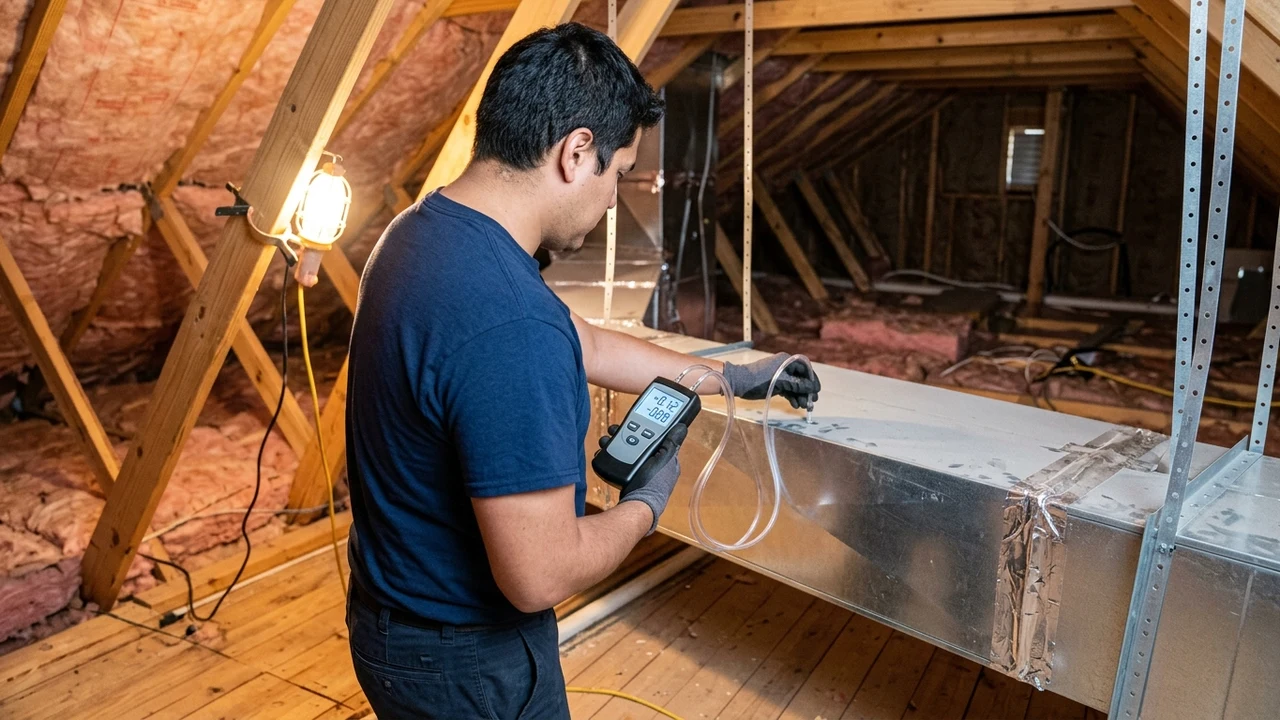
High static pressure in attic ductwork means your HVAC system pushes air and heat against too much resistance, like breathing through a straw. This chokes airflow, raises energy bills, and shortens equipment life. Fix it by sealing ducts, resizing returns, upgrading filters, and scheduling a professional static pressure test.
Your air conditioner runs all day. Still, the upstairs rooms stay warm and sticky. Sound familiar? In many Richmond two-story and tri-level homes, the real trouble hides up in the hot attic. The ducts up there are quietly choking your whole system. When air cannot move freely, your HVAC works harder, your bills climb, and your comfort drops. On most two-story Richmond homes we test, we find this exact problem in about 8 out of 10 cases.
What High Static Pressure in Attic Ductwork Really Means
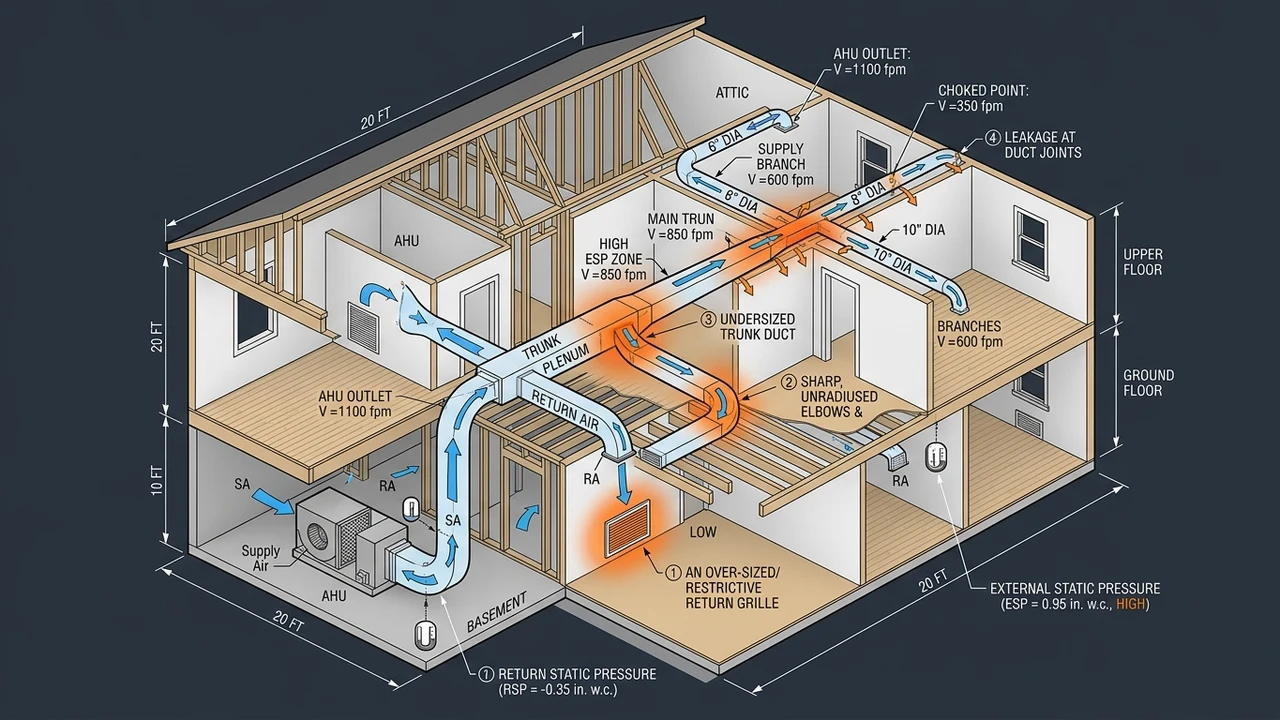
Let me keep this simple. Static pressure is the push-back your ducts give against moving air. Picture a garden hose. When you pinch it, the pressure goes up and the water flow goes down. Your HVAC system feels the same thing. When attic ductwork is too small, too long, or too leaky, the air must fight to get through. That fight is high static pressure, and it slowly chokes your equipment.
We measure this push-back in a unit called inches of water column (w.c.). That is just a small, sensitive way to read air resistance. Most home HVAC systems are built to handle only about 0.5 in. w.c. of total static pressure. That is the number the maker stamps on the blower. When we test real Richmond homes, we often see 0.8 to 1.2 in. w.c. – sometimes double the design limit. Your blower is trying to breathe through a pinched straw all day.
The Simple Idea Behind Static Pressure
Here is the short version. Your blower is a fan. It can only push so hard. Give it wide, smooth, sealed ducts and air flows easily. Give it narrow, crushed, or leaky attic ducts and the fan struggles. High static pressure means the system runs in a constant strain just to move basic airflow.
The result shows up fast. Weak vents. Hot upstairs bedrooms. A tired blower motor that can fail years too early. In our field notes, a choked system can lose 20% to 40% of the airflow it was built to deliver. That is a huge gap for one small pinch point in the attic.
Key Terms, Ducts, and Parts You Should Know
Let me explain the main words in plain English, so nothing feels confusing. Return air is the air your system pulls back in from the rooms. Supply air is the cooled or warmed air it sends back out. The blower is the fan that moves it all. When the return side is starved, static pressure spikes – and honestly, undersized returns are the number one cause we find.
Here is a quick guide we use to read the numbers on a full test:
| Total Static Pressure (in. w.c.) | What It Means | What To Do |
|---|---|---|
| 0.5 or below | Healthy. The system breathes fine. | Keep up normal maintenance. |
| 0.6 – 0.8 | Getting tight. Early choking. | Check filters and return size. |
| 0.9 – 1.2 | High. The system is choking. | Seal, resize, or add returns. |
| 1.3 and up | Severe. Parts fail early. | Call a pro fast. |
A filter matters more than most people think. A thick, dirty filter alone can add 0.2 to 0.5 in. w.c. of resistance. That one small part can push a healthy system into the danger zone.
Why High Static Pressure Matters for Richmond Homes
I’ve handled cases exactly like this for years, and the pattern is almost always the same. A family calls because the upstairs is hot, the downstairs is cold, and the power bill keeps rising. They think the AC is too small. Nine times out of ten, the equipment is fine – the attic ductwork is choking it. High pressure is the quiet thief that wrecks comfort and drains money.
Why does this hit Richmond so hard? Our summers are hot and humid, and attics here can bake past 130°F on a July afternoon. That heat pushes your HVAC system to run longer and harder. Add tight or leaky attic ducts, and the strain doubles. Multi-level homes feel it worst, because the air must travel far to reach the top floor.
Quick Wins When Your Airflow Is Fixed
Fixing static pressure gives you fast, real results. Better airflow reaches the far rooms. Weak vents come back to life. Your home cools evenly instead of fighting itself floor by floor. Many folks tell us the upstairs feels 5 to 8 degrees more even within the first day.
There is a comfort payoff too. When airflow improves, your home holds humidity better and feels less sticky. If your home stays humid even with the AC running, choked ducts are often part of the story. Good airflow helps the coil pull moisture out the way it should. And when the system runs less, it is quieter and calmer.
The Long Game: Lower Energy Bills and Longer Equipment Life
Here is where the money shows up. A choked system works harder for every degree of cooling. That extra strain can raise energy bills by a noticeable amount month after month. Fix the airflow, and your energy use drops because the blower and compressor stop straining.
Your equipment also lasts longer. A blower motor forced to fight high pressure wears out early. So does the compressor. When you reduce static pressure, you cut the risk of early failure and expensive replacement. A healthy system can serve a Richmond home well for 12 to 15 years, but a choked one may quit in half that time.
How High Static Pressure Chokes Your HVAC System
Think of your HVAC system as a set of lungs. The blower breathes in through the return and out through the supply. When the attic ducts are tight, crushed, or leaky, the lungs cannot fill. The blower spins fast but moves little air. That is choking, plain and simple. And it shows up in ways you can see, hear, and feel.
Here are the warning signs we check first on every call:
| Warning Sign | What’s Likely Happening |
|---|---|
| Weak air from upstairs vents | Not enough airflow reaching far rooms |
| Hot upstairs, cold downstairs | Uneven supply from choked ducts |
| Loud, whistling vents or ducts | Air forced through tight spaces |
| AC or furnace runs nonstop | System cannot hit the set temperature |
| High energy bills | Blower and compressor work harder |
| Frozen coil in summer | Low airflow over the cold coil |
Low airflow does more than annoy you. It can freeze the indoor coil into a block of ice, because not enough warm room air passes over it. If you want to stop that cycle, our guide on how to prevent AC freeze-ups in Richmond summers walks through the airflow link step by step. A frozen coil then blocks even more air. It is a nasty loop.
There is a winter side too. High static pressure hurts heating just as much. A furnace starved of return air can overheat and shut off on a safety switch. That means short, weak heat cycles on the coldest nights. The same choked ductwork that ruins summer comfort ruins winter comfort as well.
You may also notice your system runs almost around the clock. When airflow is low, the thermostat never feels satisfied, so the system runs and runs. If your AC never seems to shut off, our breakdown of why your AC runs constantly in Richmond explains the airflow connection in more detail. The funny part is, people often blame the thermostat when the real problem sits in the attic.
If your upstairs rooms never get comfortable, let’s take a look together. Richmond Air can run a full static pressure test and find the exact choke point instead of guessing.
Step-by-Step: How We Find and Fix High Static Pressure in Attic Ducts
In my professional experience, you cannot fix what you do not measure. I’ve walked into homes where three companies just swapped parts and hoped. The real answer took 20 minutes with a simple gauge and a few test holes. Here is the exact process we follow, in order, on Richmond homes.
Phase 1: The Home Audit and Return Air Check
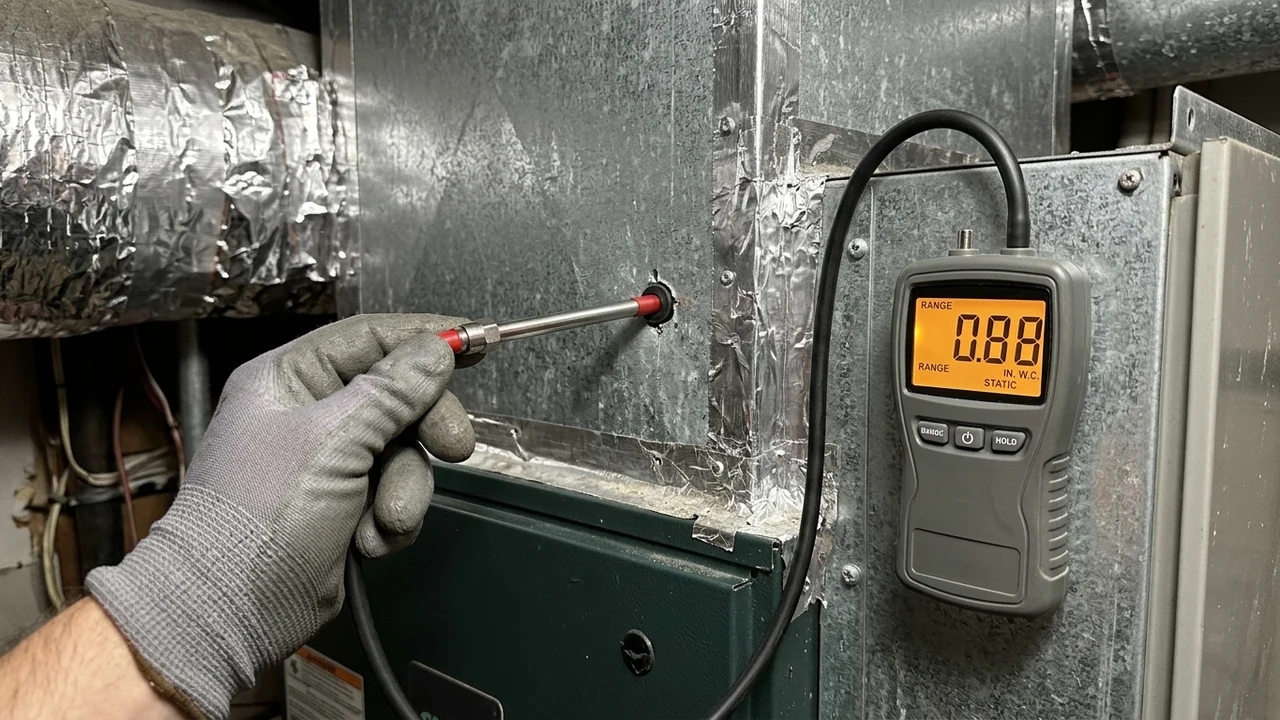
First, we measure. We put small probes on both sides of the air handler and read the total static pressure. According to ENERGY STAR, a program run by the U.S. Environmental Protection Agency and the Department of Energy, about 20% to 30% of the air moving through a typical duct system is lost to leaks, holes, and poorly joined ducts. So we hunt for those leaks early.
Next, we check the return side, because starved returns cause most high-pressure cases. We look at return size, filter type, and how many return grilles feed the system. A thick, dirty filter or a coated coil can strangle airflow fast. If the indoor coil is grimy, our piece on how a dirty evaporator coil silently destroys your AC shows why cleaning it restores real airflow.
Then we walk the attic. We look for crushed flex duct, sharp bends, long runs, and disconnected joints. Attic heat and time make flex duct sag and pinch. In many older Richmond homes, the original duct design was undersized from day one – built cheap, not built to breathe. We map every choke point before touching a tool.
Phase 2: The Fix, the Blower Test, and Fine-Tuning
Now we fix the real cause, not just the symptom. Common repairs include adding a second return, enlarging the return trunk, replacing crushed runs, and sealing leaks with mastic. Sealing alone is powerful. ENERGY STAR notes that sealing and insulating ducts can improve heating and cooling efficiency by as much as 20% in many homes.
Here is how the top causes match up with the real fix:
| Common Cause | Simple Fix |
|---|---|
| Undersized return ducts | Add or enlarge return air paths |
| Dirty or thick filters | Use the right MERV, change often |
| Crushed attic ducts | Replace or re-route the duct run |
| Too many tight bends | Use smoother, wider turns |
| Closed or blocked vents | Open vents, clear furniture |
| Leaky joints | Seal with mastic and proper methods |
A quick word on filters, since people get this wrong a lot. A high-MERV filter (that number just tells you how fine the filter traps dust) can clean the air but choke it if the return is small. MERV is short for the rating that shows how much tiny stuff a filter catches. Pick a filter that fits your system, and change it on time.
After the fix, we test again. We want the full system back at or near 0.5 in. w.c. We also confirm airflow at the far vents, so the top floor finally gets its share. Pairing this work with a professional AC tune-up keeps the gains locked in, and a simple seasonal maintenance checklist helps you hold that airflow all year.
Common Pitfalls, Misconceptions, and Challenges to Avoid
I’ve seen good money wasted on the wrong fix more times than I can count. People chase the wrong clue and the choking never stops. Let me save you that pain. Here are the traps that trip up both homeowners and even some contractors.
The biggest myth is “just buy a bigger unit.” A bigger system pushed through the same tight ducts only makes static pressure worse. It is like putting a bigger engine on a clogged pipe. You get more strain, more noise, and higher bills – not more comfort. Right-sizing the ductwork almost always beats oversizing the box.
- Closing vents to “save energy.” Shutting vents raises pressure and can crack ducts or trip safety limits.
- Cramming in the thickest filter. A super-thick filter can add real resistance if the return is small.
- Ignoring the attic. Out of sight, out of mind – but that is where most choking lives.
- Sealing supply, skipping return. Both sides matter, or the fan still starves.
- Skipping the re-test. Without a second reading, you never know if the fix worked.
Filters deserve special care, because they are the easiest thing to get right and the easiest to forget. The U.S. Department of Energy’s Energy Saver guide reports that swapping a clogged filter for a clean one can lower an air conditioner’s energy use by 5% to 15%. That is real money for a task that takes two minutes.
One more challenge is quality of the install itself. Cheap flex duct, sloppy joints, and long lazy runs all add resistance you cannot see. Good workmanship keeps airflow smooth and keeps indoor air quality higher too, since sealed ducts pull in less attic dust. When ducts are truly beyond help in a hot upstairs zone, a ductless mini-split system can cool that space without fighting the old ductwork at all.
If you need help sizing returns or sealing attic ducts, contact Richmond Air. We can check your system and give you honest options – repair, seal, or a smarter layout – with no pressure.
How to Measure Success: Numbers That Prove Your HVAC Can Breathe
I’ve seen this pattern many times in my work: people fix ducts but never re-test, so they never truly know if it worked. Measuring is the only proof. After a solid repair, the numbers tell the whole story – lower pressure, stronger airflow, and a system that finally rests.
Start with the total static pressure reading. Before, you may have seen 0.9 to 1.2 in. w.c. After good work, we want it back at or below 0.5 in. w.c. That single number is the clearest sign your HVAC system can breathe again. We write it down before and after, every time.
Next, check comfort and run time. A healthy home cools evenly, top to bottom. The system runs in normal cycles instead of grinding nonstop. Many Richmond homeowners tell us the upstairs finally matches the downstairs within a degree or two, and the system runs noticeably less on hot days.
Watch these key markers to confirm the fix held:
- Total static pressure back near 0.5 in. w.c.
- Stronger airflow felt at the rooms farthest from the unit
- Even temperatures floor to floor, no more hot upstairs
- Lower monthly energy bills over a full season
- Quieter vents with no more whistling
- A blower that no longer strains or overheats
Track your bills across a whole season for the real picture. One month can fool you, but a summer of data cannot. If your ducts were leaky, cutting that 20% to 30% loss ENERGY STAR describes can show up as steady savings. That is the payoff for fixing the choke instead of masking it.
Frequently Asked Questions
What happens if static pressure is too high in an HVAC system?
Too much pressure chokes airflow, so the blower strains and the far rooms never get enough air. Your home heats and cools unevenly, bills climb, and the coil may freeze in summer. Over time, the extra strain wears out the blower motor and compressor, which can lead to early failure and costly replacement.
How would you reduce static pressure in a duct system?
The fastest wins are simple: change dirty filters, open closed vents, and use a filter that fits your system. Bigger fixes target the cause – add or enlarge return air paths, replace crushed attic ducts, smooth out tight bends, and seal leaky joints. A pro can measure before and after to confirm you actually cut the pressure.
What is the ideal static pressure for ductwork?
Most home systems are rated for about 0.5 in. w.c. of total static pressure. Many technicians like to see the whole system at or below that number. Once readings climb past 0.8 in. w.c., the system is choking and needs attention. A quick test tells you exactly where you stand.
What causes static pressure in HVAC?
Static pressure comes from anything that blocks airflow. The usual causes are undersized returns, dirty filters, crushed or leaky attic ducts, too many sharp bends, and closed vents. A dirty coil adds to it as well. In Richmond, hot attics and older, undersized duct design make these problems more common.
How often should Richmond homeowners check attic duct static pressure?
I suggest a static pressure check at least once a year, tied to your spring or fall tune-up. Our humid summers push systems hard, so a yearly test catches small choke points before they turn into big repairs. If you notice hot rooms, loud vents, or rising bills, schedule a check right away instead of waiting.
Breathe Easy: Keeping Your Richmond Home Comfortable
High static pressure is not a mystery once you know where to look. It is your HVAC system fighting to breathe through tight, leaky, or undersized attic ductwork. Fix the airflow and everything improves – even temperatures, lower energy bills, quieter vents, and equipment that lasts years longer. For multi-level Richmond homes baking under hot summer attics, that fix makes a real difference.
You do not have to guess your way through it. Measure first, fix the true cause, then test again to prove it worked. If your upstairs stays hot or your bills keep creeping up, Richmond Air can run a full static pressure test and map the exact choke point in your ducts. Your system wants to breathe – let’s help it. Have you checked your attic ductwork lately? I’d love to hear how your home holds up through a Richmond summer.