Your AC system just stopped working in the middle of a hot Richmond summer. You’re sweating, the kids are complaining, and you’re wondering: Should I fix this thing or buy a new one? I get it. This choice feels huge because it’s about your money, your comfort, and your home.
Here’s the truth. Many Richmond homeowners throw money at repairs year after year, only to see another breakdown a few months later. Others rush to buy a new system when a simple fix would’ve worked just fine. Both mistakes cost you hundreds or even thousands of dollars.
So what’s actually cheaper? Well, it depends on a few big things: how old your system is, how much the repair costs, and how often you’re calling the HVAC technician. In this guide, I’ll walk you through the real numbers, the key factors, and a simple rule that helps you make the right choice.
By the end, you’ll know exactly when repair makes sense and when replacement saves you more money in the long run. No confusing jargon. No sales tricks. Just honest advice to help you decide what’s best for your Richmond home.
Let’s figure this out together.
Average AC Repair Costs in Richmond, VA
Typical Repair Costs: $150-$600
So, how much will fixing your AC unit actually cost you here in Richmond? Most repairs fall between $150 and $600. That’s a pretty big range, right? The final price depends on what’s broken and how hard it is to fix.
Here’s something important: emergency service costs more. If your AC breaks on a Saturday night or during a holiday, expect to pay 50% to 100% more than normal rates. That’s why I always tell people to get their system checked in the spring before the summer heat hits.
Most Richmond HVAC companies charge a diagnostic fee between $75 and $150 just to come out and figure out what’s wrong. Some companies waive this fee if you go ahead with the repair. Always ask about this upfront.
Common Repairs and Their Prices
Let me break down the most common AC repairs and what they typically cost in the Richmond area. Knowing these prices helps you spot when a technician is giving you a fair quote.
Here are the repairs I see most often:
- Thermostat replacement – $150 to $300. This is usually a quick fix that takes less than an hour.
- Refrigerant recharge – $200 to $400 for modern systems. If you have an older unit with R-22 refrigerant, expect to pay $600 or more because R-22 is being phased out and costs keep going up.
- Fan motor replacement – $300 to $500. Your AC has fans inside and outside. When they stop working, your system can’t move air through your home.
- Compressor repair or replacement – $1,200 to $2,500. This is the big one. The compressor is like your AC’s heart, and it’s the most expensive part to replace.
- Capacitor or contactor replacement – $150 to $400. These small electrical parts help start your system and keep it running smoothly.
- Drain line cleaning – $150 to $250. Clogged drain lines cause water leaks and can damage your home if ignored.
One thing I learned the hard way: always ask your HVAC technician what’s covered under warranty. Many parts come with a 5 to 10-year manufacturer’s warranty. If your system is still covered, you might only pay for labor, which saves you a bunch of money.
The truth is, small repairs make sense when your system is young. But if you’re facing a $1,500 compressor replacement on a 15-year-old unit? That’s when you need to think about replacement instead.
The 50% Rule: When Replacement Makes More Financial Sense
How to Calculate the 50% Threshold
Here’s a simple rule that saved me from wasting money on my old AC system: if the repair cost is 50% or more of what a new system would cost, you should probably replace it instead of fixing it.
Let me show you how this works with a real Richmond example.
Say your HVAC technician tells you the repair will cost $2,500. A new AC replacement for your home would cost around $5,000. Do the math: $2,500 is exactly 50% of $5,000. That’s your breaking point.
Why does this 50% rule protect your wallet? Because you’re paying half the price of a new system to fix an old one that could break again next month. With a new system, you get a 10-year warranty, better energy efficiency, and peace of mind for years.
Here’s another example: your compressor dies, and the quote is $1,800. A full replacement costs $6,000. That’s only 30% of the new system cost, so repair makes sense if your unit is fairly young.
I once ignored this rule and paid $2,200 to fix my 14-year-old AC. Three months later, another part failed. I ended up buying a new system anyway and basically threw that $2,200 away. Don’t make my mistake.
When to Break the 50% Rule
Okay, so the 50% rule is great, but it’s not perfect for every situation. Sometimes you should repair even when the cost is high.
If your AC unit is under 5 years old and still covered by warranty, go ahead and repair it. Why? Because the manufacturer’s warranty usually covers the expensive parts. You might only pay for labor, which makes the repair way cheaper than replacement.
What about a single component failure versus multiple problems? If only one part broke and everything else works fine, repair makes sense. But if your technician says, “Well, the compressor is bad, the fan motor is dying, and you’re leaking refrigerant,” that’s multiple issues. Time to replace.
Here’s something most people don’t think about: seasonal timing. If your AC dies in October when Richmond starts cooling down, you can wait until winter or early spring for replacement. HVAC companies offer better deals in the off-season. But if it’s July and you’re sweating? You might have to repair just to survive the summer heat.
Age of Your AC System: The #1 Decision Factor
System Lifespan in Richmond’s Climate
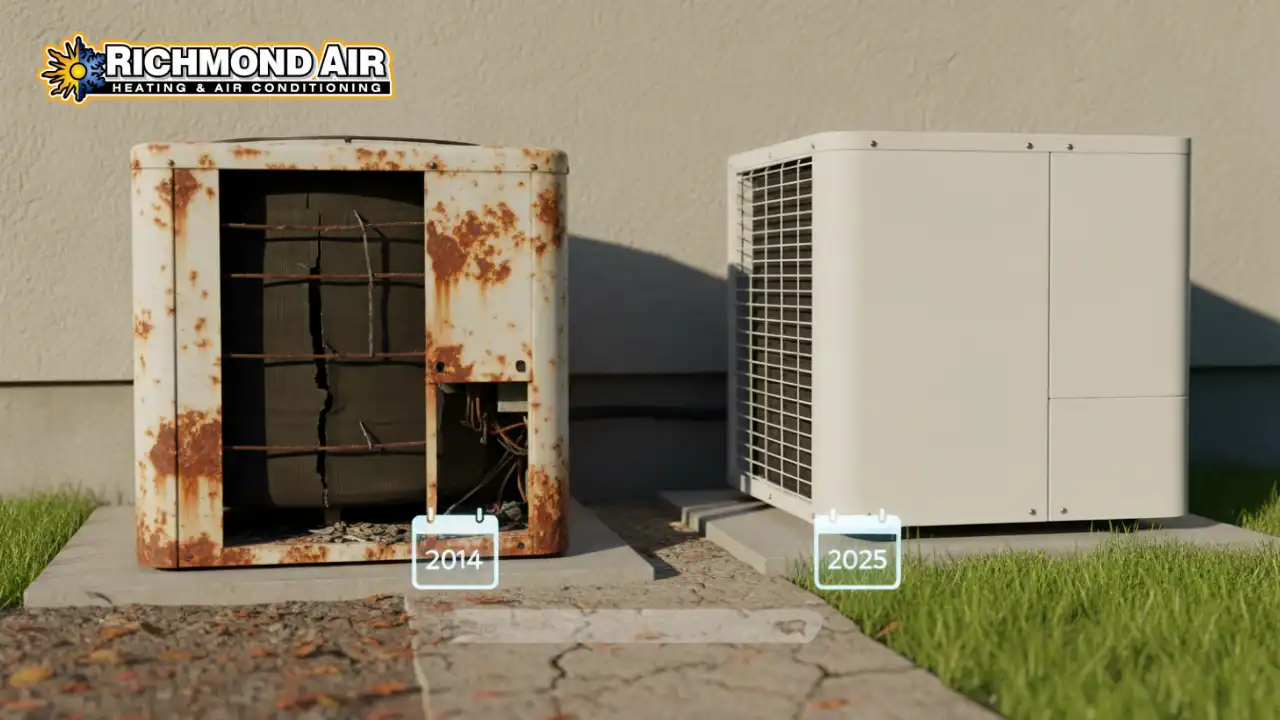
Let me be straight with you: the age of your AC system matters more than anything else when deciding to repair or replace.
Most HVAC systems last between 15 and 25 years, according to experts like Bob Vila. But here in Richmond? Our hot, sticky summers make AC units work way harder than in other places.
Richmond’s humidity can hit 70% in July. That means your air conditioner runs longer and works harder to cool your home. All that extra work shortens its life. A system that might last 20 years in a mild climate might only give you 15 good years here.
I’ve seen it happen to friends. Their AC looked fine at 12 years old, but by year 15, they were calling the repair technician every summer. The humidity and heat just wear these machines down faster.
Here’s what you need to know about age thresholds:
Under 10 years old? Your system still has plenty of life left. Repairs almost always make sense unless something major, like the compressor, fails.
Between 10 and 15 years? This is the grey area. You need to look at other factors like repair frequency, energy bills, and overall condition. One expensive repair might be okay, but if problems keep popping up, it’s time to think about replacement.
Over 15 years old? You’re living on borrowed time. Even if your AC still runs, it’s using way more electricity than modern systems. At this point, replacement usually saves you money in the long run.
Age-Based Cost Analysis
Let me show you exactly how age affects your decision with real numbers. This table makes it super clear:
| System Age | Best Choice | Why It Makes Sense | Typical Cost Impact |
| Under 10 years | Repair | System still has good life left, likely has warranty coverage | Repairs: $300-$800 vs. Replacement: $4,000-$7,000 |
| 10-15 years | Depends | Need to consider total repair costs, energy bills, and frequency of issues | If repairs exceed $1,000 in 2 years, replacement saves money long-term |
| Over 15 years | Replace (usually) | High risk of repeated breakdowns, wasting energy monthly | Paying $50-$100 more per month in energy = $600-$1,200 yearly waste |
Systems under 10 years: Repair is almost always cheaper. You might spend $300 to $800 on a fix, but a new system costs $4,000 to $7,000. Plus, your unit probably still has some warranty coverage on major parts. It just makes sense to keep it going.
Systems 10 to 15 years old: This is where it gets tricky. You need to think about the total picture, not just one repair.
Add up what you’ve spent on repairs in the last two years. If it’s over $1,000 and your system is 12 years old, you’re probably better off replacing it. Why? Because more problems are coming, and you’re just delaying the inevitable.
Also, check your energy bills. Are they going up even though you’re not using more AC? That’s your old, tired system working harder to do the same job. A high-efficiency system with a 16 or 18 SEER rating could cut your cooling costs by 30% or more.
Systems over 15 years old: Here’s my honest take: unless the repair is super cheap (under $300), just replace it.
I know a guy who spent $1,500 fixing his 17-year-old AC. Four months later, the fan motor died. Another $450. Then the next summer, a refrigerant leak. He finally gave up and bought a new system after throwing away over $2,000 on repairs.
The older your system gets, the more likely something else will break right after you fix one thing. It’s like an old car that nickel-and-dimes you to death.
Plus, a 15-year-old system is an energy guzzler. You’re paying maybe $50 to $100 more every month in electricity costs compared to a modern unit. Over a year, that’s $600 to $1,200 just wasted on higher bills.
Do the math: if a new AC system saves you $800 a year in energy, it basically pays for itself in 5 to 7 years. And you get reliable cooling, a warranty, and no more surprise breakdowns.
R-22 Refrigerant: The Hidden Cost Factor
Why R-22 Systems Are Expensive to Repair
Here’s something that catches a lot of Richmond homeowners by surprise: if your AC system uses R-22 refrigerant, fixing it just got a whole lot more expensive.
R-22 (also called Freon) was the standard refrigerant for decades. But it’s terrible for the environment. The government started phasing it out in 2010, and as of 2020, companies can’t make or import new R-22 anymore.
So what does that mean for you? The price of R-22 has gone through the roof. I’m talking about costs that were $50 per pound five years ago, now hitting $150 to $200 per pound or more. That’s crazy expensive.
If your HVAC technician tells you that you need a refrigerant recharge on an R-22 system, get ready. What used to cost $300 might now cost $800 to $1,200, depending on how much refrigerant you need.
But here’s the real problem: refrigerant leaks. If your system is leaking R-22, you’re looking at a nightmare situation. You have to pay to find the leak, fix it, and then refill the system with super expensive refrigerant. The total bill can easily hit $1,500 to $2,500.
At that point, you’re better off putting that money toward a new system with modern refrigerant. My neighbor learned this the hard way. He spent $1,800 fixing an R-22 leak only to have another leak pop up eight months later. He finally gave up and replaced the whole thing.
If your AC uses R-22 and needs a major repair, seriously think about replacement. You’re throwing money at a system that’s only going to get more expensive to maintain.
Modern Refrigerant Systems (R-410A)
Now let’s talk about the good news: modern AC systems use R-410A refrigerant, and it solves all these problems.
R-410A (sometimes called Puron) is way better for the environment. It doesn’t hurt the ozone layer like R-22 does. So you’re not just saving money, you’re doing something good for the planet too.
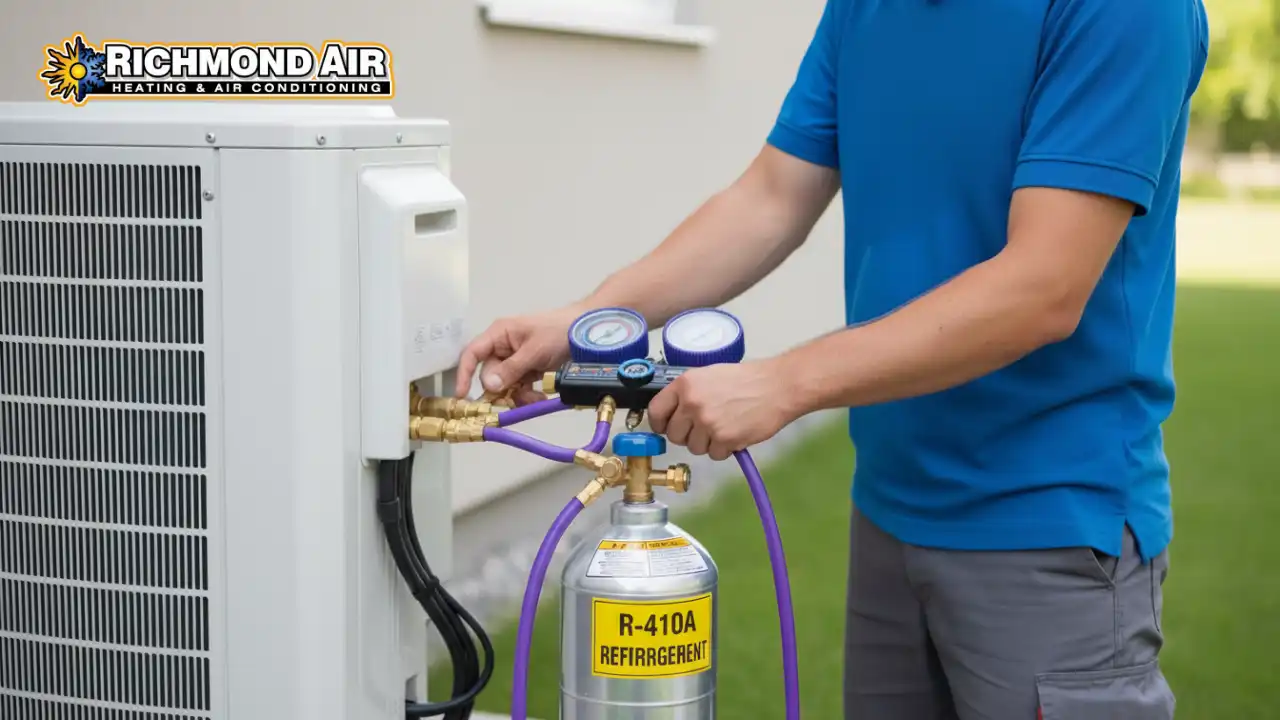
The best part? R-410A prices are stable. You’re not going to wake up one day and find out the cost tripled because of some ban. It’s the current standard, and it’s going to stay that way for a long time.
When you buy a new AC system with R-410A, you’re following all the environmental regulations. No surprises. No worries about your refrigerant becoming illegal or impossible to find. Everything is up to code and stays that way.
I replaced my old R-22 system two years ago with a modern unit, and honestly? The peace of mind alone was worth it. No more stressing about skyrocketing repair costs every time something goes wrong.
If your system still runs on R-22, use that as a strong reason to replace rather than repair. The clock is ticking, and every repair just gets more expensive.
Signs Your AC Needs Attention
Warning Signs: Repair Might Be Enough
Your AC system talks to you through warning signs. Learning to read these signs helps you catch small problems before they become expensive disasters.
Here are the signs that usually mean a simple repair will fix things:
- Strange noises are your first clue that something’s wrong. If you hear rattling, buzzing, or clicking sounds, it might just be a loose part or a failing capacitor. These are cheap fixes, usually $150 to $400.
- Odd smells coming from your vents can mean different things. A musty smell usually means mold in your ductwork or drain pan. A burning smell might be dust on the heating elements or a bad motor. Most smell problems are fixable without replacing the whole system.
- Inconsistent cooling, where some rooms feel okay but others don’t, can mean blocked vents, dirty filters, or low refrigerant. All of these are repair-level issues.
- Thermostat malfunctions are super common. Your thermostat might show the wrong temperature, not respond when you adjust it, or turn the system on and off randomly. A new thermostat costs $150 to $300 and takes less than an hour to install.
- Minor refrigerant leaks can be fixed if your system is newer and uses R-410A refrigerant. The technician finds the leak, patches it, and refills the system. Just watch out if you have an old R-22 system because that refrigerant costs a fortune now.
I once panicked when my AC started making a loud buzzing sound. Turns out it was just a bad contactor that cost $200 to replace. The whole system was fine. Don’t assume the worst until a professional checks it out.
Warning Signs Replacement Is Necessary
Some signs tell you your AC system is really dying, not just having a bad day. These are the red flags that scream “time for a new system.”
- Hot and cold spots throughout your home that won’t go away even after fixing vents or changing filters mean your system can’t handle the job anymore. Maybe it was never sized right, or maybe it’s just worn out. Either way, you need a replacement with a proper load calculation.
- Frequent cycling, where your AC turns on and off every few minutes, is a big problem. It wastes energy, wears out parts faster, and never cools your home properly. This usually means the system is failing or badly oversized.
- Constant breakdowns are the clearest sign. If you’re calling the HVAC technician multiple times every summer, stop throwing money away. You’re paying for repairs AND suffering through breakdowns. A new system ends that cycle.
- Rising energy bills, even though you’re not using more AC? That’s your system losing efficiency. I watched my bills climb $40 to $60 higher each summer before I finally replaced my old unit. The new high-efficiency system cut my costs by almost a third.
Here’s what I tell everyone: one or two of these signs might be okay. But if you’re dealing with three or more? Your AC is telling you it’s time to retire it.
Conclusion
So here’s the bottom line: choosing between AC repair and replacement comes down to three main things: your system’s age, the repair cost, and how often things break.
If your AC unit is under 10 years old and the repair is reasonable, fix it. If it’s over 15 years old or the repair costs more than half of a new system, replace it. And if you’re stuck in that 10-to-15-year grey area? Add up your recent repairs and check your energy bills. The answer usually becomes pretty clear.
Don’t wait until your AC dies during a July heatwave to make this decision. Get a trusted HVAC technician to look at your system now. They’ll give you honest numbers and help you figure out what makes the most sense for your home and your wallet.
Richmond summers are too hot to gamble with an old, dying system. Make the smart choice, and you’ll stay cool and save money for years to come.
Frequently Asked Questions
Is it worth repairing a 15-year-old AC?
Honestly? Probably not, unless the repair is super cheap (under $300). At 15 years, your system is near the end of its life. You’ll likely face another breakdown soon. Plus, you’re wasting money on high energy bills every month. A new system saves you more in the long run.
How long does AC installation take?
Most AC replacement jobs take one full day, around 6 to 10 hours. If your ductwork needs work or the installation is complicated, it might take two days. Simple swaps where everything fits perfectly can be done in 4 to 6 hours.
Can I replace just the outdoor unit?
You can, but I don’t recommend it. Your indoor unit and outdoor unit are designed to work together. Mixing old and new parts makes your system less efficient and can void your warranty. Replace both units at the same time for best results.
What’s the best time of year to replace the AC in Richmond?
Fall or winter, hands down. HVAC companies are less busy, so you get better prices and faster scheduling. I saved about $500 by replacing mine in November instead of waiting until summer. Plus, you avoid the panic of being without AC during a July heatwave.
Do I need to replace my furnace at the same time?
Not always, but it makes sense if your furnace is also old (over 15 years). Replacing both together saves on labor costs because the technician is already there working on your system. You also get matched equipment that works better together.