You turn the AC on. It runs. The house gets cooler, but you still feel sticky. The air is heavy. Your shirt clings to you. And you’re standing right under the vent wondering, “Why does my Richmond home feel like a sauna even with the AC blasting?” You’re not imagining it, and your AC isn’t broken. Something specific is happening, and once you understand it, fixing it is a lot simpler than you think.
Richmond’s Climate Is Working Against Your AC (And You)
Here’s something most HVAC articles won’t tell you. Richmond isn’t just hot in summer, it’s deeply humid. Sitting near the James River in a subtropical climate zone, Richmond pulls in warm, moisture-loaded air all season long. By July and August, outdoor relative humidity regularly hits 70–90%. That’s not a heatwave. That’s a swamp.
Your AC was never designed to fight that alone. Most systems are built to handle normal humidity levels. But in Richmond, Virginia, the air outside your windows is already soaked before your AC even kicks on. Every time a door opens, every tiny gap in your walls or ducts, outdoor moisture infiltration sneaks in and keeps working against your system.
That’s why your neighbor in a drier state runs the same AC and feels perfectly comfortable. Meanwhile, you’re turning the thermostat down to 68° and still feeling sticky. It’s not just the heat. It’s the Virginia summer humidity, and your AC is in a daily battle with it that it doesn’t always win.
Your AC Does Two Jobs, Most People Only Know About One
I’ve talked to hundreds of Richmond homeowners over the years, and almost all of them think their AC does one thing, makes the air cold. That’s only half the story. Your AC actually has two jobs. Job one is cooling (removing heat from the air, this is called sensible heat removal). Job two is dehumidification (pulling moisture out of the air, this is called latent heat removal). When your home feels sticky, it means job two is failing. Even if job one is working perfectly fine.
Here’s how it works. Your AC pulls warm indoor air across a very cold component called the evaporator coil. As that warm air touches the cold coil, two things happen. The air cools down, and the water vapor in that air turns to liquid droplets, just like a cold glass of water on a hot day. That liquid condensation then drips off the coil and flows out of your home through the condensate drain line. That’s how your AC removes moisture. It’s not magic, it’s just basic physics happening inside your walls every cooling cycle.
Here’s the important part. Cooling and dehumidifying are not the same thing. Your AC can lower the temperature quickly, but pulling enough moisture out of the air takes time. The system needs to run in long, steady cycles to do both jobs properly. When something interrupts that process, and in Richmond homes, several things can, you end up with air that feels cool but still heavy and clammy. That’s the problem we’re going to solve.
Signs Your Richmond Home Has a Humidity Problem (Not Just a Heat Problem)
A lot of Richmond homeowners assume their discomfort is just about temperature. So they keep lowering the thermostat. The house gets colder, but never comfortable. That’s the clearest sign you’re dealing with a humidity problem, not a heat problem. And you’re not alone. According to the U.S. Environmental Protection Agency, one third of all structures have damp conditions that may encourage development of pollutants such as mold and bacteria, conditions that can cause allergic reactions, including asthma, and spread infectious diseases. In a climate like Richmond’s, that number is almost certainly higher.
Here’s a quick checklist. If you’re seeing two or more of these, your home has a high indoor humidity issue:
- Sticky or clammy skin indoors: You feel sweaty even sitting still with the AC on
- Condensation on windows or vents: Water droplets forming on glass or metal surfaces inside your home
- Musty smell coming from vents or rooms: That damp, basement-like odor is a classic sign of mold or mildew growing somewhere in your system
- Visible mold or dark spots: Check bathroom ceilings, corners near vents, and around window frames
- Warped wood floors or peeling paint: Moisture gets absorbed into materials over time and causes real structural damage
- Worsening allergy symptoms indoors: According to indoor air quality researchers, dust mites thrive when humidity goes above 50%, and mold spores become airborne, triggering sneezing, congestion, and breathing issues
- Uneven cooling and hot spots: some rooms feel fine, others feel stuffy and warm despite the AC running
One number to remember: according to the American Society of Heating, Refrigerating and Air-Conditioning Engineers (ASHRAE), the recommended relative humidity for indoor spaces sits between 30% and 60%, and for a comfortable Richmond home in summer, you want to stay closer to the lower end of that range, ideally under 50%. If your home is sitting above that consistently with the AC running, your AC is losing the humidity battle, and your health and home are paying the price. ASHRAE confirms this standard directly in their official technical documentation.
The Real Reasons Your AC Is Running But Your Home Still Feels Sticky
Here’s the honest truth, your AC is probably trying. It just can’t win by itself. Richmond’s summer humidity is relentless, and several things can quietly break your system’s ability to pull moisture from the air. Let’s go through each one.
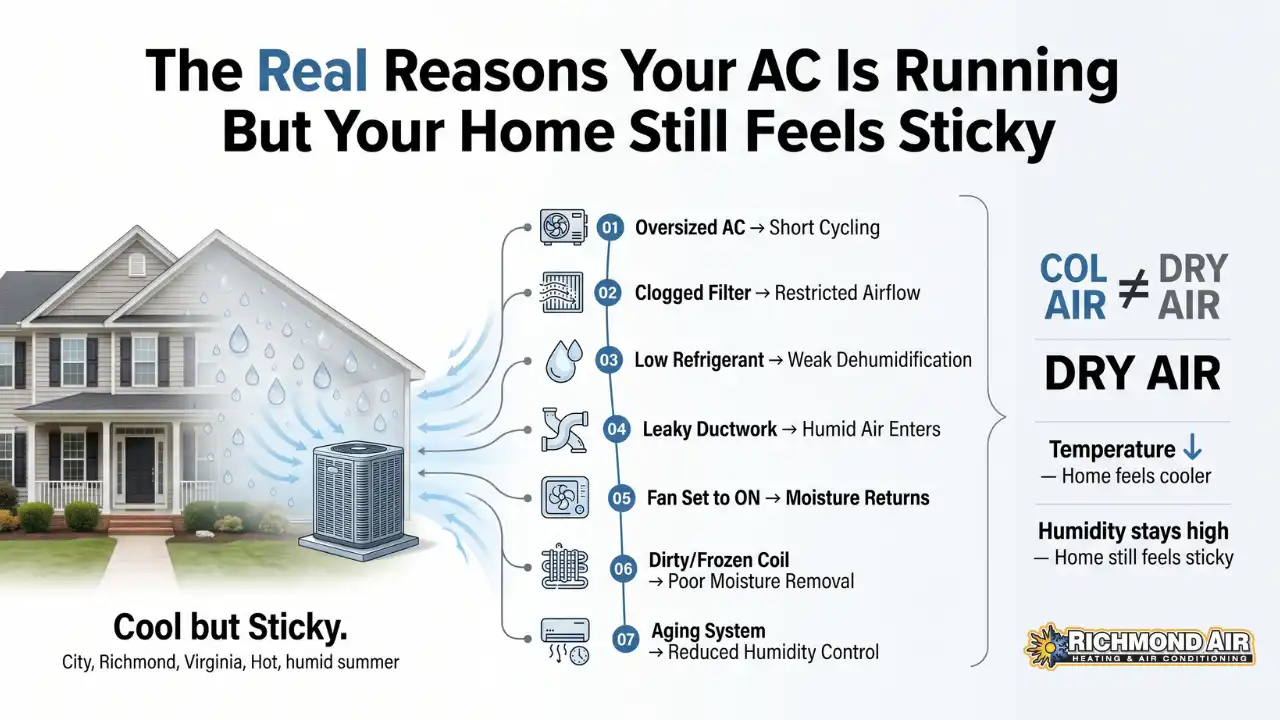
1. Your AC Is Too Big for Your Home (Short Cycling)
I’ve walked into Richmond homes where the AC was brand new, and the place still felt like a wet towel. Nine times out of ten, the unit was oversized. It’s one of the most common and least talked-about problems in residential HVAC.
Here’s what happens. An oversized AC blasts cold air into your home so fast that the thermostat hits your target temperature in just a few minutes. The system shuts off. But cooling and dehumidifying are two different things. Cooling is fast. Dehumidification is slow. The system never ran long enough to pull moisture out of the air. Then it kicks back on again a few minutes later, and the whole cycle repeats. This is called short cycling.
The result? Your home feels cold but clammy. Like a refrigerator, not a comfortable living room.
The numbers here are eye-opening. According to Department of Energy data, over 60% of residential HVAC systems in the United States are incorrectly sized, many running at double or triple the capacity a home actually needs. A properly sized system should run steady cycles of 15 to 20 minutes. A short-cycling oversized unit may shut off every 3 to 5 minutes, never completing a full dehumidification pass. And on top of the comfort problem, oversizing wastes 20–30% more energy and can cut your system’s lifespan nearly in half, from the standard 15–20 years down to just 8–10 years.
The fix is a proper Manual J load calculation, the industry standard for correctly sizing an HVAC system to your specific home. If you’re noticing signs your air conditioning needs repair alongside a constantly sticky home, short cycling from an oversized unit may be the root cause.
2. Your Air Filter Is Clogged
This one sounds too simple. But I’ve seen it cause serious humidity problems in Richmond homes that had been dealing with sticky air for months, and the fix took less than five minutes.
A clogged air filter blocks airflow to your evaporator coil. When air can’t move freely across the coil, the coil gets too cold and can actually freeze over. A frozen coil can’t pull moisture from the air, it just blows cold, damp air back into your home.
Most Richmond homeowners should be changing their air filter every 1 to 3 months. If you have pets, dust allergies, or run your system constantly through a humid Virginia summer, lean toward the shorter end of that range. Check it right now. If it looks grey and packed with dust, that could be your entire humidity problem right there.
3. Low Refrigerant Levels
Refrigerant is the chemical that makes your evaporator coil cold enough to condense moisture out of the air. Think of it as the secret ingredient. Without enough of it, your coil can’t get cold enough, and your AC quietly loses its ability to dehumidify, even if it’s still blowing cool-ish air.
According to the EPA, residential AC systems can leak refrigerant at an average rate of 5 to 11% per year. That’s a slow, invisible loss that most homeowners never notice, until their house starts feeling sticky all summer. By the time you call for help, your system may have been running low for an entire season.
Signs to watch for: AC blowing slightly warm air, ice buildup on the indoor unit, a faint hissing sound near the outdoor unit, or energy bills that are creeping up without explanation. Low refrigerant is not a DIY fix. By federal law, only a licensed HVAC technician can handle refrigerant. Don’t let anyone “top it off” without also finding and fixing the leak, otherwise you’ll be in the same position next summer.
4. Leaky Ductwork Pulling Humid Air From Your Attic or Crawl Space
This is one of the biggest hidden causes of humidity problems in Richmond homes, and it’s especially common in older houses. Leaky ductwork doesn’t just waste energy. It actively floods your home with humid air from places like your attic or crawl space, where moisture levels can be extremely high during Virginia summers.
Here’s what’s happening. When your AC runs, it creates negative pressure inside the duct system. Gaps, cracks, and loose connections in the ductwork suck humid unconditioned air in from surrounding spaces. Your AC is now fighting a constant incoming flood of new moisture, and it’s losing.
According to ENERGY STAR and the EPA, the typical home with a forced-air system loses 20 to 30% of its conditioned air due to duct leakage. An EPA-sponsored report found that 70% of homes have significant duct leakage. In Richmond, where many homes have ducts running through hot, muggy attics and crawl spaces, this problem is particularly severe. Duct sealing is the fix, and the energy and comfort savings can be dramatic.
5. Your Thermostat Fan Is Set to “ON” Instead of “AUTO”
This is the easiest fix on this entire list, and it’s free.
Check your thermostat right now. Look at the fan setting. If it says “ON”, your blower is running 24 hours a day, even when the AC isn’t actively cooling. That seems harmless, right? Wrong. When the AC shuts off, moisture that condensed on the evaporator coil hasn’t had time to drain away. The fan blows that moisture right back into your home.
Switch the fan to “AUTO”. In AUTO mode, the blower only runs during active cooling cycles, which means moisture on the coil has time to drip into the condensate drain line and drain out of your home properly. This one setting change can make a noticeable difference in indoor humidity within hours. Try it today before anything else.
6. Frozen or Dirty Evaporator Coils
I’ve handled cases where a Richmond homeowner’s AC was running constantly, energy bills were sky-high, and the house still felt damp. When we opened the unit, the evaporator coil was either coated in a thick layer of dust and grime, or frozen solid in a block of ice.
Both problems stop dehumidification dead in its tracks. Dirty coils can’t absorb heat or moisture efficiently. Frozen coils physically can’t do anything, they just circulate cold, damp air through your home while the moisture problem gets worse.
Both are usually caused by one of two things: restricted airflow (from a clogged filter or blocked vents) or low refrigerant levels. Signs to watch for: poor cooling despite the system running hard, visible ice on the indoor air handler, or water pooling around the unit. If you notice any of these, turn the system off and call a professional. Running a frozen system can damage the compressor, the most expensive component in your AC.
7. Your AC System Is Simply Too Old
A well-maintained AC in Richmond should last 15 to 20 years. But as systems age past the 10 to 12 year mark, they lose efficiency, and one of the first things to go is their ability to properly control humidity.
Older systems were designed for older homes with different insulation standards. The evaporator coils wear down, refrigerant connections develop slow leaks, and components like the blower motor lose the power needed to push air across the coil consistently. In a subtropical climate like Richmond’s, where your AC battles 70–90% outdoor humidity all summer, an aging system simply can’t keep up with both cooling and moisture removal at the same time.
Honest answer: if your system is over 12 years old and your home has felt sticky for more than one summer in a row, the system’s age may be the core problem. Understanding when AC repair vs. replacement makes more sense can save you years of discomfort and rising energy bills.
What Humidity Should Your Home Be in a Richmond Summer?
Simple answer: your home should sit between 30% and 50% relative humidity during summer. That’s the sweet spot where the air feels comfortable, your home stays healthy, and mold has no chance to grow. According to the EPA’s own indoor air quality guidelines, keeping indoor humidity below 60% is essential, and ideally closer to that 30–50% range for real comfort. Once you cross 60%, you’re in danger zone. Mold can start growing within 24 to 48 hours on damp surfaces, and dust mites, a major allergy trigger, thrive at those levels too.
The easiest way to know where your home stands? Buy a hygrometer. It’s a small device that measures relative humidity in real time. Most hardware stores carry them for $10 to $30. Set one in your living room and check it on a hot Richmond summer afternoon with your AC running. If it’s reading above 50% consistently, your AC is not doing its full job, and something from the list above is interfering with dehumidification. That number doesn’t lie. It tells you exactly whether your system is winning or losing the battle against Richmond’s muggy summer air.
Quick Fixes You Can Try Today Before Calling Anyone
Before you pick up the phone, try these first. In my experience, a surprising number of Richmond homeowners have fixed their sticky home problem with one or two of these simple checks, no tools, no cost, no technician needed. Go through them in order.
| # | Quick Fix | Why It Helps | Time Needed |
| 1 | Switch thermostat fan from ON → AUTO | Stops moisture from being blown back into your home between cooling cycles | 30 seconds |
| 2 | Close all windows and exterior doors | Stops Richmond’s 70–90% outdoor humidity from flooding indoors | 1 minute |
| 3 | Run bathroom and kitchen exhaust fans | Vents cooking and shower moisture outside before your AC has to fight it | 15–20 minutes |
If you’ve gone through all three of these and your home still feels sticky, the problem runs deeper. Something mechanical is working against you, and that’s when it’s time to call a professional.
When It’s Time to Call an HVAC Professional in Richmond
I’ve seen homeowners spend an entire Richmond summer adjusting settings, buying fans, and lowering the thermostat, all because they didn’t realize the problem they were dealing with needed a professional diagnosis, not a DIY fix. There’s no shame in that. But there is a clear line between what you can handle yourself and what genuinely requires a licensed HVAC technician with the right tools and training.
Honestly, if you’re experiencing any one of these, let alone two or three, the longer you wait, the worse and more expensive the problem gets. At Richmond Air, we diagnose exactly these kinds of humidity and cooling issues every day across Richmond, VA. If your home feels sticky and your AC seems to be running fine on the surface, our AC repair services in Richmond can get to the root cause fast, so you’re not spending another summer uncomfortable in your own home.
Why Richmond Homes Are Especially Vulnerable (And What to Do About It)
Here’s something worth saying clearly, this is not a generic AC problem. Richmond has a specific combination of factors that makes indoor humidity control harder here than in most other cities. Understanding that combination explains why your neighbor two states over runs the same AC unit and never feels sticky.
First, Richmond’s housing stock is old. A large portion of homes in neighborhoods like Church Hill, The Fan, Northside, and Chesterfield were built before 1980, many before 1960. These homes were constructed long before modern insulation standards, vapor barriers, and tight building envelopes existed. That means more air leaks, more outdoor moisture infiltration, and ductwork that was never designed with today’s humidity levels in mind.
Second, crawl space foundations are everywhere in Richmond. Unlike slab foundations, crawl spaces sit directly above damp soil. In summer, that soil releases moisture constantly, and without proper crawl space encapsulation, that moisture rises straight into your home’s air supply. Your AC is fighting ground-level humidity from below while battling James River air from outside at the same time.
Third, Richmond sits in a subtropical humidity zone where summer relative humidity routinely pushes 70–90% outdoors. That’s not a bad week, that’s June, July, and August, every single year. Most standard AC systems are simply not designed to dehumidify against those levels without additional support or proper sizing for the local climate.
Put all three of those factors together, old homes, crawl space foundations, and subtropical summers, and you have a recipe for exactly the sticky, clammy indoor environment that Richmond homeowners deal with every year. The good news is that once you understand the local picture, the solutions become much clearer.
Whether it’s a proper system sizing review, duct sealing, or a whole-home dehumidifier, Richmond Air knows this city’s homes inside and out. Check out our AC maintenance services built specifically for Richmond homeowners and let us help you build a long-term solution that actually fits where you live.
Final Thoughts
Richmond summers are brutal, and if your home still feels sticky with the AC running, now you know exactly why. From short cycling and leaky ductwork to low refrigerant and a simple fan setting, every cause has a fix. The key is knowing which one you’re dealing with. Try the quick checks first. If the problem persists, don’t wait, Richmond’s humidity season is long, and moisture does real damage over time. At Richmond Air, we diagnose and fix exactly these kinds of issues every day across Richmond, VA. Reach out to us today and let’s get your home feeling cool, dry, and comfortable, the way it should all summer long.
Frequently Asked Questions
Why does my house feel humid even though the AC is running?
Your AC is cooling the air but failing at dehumidification. The most common causes are short cycling, low refrigerant, a clogged filter, or leaky ductwork pulling humid air in from your attic or crawl space.
What is the ideal indoor humidity for a Richmond home in summer?
Between 30% and 50%. Above 60%, mold can begin growing within 24 to 48 hours. Pick up a hygrometer at any hardware store to check your levels.
Can a brand new AC still cause humidity problems?
Yes. A new but oversized unit short cycles, cooling too fast and shutting off before removing moisture. According to Department of Energy data, over 60% of HVAC systems are incorrectly sized.
Should my thermostat fan be ON or AUTO?
Always AUTO. The ON setting runs the blower 24/7 and blows moisture back into your home before it drains. Switching to AUTO is free and can make a noticeable difference the same day.
When should I call an HVAC professional?
Call if quick fixes don’t help within a few days, your home stays above 50% humidity with the AC running, you see ice on the unit, hear hissing, or smell musty odors from your vents.