Think of a heat pump as a smart machine that moves warmth from one place to another. It doesn’t create heat like a furnace does. Instead, it picks up heat from outside air and brings it inside your home during winter. In summer, it does the opposite – it takes hot air from inside and pushes it outside.
This might sound strange. How can it get heat from cold air? Well, even when it feels freezing outside, there’s still some heat in the air. The heat pump is clever enough to grab that heat and move it where you need it.
Understanding Heat Transfer Technology
The magic happens through something called refrigerant. This special liquid flows through pipes in your heat pump system. When it’s cold, the refrigerant soaks up heat from outside like a sponge. Then a compressor squeezes it, making it even hotter. This hot refrigerant travels inside and warms up your home.
The same equipment works for cooling. The process just runs backward. That’s why many people love heat pumps – you get heating and cooling in one machine.
I remember when my neighbor in Richmond got her first heat pump installed. She kept asking, “How can it heat my house when it’s 30 degrees outside?” The technician explained it perfectly. He said, “As long as the temperature is above absolute zero, there’s heat to grab.” That’s around -460 degrees Fahrenheit, so we’re safe here in Richmond, VA!
Why Heat Pumps Are Perfect for Richmond’s Climate
Richmond has mild winters and hot, sticky summers. This makes it an ideal spot for heat pumps. Our winter temperatures rarely drop below 20 degrees. That’s the sweet spot where air source heat pumps work best.
During those hot Virginia summers, your heat pump keeps your house cool without any extra equipment. You save money because you’re not buying and maintaining two separate systems – a furnace and an air conditioner.
Plus, Virginia offers rebates and tax credits for installing energy-efficient systems. More on that later!
Benefits of Installing a Heat Pump in Richmond, VA
Let me be straight with you. Getting a heat pump installation in Richmond is one of the smartest moves you can make for your home. I’ve talked to dozens of homeowners here, and they all say the same thing – they wish they’d done it sooner.
Save Money on Energy Bills Year-Round
Your energy bills take a big hit when you run a furnace in winter and AC in summer. With a heat pump, you use way less electricity. Why? Because it moves heat instead of making it from scratch.
Think about it like this. What’s easier – creating fire to warm up, or just moving warm air from one room to another? Moving air takes much less work. That’s exactly what your heat pump does.
Most Richmond families see their utility bills drop by 30-40% after installation. One family in Glen Allen told me they saved over $800 in their first year. That’s a nice vacation right there!
The energy efficiency really shines in spring and fall. When it’s 50 degrees outside, your heat pump barely has to work. It just gently moves heat around. Compare that to a furnace burning gas or a traditional AC working overtime.
One System for Both Heating and Cooling
Here’s what I love most. You don’t need two different machines taking up space. No furnace in the basement and an air conditioner outside. Just one single unit does everything.
This means fewer things that can break. You’re not paying for maintenance on two systems. You’re not calling technicians twice as often. And when something does need a fix, the repair is usually simpler and cheaper.
I met a homeowner in Mechanicsville last fall. She said the best part was the peace of mind. “I used to worry about my old furnace dying in January. Now I just set my thermostat and forget it. Heating and cooling all year from one machine.”
The installation is cleaner, too. Your contractor doesn’t have to mess with gas lines or worry about carbon monoxide. It’s all electric, which is safer for your family and better for indoor air quality.
Types of Heat Pumps Available in Richmond
Not all heat pumps are the same. You’ve got choices, and picking the right one matters. Let me break down the main types you’ll see in Richmond.
Air Source Heat Pumps
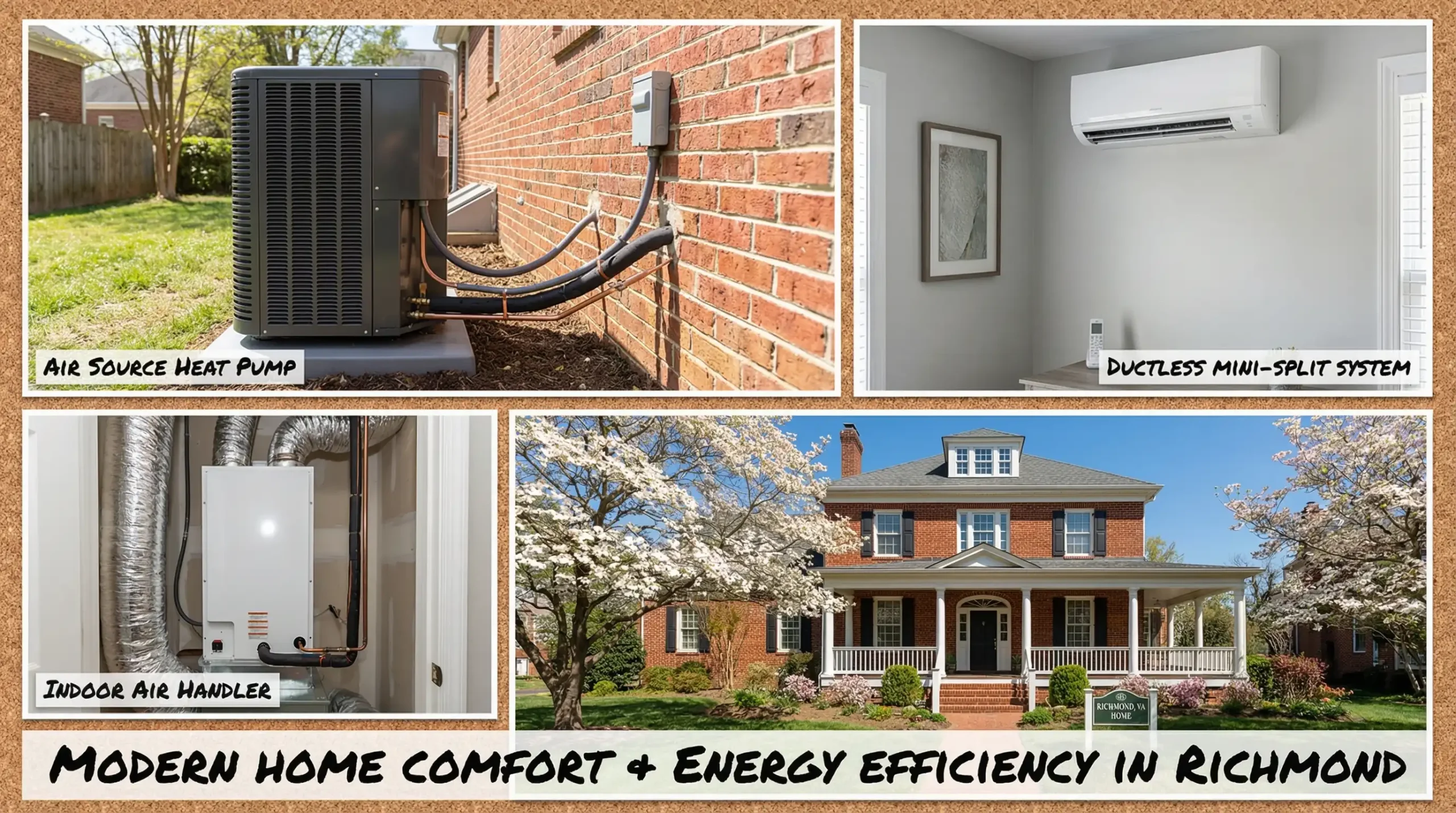
These are the most popular in Virginia. An air source heat pump pulls heat from outside air. You’ll see one outdoor unit that looks like a regular AC and an indoor unit or air handler inside your house.
Most Richmond contractors push these because they work great in our weather. They’re also the cheapest to install. You’re looking at $8,500 to $18,000, depending on your home size and the brand you pick.
The newer models work even when it’s super cold. Some high-efficiency units can grab heat when it’s down to 5 degrees outside. That’s way colder than Richmond winters usually get.
Ductless Mini-Split Systems
Don’t have ductwork? No problem. A ductless mini-split mounts on your wall. Small pipes connect the indoor and outdoor units.
These are perfect for older Richmond homes that never had central air. I’ve seen beautiful historic homes in The Fan use these. They keep the charm of the house while adding modern comfort.
The cool thing about mini-splits is that you can control different rooms separately. Want your bedroom cold but your living room warmer? Easy. Each unit has its own thermostat.
They cost a bit more – around $3,000 to $5,000 per room. But if you’re only cooling and heating certain spaces, you save money in the long run. Plus, installation is way faster. Often done in one day.
How Much Does Heat Pump Installation Cost in Richmond, VA?
Let’s talk money. This is usually the first question I get from homeowners. And honestly, the answer isn’t simple. But I’ll give you real numbers from Richmond area installations.
Average Installation Prices in Richmond
A typical heat pump installation in Richmond, VA runs between $8,500 and $18,000. I know that’s a big range. Here’s why.
Your home size matters most. A small 1,200 square foot house needs maybe 2 tons of capacity. That’s the cheaper end – around $8,500 to $10,000. A bigger 2,500 square foot home might need 4 or 5 tons. That pushes you toward $15,000 or more.
The brand also changes the price. Carrier and Trane are premium brands that cost more but last longer. Lennox sits in the middle. Budget brands save you money upfront but might not hold up as well.
Efficiency ratings matter too. A basic 14 SEER unit costs less than a high-efficiency 20 SEER model. But that high-efficiency unit saves you more on monthly bills. It’s like buying a car – better gas mileage costs more upfront.
Don’t forget the extras. If your ductwork is old and leaky, you might need repairs. That’s another $1,500 to $3,000. Upgrading your electrical panel? Add $1,000 to $2,000. A new smart thermostat? Around $200 to $400.
Rebates and Tax Credits Available in Virginia
Here’s the good news. You don’t pay full price out of pocket.
The federal government offers tax credits for energy-efficient heat pumps. Right now, you can get up to $2,000 back on your taxes for qualifying systems. Your heat pump needs to meet certain efficiency standards – usually 16 SEER or higher.
Virginia also has rebates through Dominion Energy if that’s your power company. They offer $300 to $600, depending on your system’s efficiency. Some local Richmond programs add even more.
Your contractor should help you find these rebates. Good ones know all the programs. I’ve seen homeowners get back $3,000 to $4,000 total when they stack everything up. That makes a $12,000 installation feel more like $8,000 or $9,000.
The Inflation Reduction Act of 2022 expanded these incentives significantly. According to the U.S. Department of Energy, qualifying heat pumps can now receive up to 30% back in tax credits through 2032. Most Richmond companies also offer financing with approved credit. Some even have deals with zero interest for 60 months. That makes monthly payments super manageable.
The Heat Pump Installation Process: What to Expect
You’re probably wondering what actually happens when you get a heat pump installed. Let me walk you through it. No surprises.
From Free Estimate to Final Installation
First, call a few Richmond contractors for free estimates. Don’t just pick one. Get at least three. They’ll send someone to your house to look around.
The technician measures your home. They check your ductwork, your electrical panel, and where the outdoor unit will go. This is called a load calculation. It figures out exactly what size heat pump you need.
Then they give you options. Good contractors show you different brands and efficiency levels. They explain what each costs and what you save. Take your time here. This equipment lasts 15 to 20 years. It’s worth getting right.
Once you pick your system, they schedule installation. Most Richmond companies can start within a week or two. The busy season is spring and fall, so summer or winter might be faster.
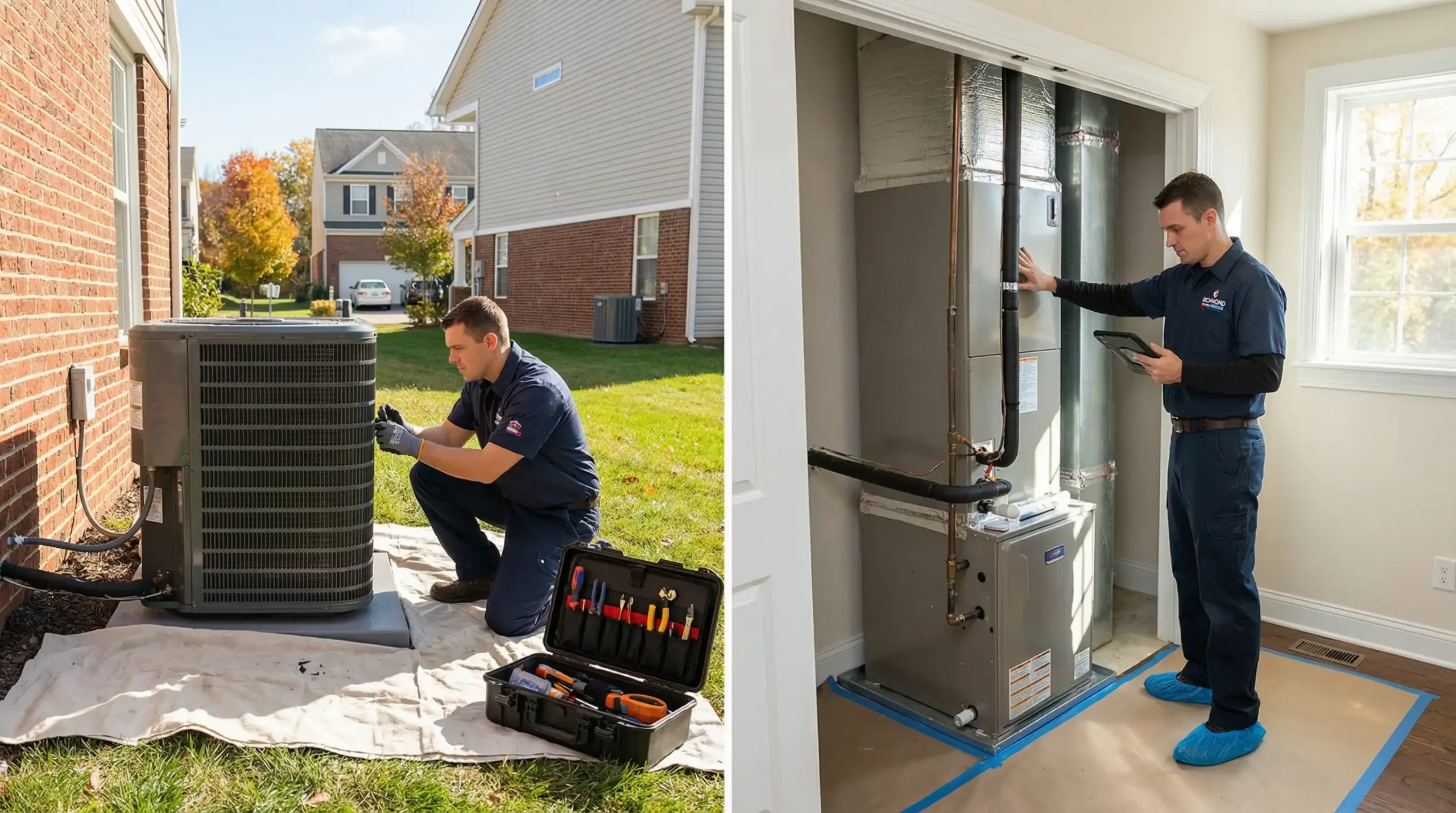
On installation day, a team shows up. Usually 2 to 4 installers. They bring everything – the new heat pump, tools, materials, all of it.
They start by putting the outdoor unit on a pad outside. Then they run refrigerant lines through your wall. Inside, they connect to your ductwork or install the air handler. Finally, they hook up the electrical and test everything.
How Long Does Installation Take?
Most installations take one full day. Sometimes two if your home is bigger or the job is complicated.
I’ve seen simple replacements done in 6 hours. That’s when you’re swapping an old heat pump for a new one, and everything’s already set up. Just disconnect the old, connect the new.
New installations take longer. If you’re going from a furnace and AC to a heat pump, figure on a full day or a day and a half. The technicians have to run new lines and possibly modify your ductwork.
Ductless mini-splits are the fastest. I’ve watched teams do those in 4 to 5 hours. Less mess, less work.
Good installers protect your home. They wear shoe covers. They lay down drop cloths. They clean up all their mess. You shouldn’t even know they were there except for yor nice new heat pump.
After installation, they test everything. They make sure your thermostat works. They check for refrigerant leaks. They show you how to use your new system.
Most companies follow up a few days later. They want to make sure you’re happy and everything’s running smoothly. That’s good customer service.
Choosing the Right Heat Pump Size for Your Richmond Home
Here’s a mistake I see all the time. People think bigger is better. It’s not. Getting the right size heat pump is super important.
Load Calculation and Why It Matters
A load calculation sounds fancy, but it’s really just math. Your contractor figures out how much heating and cooling your home needs.
They look at your home’s square footage. They check your insulation. They count windows and doors. They even think about which way your house faces. A house with big windows facing south gets more sun, so it needs less heat but more cooling.
Richmond’s weather matters too. We need systems that handle 95-degree summers and occasional 20-degree winter nights.
A proper load calculation takes about an hour. Any contractor who eyeballs it and guesses? Run away. That’s lazy and will cost you money later.
According to ACCA (Air Conditioning Contractors of America), proper sizing through load calculation is critical for efficiency and comfort. Oversized or undersized systems waste energy and break down faster.
Matching Tonnage to Your Home’s Needs
Tonnage isn’t weight. It’s cooling power. One ton equals 12,000 BTUs per hour. Most homes need 2 to 5 tons.
A too-small heat pump runs constantly. It never catches up. Your home stays uncomfortable. The system wears out fast because it never rests.
A too-big heat pump is worse. It cools or heats your house super fast, then shuts off. Sounds good, right? Wrong. It cycles on and off too much. This wastes energy and doesn’t remove humidity well. Plus, all that starting and stopping wears out the compressor.
My house is about 1,800 square feet. My contractor recommended a 3-ton heat pump. I wanted to go bigger, thinking it’d work better. He talked me out of it. He was right. My system runs perfectly, and my bills are low.
Most Richmond homes break down like this:
- 1,000 to 1,500 square feet: 2 to 2.5 tons
- 1,500 to 2,000 square feet: 2.5 to 3.5 tons
- 2,000 to 2,500 square feet: 3.5 to 4.5 tons
- 2,500+ square feet: 4.5 to 5+ tons
But that’s rough. Your actual home might be different. That’s why the load calculation matters so much.
Top Heat Pump Brands Recommended by Richmond Contractors
Walk into any HVAC shop in Richmond and ask about brands. You’ll hear the same names over and over. Let me tell you why.
Carrier, Trane, and Lennox: The Local Favorites
The carrier is huge here. They make solid equipment that lasts. I see Carrier heat pumps from the 1990s still running. Their high-efficiency models come with variable speed technology. That means quieter operation and better temperature control.
Trane is known for being tough. They use thicker metal and heavier parts. You pay more, but you get a heat pump that takes a beating. If you’ve got kids or pets running around, or if your outdoor unit is in a tight spot, Trane holds up better.
Lennox sits right in the middle for price and quality. They’ve got great warranties and their systems are pretty quiet. I like their smart thermostat options too.
Most Richmond contractors install these three brands because they’re easy to service. Parts are available. Technicians know them inside out. That matters when your heat pump needs repair five years from now.
Mitsubishi is the go-to for ductless mini-splits. They invented the technology. Their units last forever and work down to -13 degrees outside.
Warranty Coverage and What to Look For
Warranties confuse people. Here’s the simple version.
Manufacturers cover parts for 5 to 10 years. Some fancy models go up to 12 years. That means if your compressor dies in year 7, you get a free compressor. You just pay for labor.
Labor warranties come from your installer. This is where contractors differ. Some offer 1 year. Good ones offer 5 or even 10 years. This covers the work itself – if they mess something up, they fix it for free.
Extended warranties cost extra – usually $200 to $500. They’re sometimes worth it. If you’re keeping your house for a long time and want total peace of mind, go for it. If you might move in 5 years, skip it.
Read the fine print. Most warranties require annual maintenance. Skip your tune-ups and you might void the warranty. That’s another reason to sign up for a maintenance plan.
How to Choose the Best Heat Pump Installer in Richmond
This is where people mess up. They pick based on price alone. That’s like choosing a surgeon because they’re cheap. Don’t do it.
Certifications and Licenses to Verify
First thing – check if they’re licensed. In Virginia, HVAC contractors need a Class A Contractor license. Ask for the number. Look it up on the DPOR website. Takes two minutes.
NATE certification matters too. That’s North American Technician Excellence. It means the technician passed real tests proving they know their stuff. Not all installers have it, but the best ones do.
Your contractor should be insured. Both liability and workers’ comp. If someone gets hurt on your property or damages your house, insurance covers it. Get proof before they start work.
How long have they been in business? I like companies with at least 10 years in Richmond. They know local building codes. They understand our weather. And they’ll still be around if you need them later.
Check their reviews on Google and Facebook. Look for patterns. One bad review? Maybe the customer was difficult. Lots of bad reviews about the same problem? Red flag. Good contractors should have mostly 4 and 5-star ratings.
Questions to Ask Before Hiring
Here’s my list of must-ask questions:
Do you do your own load calculation? If they say, “We just estimate based on square footage,” walk away.
What’s included in your price? Some contractors quote you low, then add fees for permits, disposal of old equipment, electrical work, etc. Get everything in writing.
How long will installation take? If they say one day but similar jobs usually take two, they might be rushing. Rushed work causes problems.
Who does the work? Some companies use subcontractors. Not always bad, but you want to know. Will the same people who give you the estimate do the installation?
What happens if something goes wrong during installation? Good contractors have a plan. Bad ones get flustered and make it your problem.
Do you offer financing? Most do. Ask about interest rates and terms.
What’s your maintenance plan like? You’ll need annual service. If they include it or offer a good deal, that’s a bonus.
I once hired a contractor who answered every question with “trust me, we do this all the time.” He dodged details. The installation was a mess. I had to bring in someone else to fix it. Learn from my mistake – if they won’t answer questions clearly, find someone else.
Heat Pump Maintenance Tips for Richmond Homeowners
Your heat pump won’t take care of itself. A little maintenance goes a long way. I’ll keep this simple.
Seasonal Maintenance Checklist
Every month: Change or clean your air filter. Dirty filters make your system work harder. They’re cheap – like $15. Just slide the old one out and pop in a new one. Takes 30 seconds.
Twice a year (spring and fall): Call a technician for a tune-up. They check refrigerant levels, clean coils, test the compressor, and catch small problems before they become big ones.
The U.S. Department of Energy recommends professional maintenance at least once a year to keep systems running efficiently. Most Richmond contractors offer maintenance agreements that cover these visits.
Once a year: Clear stuff away from your outdoor unit. Leaves, grass, sticks – they all block airflow. Give it at least 2 feet of clear space all around. Trim any bushes nearby.
Winter prep: Before it gets cold, make sure your outdoor unit isn’t blocked by snow or ice. After a storm, gently brush off heavy snow. Don’t use sharp tools – you might damage the fins.
Summer prep: Hose down your outdoor unit in spring. Dirt and pollen build up over winter. A gentle spray cleans it right up. Don’t use a pressure washer though – too much force damages things.
Signs Your Heat Pump Needs Repair
Some problems are obvious. Some sneak up on you. Here’s what to watch for.
- Strange noises: A little hum is normal. Grinding, squealing, or banging? Not normal. Call someone.
- Ice build-up: A bit of frost in winter is okay. But if your outdoor unit is covered in ice, something’s wrong. It could be low refrigerant or a bad defrost cycle.
- Higher bills: If your energy bills jump with no explanation, your heat pump might be struggling. It’s working harder to do the same job.
- Weak airflow: Put your hand near a vent. Air should blow strong and steady. Weak or inconsistent airflow means problems – maybe a bad air handler or leaky ductwork.
- Won’t reach set temperature: If you set your thermostat to 70 and your house stays at 65, your heat pump isn’t keeping up. Time for repair.
- Short cycling: This means your system turns on, runs a minute, shuts off, then repeats. It’s hard on the equipment and wastes energy.
Honestly, most repairs are pretty affordable if you catch them early. Wait until your heat pump dies completely? That’s when you’re looking at big money or even full replacement.
I learned this the hard way. I ignored a weird noise for months. Finally called a technician. He said, “If you’d called two months ago, this would’ve been a $200 fix. Now your compressor’s damaged. That’s $1,800.” Don’t be like me.
Conclusion
Getting a heat pump installation in Richmond, VA, is a smart move. You save money on energy bills. You get heating and cooling from one system. And with Richmond’s mild weather, heat pumps work perfectly here.
Remember the key points. Get multiple estimates. Make sure they do a proper load calculation. Check certifications and licenses. Don’t skip maintenance. And take advantage of rebates and tax credits – they can save you thousands.
Pick a good contractor who answers your questions and stands behind their work. This equipment will be in your home for 15 to 20 years. It’s worth doing right.
Richmond has great HVAC companies with decades of experience. They know what works here. Trust the experts, but also trust your gut. If something feels off, keep looking.
Your family deserves a comfortable home year-round. A quality heat pump delivers that. And when those utility bills drop? You’ll wonder why you didn’t do it sooner.
Get in Touch With Us For more queries and professional services.
Frequently Asked Questions About Heat Pump Installation in Richmond, VA
How long does a heat pump last in Richmond, VA?
Most heat pumps last 15 to 20 years in Richmond. Some make it to 25 years with great maintenance. The key is keeping up with annual tune-ups and changing filters regularly. Richmond’s mild weather actually helps – extreme cold and heat wear out systems faster, and we don’t get much of either. The brand matters too. Carrier, Trane, and Lennox tend to outlast cheaper brands.
Can a heat pump work in Richmond’s cold winters?
Yes, absolutely. Modern heat pumps work great down to about 25 degrees. Some high-efficiency models work at 5 degrees or even lower. Richmond rarely gets colder than 20 degrees, so you’re fine. On those super rare nights when it drops to 15, your heat pump might need a little help from backup electric heat. But that’s maybe 2 or 3 nights per winter. Overall, heat pumps are perfect for Richmond’s climate.
Do I need to replace my ductwork for a heat pump?
Usually no. If you already have ductwork from a furnace or central AC, your heat pump uses the same ducts. Your contractor will check for leaks and might seal or fix problem spots. If your ducts are really old and falling apart, you might need some repairs or upgrades. But total replacement? Rare. Ductless mini-splits don’t use ducts at all – they’re perfect if you don’t have existing ductwork.
What’s the difference between heat pump installation and replacement?
Installation means you’re putting in a heat pump for the first time. Maybe you had a furnace and AC before, or maybe your house never had central heating and cooling. Replacement means swapping out an old heat pump for a new one. Replacement is usually faster and cheaper because the ductwork, electrical, and everything else is already there. Installation takes more time and costs more because they’re starting from scratch or converting your system.
Are there financing options for heat pump installation in Richmond?
Yes, most Richmond contractors offer financing. You can often get payment plans with low or zero interest for 12 to 60 months with approved credit. Some companies work with banks or financing services to give you options. You can also use a home equity loan or line of credit. Don’t forget about rebates and tax credits – those reduce what you need to finance. Ask your contractor about all available financing before you decide. Many homeowners find monthly payments easier than paying everything upfront.