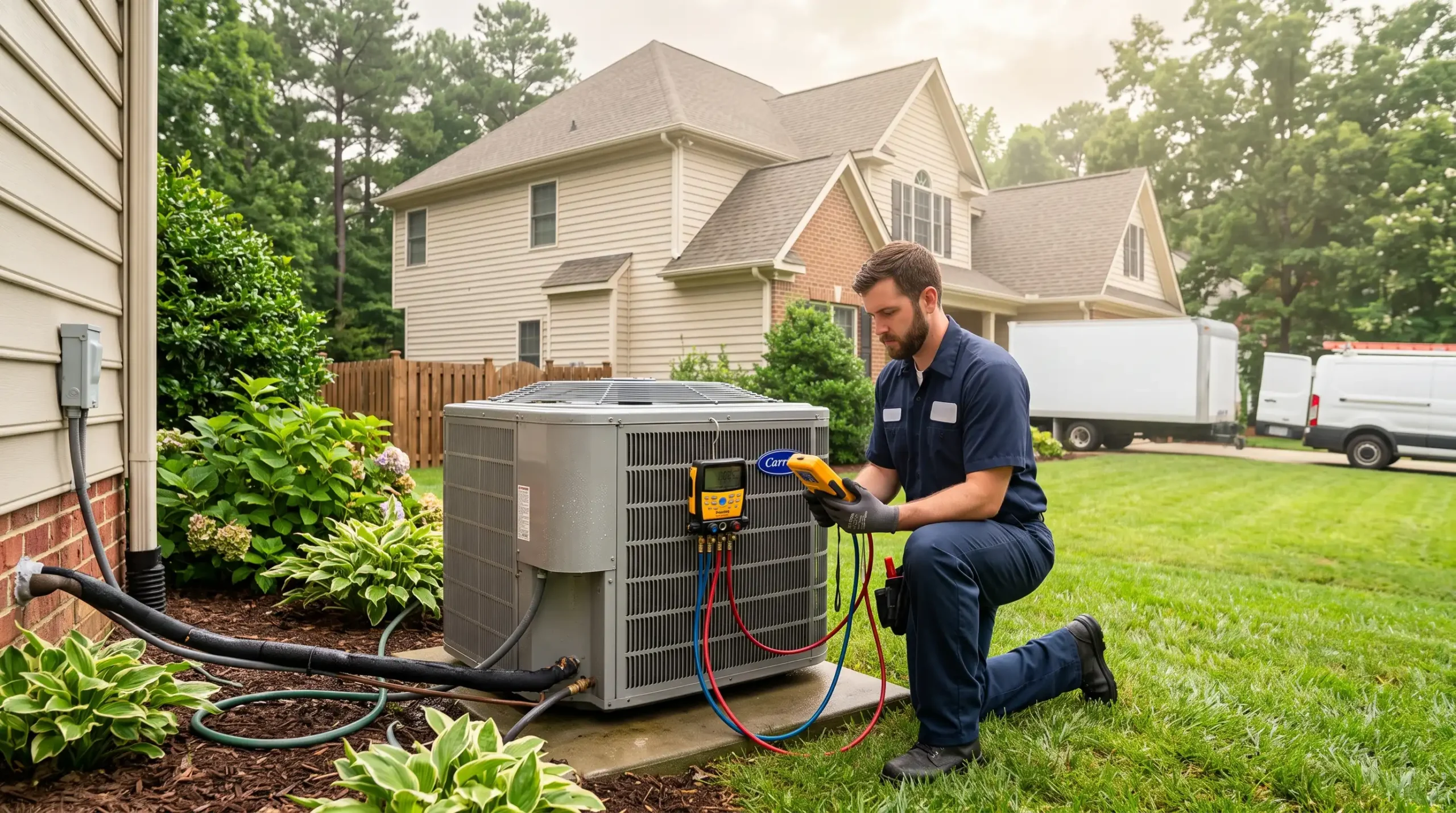
Your AC unit in Richmond works twice as hard as one in Phoenix or Denver. That’s not a guess, it’s what happens when your system has to fight 70% to 80% relative humidity every single day from June through September. In dry climates, your air conditioner mostly just cools the air. But here in Richmond, it has to pull out moisture AND cool things down at the same time. That double job wears parts out faster, clogs drain lines, and can grow mold inside your ducts if you skip regular service.
How Humidity Changes What Your AC Actually Does
I’ve worked on HVAC systems across Virginia for years, and one thing surprises most homeowners, they don’t realize their AC is also a dehumidifier. In Richmond’s summer heat, that second job is actually the harder one.
Here’s what happens inside your system. Warm, wet air from your house gets pulled over the evaporator coil. That coil is cold. When humid air touches something cold, the water in the air turns into droplets, just like a cold glass of water “sweats” on a hot day. Those droplets drip into a pan and flow out through a condensate drain line.
In dry places like Arizona, there’s very little moisture in the air. The AC only needs to lower the temperature. But in Richmond, summer humidity often sits between 70% and 85%. Your system pulls out 5 to 20 gallons of water per day depending on your home size and how humid it is outside. That’s a lot of extra work.
This extra work is called latent cooling, removing moisture from air. Sensible cooling is what you feel, the temperature drop. In Richmond, your AC spends roughly 30% to 40% of its energy just on removing moisture. In Phoenix? Almost none. That means your system runs longer cycles, works harder, and breaks down faster without proper care.
Why Richmond’s Climate Is So Hard on AC Systems
In my professional experience, I’ve seen AC units in Richmond age about 3 to 5 years faster than the same unit in a dry climate. The reason? Richmond sits in a humid subtropical zone. We get heat AND moisture from the Atlantic Ocean and Chesapeake Bay pushing inland.
July and August are the worst months. Average high temperatures hit 90°F or more, and the dew point often sits above 70°F. When the dew point is that high, the air feels thick and heavy. Your AC never really gets a break, even at night, humidity stays above 80% in many Richmond neighborhoods.
Compare that to somewhere like Denver, Colorado. Denver’s summer humidity averages around 30% to 40%. An AC system there mostly turns on, cools the house, and shuts off. Short cycles. Minimal moisture removal. Way less strain on the compressor, coils, and drain system.
In Richmond? Your system might run for 12 to 16 hours per day during a heat wave. Longer run times mean more wear on every moving part, the compressor, the fan motor, the contactors. If you’re not getting regular AC maintenance, small problems turn into expensive repairs fast. If your system is already struggling, our AC maintenance services can catch problems before they turn into full breakdowns.
Mold and Bacteria: The Hidden Danger of Skipping AC Service in Humid Climates
I’ve opened up duct systems in Richmond homes that hadn’t been serviced in 2 or 3 years. Honestly, the smell hits you first. Musty, sour, sometimes like dirty socks. That’s mold, and it loves the dark, wet environment inside your AC.
The U.S. Environmental Protection Agency (EPA) states that indoor humidity should stay between 30% and 50% to prevent mold growth. When your AC isn’t properly maintained, it can’t pull enough moisture out of the air. Humidity inside your home creeps above 60%, and mold starts growing, on coils, in drip pans, inside ducts, and on walls behind furniture.
According to the EPA’s ‘A Brief Guide to Mold, Moisture and Your Home,’ mold can begin growing on damp surfaces within 24 to 48 hours (EPA Mold Guide). In Richmond’s summer, a clogged drain line or dirty coil can create those damp conditions inside your system in less than a day.
Mold spores then blow through your vents into every room. People with allergies, asthma, or breathing problems feel it first. Kids and older adults are hit the hardest. Regular AC service includes cleaning the coils, flushing the drain line, and checking for mold, all things that prevent this problem.
Clogged Drain Lines: Richmond’s Most Common AC Problem
If I had to pick the number one service call we get during Richmond summers, it’s a clogged condensate drain line. In dry climates, this problem barely exists because there’s so little water produced. But here? Your AC is draining gallons of water every day.
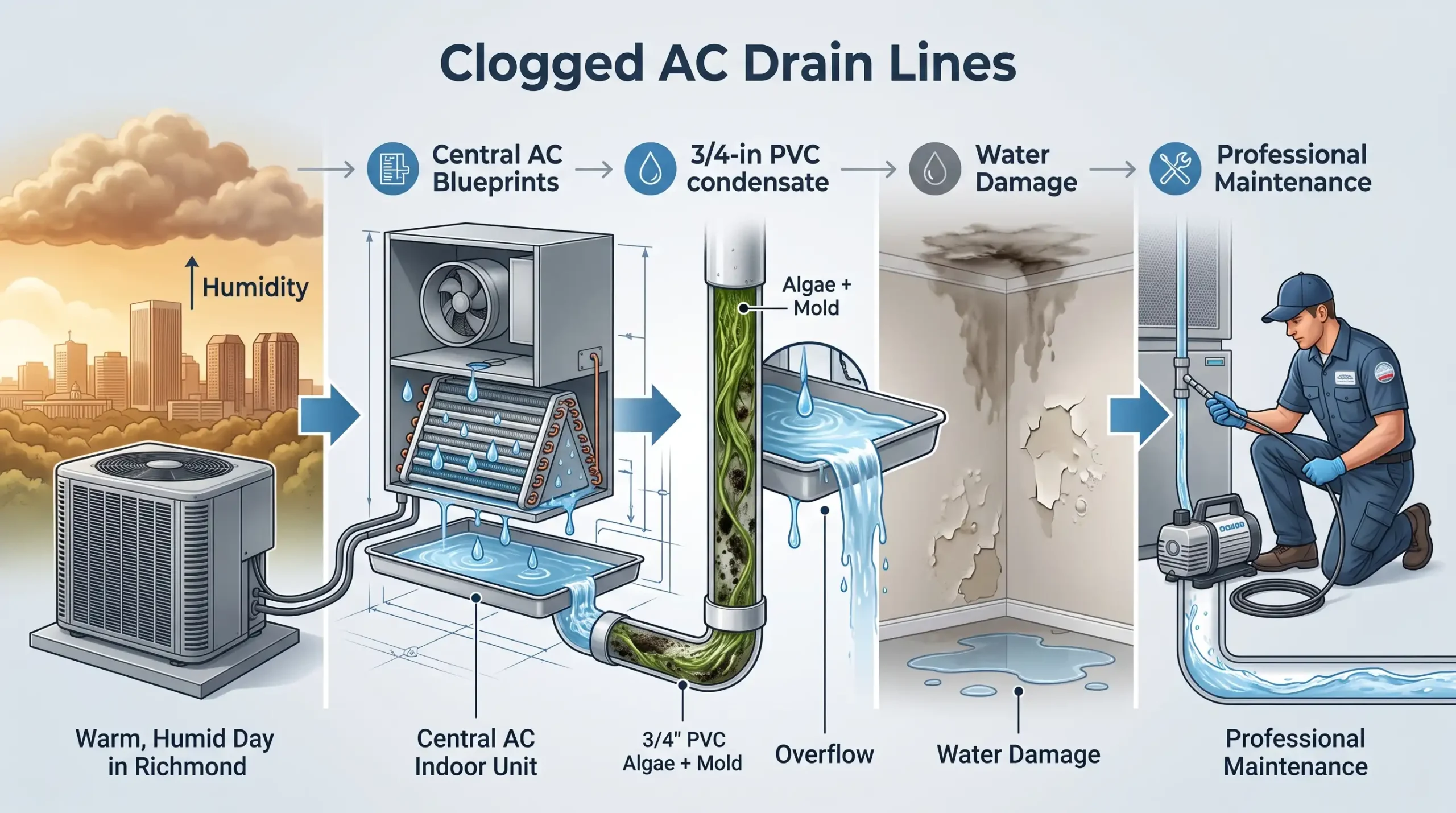
That drain line is a small PVC pipe, usually 3/4 inch wide. Algae, mold, and debris build up inside it over time. When it clogs, water backs up into the drip pan. The pan overflows. Now you’ve got water damage, on ceilings, walls, and floors. I’ve seen repair bills hit $2,000 to $5,000 for water damage that started with a $50 drain cleaning.
A basic AC tune-up includes flushing this line with a vinegar solution or compressed air. It takes about 10 minutes. But skipping it in a humid climate like Richmond’s? That’s asking for trouble.
If you’ve noticed water leaking around your indoor unit, don’t wait. Check out our guide on AC leaking water inside your house in Richmond VA, or call us to get it fixed before it causes real damage.
Your Evaporator Coil Works Overtime in Humidity
I’ve handled cases exactly like this before, a homeowner calls saying their AC blows air but the house still feels sticky and warm. Nine times out of ten, it’s a dirty evaporator coil.
The evaporator coil is where all the cooling and dehumidifying happens. In humid climates, it’s constantly wet. Dust sticks to wet surfaces much faster than dry ones. Over one summer in Richmond, a coil can build up a thick layer of grime that blocks airflow and reduces cooling by 20% to 40%.
When the coil gets dirty, two bad things happen. First, your AC can’t remove moisture well, so your home feels clammy even though the thermostat says 72°F. Second, the coil can freeze up because airflow drops. A frozen coil means no cooling at all until it thaws. If this keeps happening, you’re looking at compressor damage, and that’s the most expensive part to replace ($1,500 to $3,000 on average).
Annual coil cleaning is one of the simplest things a technician does during a service visit. In Richmond, I’d actually suggest doing it twice a year, once before summer starts and once in the middle of the season. For more on what happens when coils go bad, read our post on AC coil problems in Richmond VA.
How Humidity Affects Your Energy Bills
Your power bill tells the story. In Richmond, the average household spends $150 to $250 per month on electricity during summer, and about 50% to 60% of that goes to air conditioning. Compare that to a home in Albuquerque, New Mexico, where AC might only account for 30% of summer electric costs.
The reason is simple. When your AC has to remove moisture, it runs longer. Longer run time = more electricity used. A well-maintained system handles this much better than a neglected one. Dirty filters, low refrigerant, or a grimy coil can increase your summer energy costs by 15% to 30%.
According to the U.S. Department of Energy, proper HVAC maintenance and humidity control in hot-humid climates can reduce cooling energy use by up to 20% (DOE Advanced HVAC Humidity Control). For a Richmond homeowner, that could mean $40 to $60 saved every month just from keeping your system clean and properly charged.
Honestly, the service pays for itself in about 2 months of reduced bills. And that’s before you count the repair costs you avoid.
Refrigerant Levels Matter More in Humid Climates
In my experience working on Richmond systems, low refrigerant is the silent killer. In a dry climate, slightly low refrigerant means your house takes a bit longer to cool. Annoying, but manageable. In Richmond’s humidity? Low refrigerant means your coil can’t get cold enough to pull moisture from the air.
The result is a home that’s 72°F on the thermostat but feels like 78°F because the humidity is still at 65% or higher. You turn the thermostat down further. The system runs even longer. Your bill goes up. The compressor overheats. And eventually something breaks.
Refrigerant doesn’t “use up” like gas in a car. If levels are low, you have a refrigerant leak. Finding and fixing leaks is part of a proper AC service, especially in humid climates where that cold coil is your only defense against moisture. If you suspect your refrigerant might be low, take a look at our post on signs your central AC needs a refrigerant recharge.
What Happens When You Skip AC Service for a Year in Richmond
Let me paint the picture. Most people I talk to say, “My AC still works, so why service it?” Well, here’s what one year of no service looks like in Richmond’s climate:
- Month 1-2: Dust builds on the coil. Drain line starts growing algae. You don’t notice yet.
- Month 3-4: The coil is partially blocked. Your AC runs 2-3 hours longer each day. Your bill goes up by $30-50, but you blame the heat wave.
- Month 5-6: The drain line clogs. Water sits in the pan. Mold starts growing. Your house smells a little musty. You buy air fresheners instead of calling a tech.
- Month 7-8: The coil freezes because airflow is so restricted. You turn off the AC, let it thaw, turn it back on. It freezes again. Now you call for help.
By this point, a simple $89 to $150 tune-up has turned into a $500 to $1,200 repair, plus possible water damage to your home. In a dry climate, you could probably get away with skipping a year. In Richmond, you really can’t. If your system is already showing problems, check out our breakdown of AC repair vs. replacement in Richmond VA to see what makes sense for your situation.
The Right AC Service Schedule for Richmond’s Humidity
I’ve seen this pattern many times in my work, homeowners in Richmond treat AC service the same way people in mild climates do. Once a year, maybe. That’s not enough here.
For Richmond’s humid climate, here’s what I tell every customer:
Spring (March-April): Full system tune-up before summer hits. Clean coils, flush drain line, check refrigerant, test all components.
Mid-Summer (July): Quick check on the drain line and coil. In Richmond, 8 out of 10 drain clogs happen between June and August. A mid-season check prevents most emergency calls.
Monthly (you do this): Change or clean your air filter every 30 days during summer. In humid air, filters clog faster because moisture makes dust stick. A clogged filter restricts airflow and makes everything else worse.
Fall (October): Post-season inspection. Make sure no mold grew during summer, drain pan is dry, and coil is clean before you switch to heating mode.
This schedule might seem like a lot compared to what your friend in California does. But their AC runs maybe 600 hours a year. Yours runs 1,200 to 1,800 hours. Double the run time means double the maintenance need.
Dry Climate vs. Humid Climate: Why the Same AC Advice Doesn’t Apply
Most online AC tips are written for a general audience. They don’t account for Richmond’s specific conditions. So let me clear up some differences:
- “Change your filter every 90 days.”, In Richmond? No. Change it every 30 days in summer. Humid air makes filters dirtier faster.
- “You only need one tune-up per year.”, In dry states, sure. In Richmond, you need at least a spring service and a mid-summer drain check.
- “A bigger AC unit cools better.”, Actually, an oversized unit in humid climates is worse. It cools the air too fast, shuts off before removing moisture, and your home stays humid. This is called short cycling, and it’s a big problem in Richmond. Proper sizing matters more here than anywhere.
“Turn off your AC when you leave.”, In Richmond, this lets humidity build up inside your home while you’re gone. Mold can start forming in hours. A better approach: raise the thermostat to 78°F but keep it running to control moisture.
Signs Your AC Is Losing the Humidity Battle
How do you know if your AC isn’t handling Richmond’s humidity well? Watch for these:
- Your home feels clammy or sticky even though the thermostat shows a cool temperature. This is the number one sign. The temperature is fine, but humidity is still above 55%.
- Windows fog up on the inside. Condensation on inside glass means too much moisture in your air.
- Musty smell from the vents. That’s mold or mildew growing inside the system.
- The AC runs constantly but never seems to finish cooling. It’s working too hard because it can’t dehumidify properly.
- Water stains on the ceiling near your air handler. The drain pan is overflowing.
If you notice any of these, don’t wait until the system breaks. Give us a call or learn more about what a full AC tune-up actually fixes.
Protecting Your Investment: Why Regular Service Pays for Itself
A new AC system in Richmond costs between $5,000 and $12,000 installed. The average system lasts 15 to 20 years with proper care. Without maintenance in a humid climate, that drops to 10 to 12 years. That’s thousands of dollars in lost value.
Regular service, let’s say $150 to $300 per year for two visits, extends your system’s life, keeps energy bills low, and prevents costly emergency repairs. Over 15 years, that’s about $3,000 in maintenance versus potentially $7,000+ in extra replacement costs and repairs.
To be fair, people in dry climates can stretch their service intervals a bit more. Their systems don’t deal with constant moisture, mold risk, or clogged drains. But if you live in Richmond, treating your AC like a dry-climate machine is the fastest way to shorten its life.
Keep Your Home Comfortable, And Your AC Healthy
Richmond’s humidity isn’t going anywhere. Every summer, your AC fights a battle that systems in dry climates never face. The moisture in our air wears down parts faster, clogs drains, grows mold, and drives up energy bills.
The good news? Regular service handles all of it. A clean coil, clear drain line, proper refrigerant charge, and fresh filter make the difference between an AC that lasts 18 years and one that dies at 10.
If it’s been more than 6 months since your last service, or if your home feels sticky even with the AC running, reach out to Richmond Air. We know this climate, we know these systems, and we can help you stay cool without the surprise repair bills.
Frequently Asked Questions
How often should I service my AC in Richmond’s humid climate?
At least twice a year, once in spring before summer hits, and a mid-summer check in July. Monthly filter changes are also a must during the humid months. In dry climates, once a year might be enough, but Richmond’s moisture load demands more attention.
Does humidity really make my AC work harder?
Yes. Your AC has to remove moisture (latent cooling) AND lower the temperature (sensible cooling). In Richmond, roughly 30% to 40% of your system’s energy goes toward pulling water from the air. In dry climates, almost all the energy goes to temperature alone.
Can high humidity damage my AC system permanently?
It can. Constant moisture exposure leads to mold on coils, corroded drain pans, algae-clogged drain lines, and overworked compressors. Over time, these problems shorten your system’s lifespan by 3 to 5 years compared to the same unit in a dry climate.
Why does my house feel humid even though my AC is on?
Usually this means your system isn’t dehumidifying well. Common causes: dirty evaporator coil, low refrigerant, oversized AC unit (short cycling), or a failing compressor. A technician can diagnose which one it is in a single visit.
Is it worth adding a whole-house dehumidifier in Richmond?
For many Richmond homes, yes, especially older homes or homes with poor insulation. A whole-house dehumidifier works alongside your AC to handle the moisture load, so your AC can focus on cooling. This reduces strain and can extend your system’s life. They cost between $1,500 and $2,800 installed, and many homeowners see the payback in lower bills and fewer repairs within 2 to 3 years.