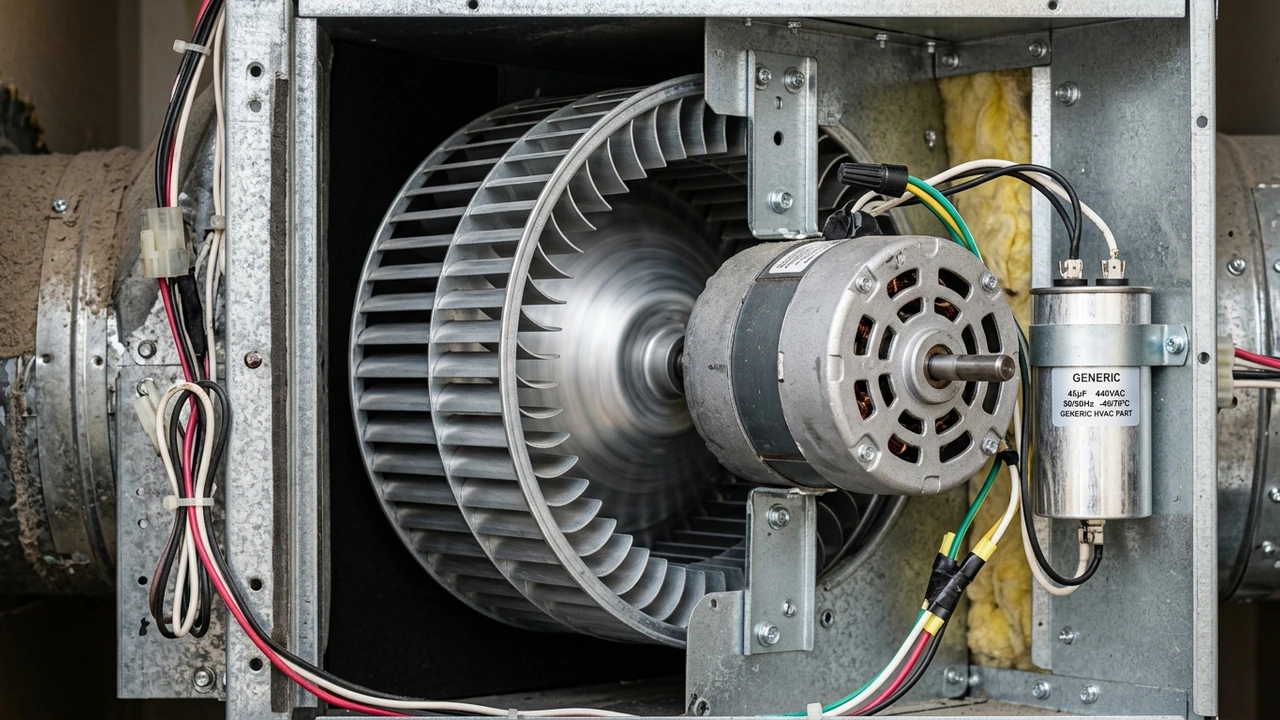
Your AC is humming. The thermostat says cool. But you hold your hand to the vent and feel almost nothing. In a Richmond July, that is a scary feeling, and most of the time it points to one small part: the blower motor.
What “running but not moving air” actually means
Your system has two big parts. One sits outside. One sits inside.
The outside unit can run fine while the inside fan sits still. That is why you hear noise but feel no airflow.
The inside fan pushes cool air into your rooms. When it stops, your vents go quiet, and the little air that does come out feels weak or warm.
In our shop, about 7 out of 10 “no air” calls in summer trace back to the indoor unit, not the outdoor one. So that is where we look first.
If the fan will not spin at all, that is a clear sign. You can see what to check when your AC fan is not spinning at all.
The blower motor: the fan that pushes your cool air
I have opened up hundreds of Richmond air handlers over the years, and I can tell you the blower motor is the hardest working part in the whole system.
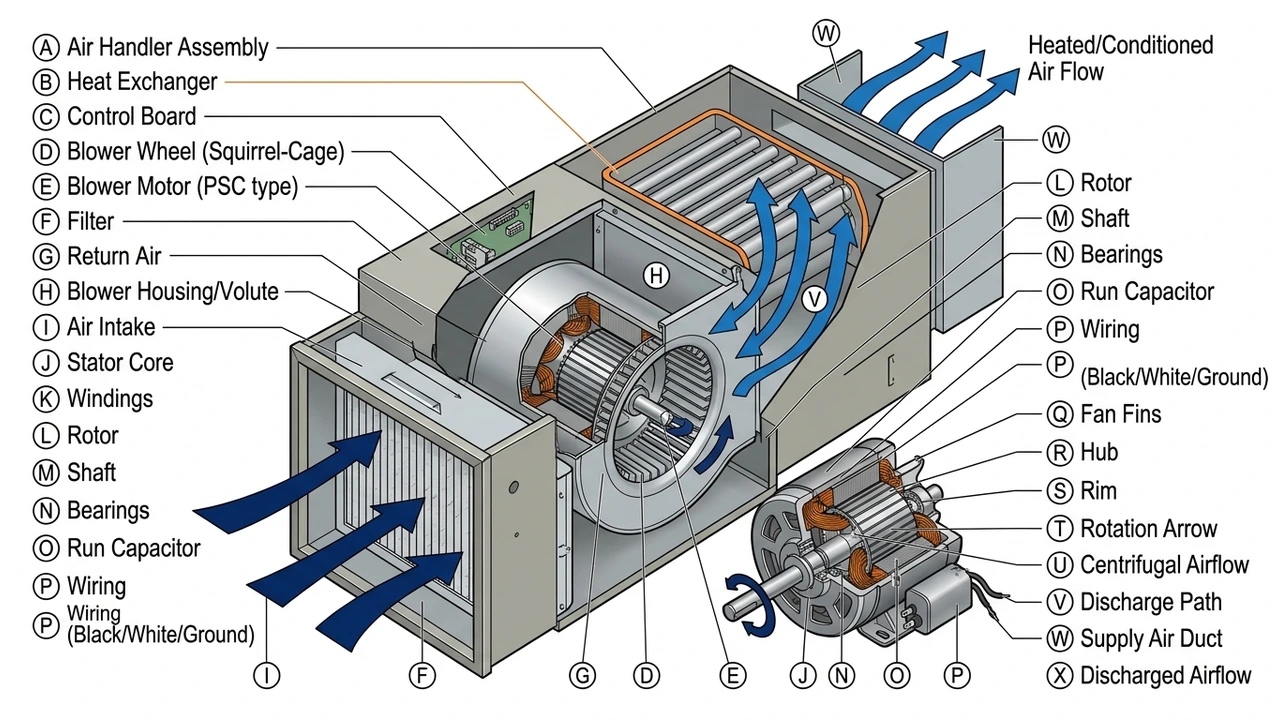
The blower motor is a small electric motor. It spins a fan wheel. That wheel pushes cold air through your ducts and out your vents.
Think of it like the heart of your cooling. The evaporator coil makes the air cold. The blower motor moves it to you.
A normal home system moves about 400 cubic feet of air per minute for every ton of cooling. When the motor slows, that airflow drops fast.
When the motor dies, the cold air has nowhere to go. It just sits at the coil while your rooms stay hot.
Warning signs your blower motor is going bad
Most motors do not quit all at once. They warn you first.
Here are the signs we see most often:
- Weak air from the vents, even on the high setting
- No air at all while the unit still hums
- Buzzing, humming, or rattling sounds
- A hot or burning smell near the vents
- The motor runs, gets hot, then shuts off on its own
- Higher power bills for the same amount of cooling
A worn motor can pull more power and still move less air. We have seen bills climb 15% to 20% in one summer when a motor is on its way out.
If you hear strange humming or rattling noises, do not wait. Those sounds often come right before a full failure.
| Sign | What it may mean |
|---|---|
| Weak airflow | Worn motor, bad capacitor, or clogged filter |
| No air but unit hums | Seized motor or failed capacitor |
| Loud rattle | Loose fan wheel or worn bearings |
| Burning smell | Overheated motor windings |
| Motor stops after a while | Motor getting too hot and cutting out |
Why blower motors fail earlyin Richmondhomes
In my experience working across Chesterfield, Henrico, and the Fan, Richmond’s summer air is hard on blower motors in a way that dry climates just are not.
Our summers are hot and very wet. That damp air pulls dust into a sticky film on the fan wheel. Heat also makes motors run hotter and age faster.
Richmond highs sit in the low 90 s°F through much of July and August. A motor that runs long hours in that heat wears out sooner than the maker planned.
Older Richmond homes add one more problem. Many have tight, dusty ducts, and that makes the motor work harder to push each breath of air.
Here is what wears our local motors down:
- Heavy summer humidity and dust
- Long run times in 90-degree heat
- Old, narrow ducts in older homes
- Dirty filters left in too long
- Power flickers during summer storms
We tell every customer to change the filter every 1 to 3 months. A choked filter is the number one thing that kills a motor early.
It is not always the motor: other reasons for weak airflow
Before you pay for a new motor, rule out the easy stuff. Weak air has many causes, and the motor is just one of them.
| Cause | Quick clue | Fix level |
|---|---|---|
| Dirty filter | Filter looks gray and packed | Easy, do it yourself |
| Thermostat set to ON | Fan blows but air is not cold | Easy, do it yourself |
| Frozen coil | Ice on the indoor unit | Medium |
| Blocked vents | Some rooms cool, some do not | Easy |
| Bad capacitor | Motor hums but will not spin | Pro |
| Leaky ducts | Air lost before it reaches vents | Pro |
A frozen coil is common here. When the coil turns to ice, air cannot pass through it.
If you see ice, you may have a frozen AC unit and not a motor problem at all.
A dirty filter by itself can block a big share of your airflow. Swapping a $10 to $20 filter fixes more “broken AC” calls than most people expect.
Simple checks you can do before you call anyone
I have driven out to a home, flipped one thermostat switch, and fixed the whole thing in under five minutes, so it really does pay to check the basics first.
Try these five steps in order:
- Set the thermostat fan to AUTO, not ON. On ON, the fan blows even when the air is not cold yet.
- Check the air filter and change it if it looks dirty.
- Make sure all vents are open and not blocked by rugs or couches.
- Look for ice on the indoor unit. If you see ice, turn the AC off and let it thaw.
- Check your breaker box for a switch that has tripped.
These five checks solve close to half of the weak-airflow calls we get. That is a lot of money saved for a few minutes of work.
If none of them help, stop there. The next steps touch wiring and a capacitor that can hold a shock, and that is pro work.
Why weak airflow is a bigger deal inRichmond summers
Weak airflow is not just annoying. In a heat wave, it can be risky for the people inside.
The CDC warns that a fan alone stops helping once indoor air passes 90°F. Above that, moving hot air can actually raise your body heat. Their heat and health guidance says air conditioning is the best way to stay safe on very hot days.
So when your blower quits in July, your home can heat up fast. Older adults, young kids, and pets feel it first.
Inside a closed Richmond home with no airflow, we have watched indoor temps climb several degrees in under an hour on a 95°F afternoon. That is why we treat “no air” as an urgent call, not a “wait till Monday” job.
When to stop and call a Richmond HVAC pro
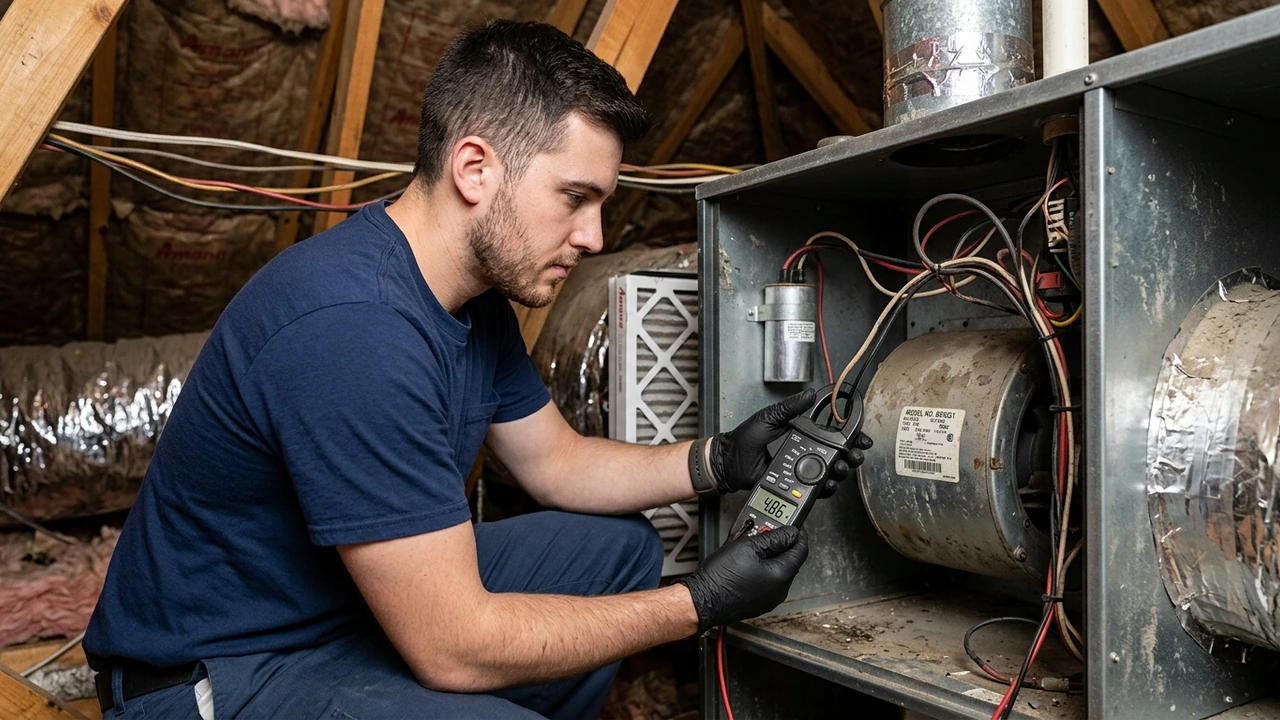
I once saw a homeowner try to swap a capacitor with the power still on, and it did not end well. That little part can hold a punch even after the unit is switched off.
A capacitor is a small part that gives the motor a push to start. When it fails, the motor hums but the fan will not turn.
Call a pro right away when:
- The motor hums but the fan does not move
- You smell something burning
- The breaker keeps tripping
- You see scorch marks or melted wire
If you notice a burning smell from your vents, shut the system off and call for help. That smell often means hot motor windings.
A failed capacitor is one of the cheapest fixes, often just $15 to $30 in parts, but it needs safe handling. If your fan hums but will not spin, we can test the motor and capacitor for you. Richmond Air can find the exact cause and get your air moving again.
Repair or replace the blower motor?
Once we know the motor is the problem, the next question is simple: fix it or swap it? Here are the typical ranges we see around Richmond.
| Option | Typical range | Best when |
|---|---|---|
| Replace capacitor | $150 – $300 | Motor still runs fine |
| Replace blower motor | $400 – $700 | Motor is seized or burned |
| Upgrade to an ECM motor | $600 – $1,000 | Old unit, high power bills |
| Full system replacement | $5,000+ | Unit is 12 to 15+ years old |
An ECM motor is a newer, smarter fan motor. It changes speed on its own and uses less power.
The EPA’s ENERGY STAR program notes that systems with high-efficiency blower motors can be up to 15% more efficient and save about $120 a year on energy, as shown on their furnaces product page.
If your unit is old and your bills keep climbing, it may be time to weigh AC repair against replacement. We help Richmond homeowners run that math every week.
Here is a simple rule we use: if a repair costs more than about half the price of a new unit, replacing usually wins.
Keep your blower motor healthy: easy Richmond maintenance
In my years of tune-ups around Richmond, the homes that book one visit each spring almost never call me back in a panic in July.
A little care goes a long way. Try to:
- Change the filter every 1 to 3 months
- Keep the outdoor unit clear of leaves and grass
- Book a spring tune-up before the heat hits
- Act on new sounds or weak air early, not later
- Keep vents open and dust-free
ENERGY STAR’s own furnace rules require a high-efficiency ECM fan motor and duct air leakage of 2.0% or less, as listed in their key product criteria. That shows how much good airflow and a strong motor depend on each other.
A yearly check costs far less than an emergency call. Most of our tune-ups run about $100 to $150, while a summer breakdown can cost several times that.
A professional AC tune-up checks the motor, capacitor, and airflow before they fail. If you want your system ready for the next heat wave, Richmond Air can set that up for you.
The bottom line for Richmond homeowners
When your AC runs but no air moves, the blower motor is the first suspect. It is not the only one, though.
Start with the filter, the thermostat setting, and a quick ice check. Then look at the motor and the capacitor.
In our hot, damp summers, a healthy blower is what keeps your home safe and cool. Do not sit in the heat and hope it fixes itself.
Catch it early, and the fix is usually small.
Frequently asked questions
Why is my AC running but no air comes out of the vents?
Usually it is the blower motor, a bad capacitor, a clogged filter, or a frozen coil. The outside unit can keep running while the inside fan sits still, which is why you hear noise but feel nothing.
Can I run my AC if the blower motor is bad?
No. Running it can overheat the motor and freeze the coil, which turns a small fix into a big one. Turn it off and get it checked.
How much does a blower motor cost to fix in Richmond?
In our area, a capacitor runs about $150 to $300 installed, and a full blower motor is often $400 to $700. An ECM upgrade can cost more, but it can also cut your power bills.
How long should a blower motor last?
Most last 10 to 15 years. Richmond’s heat and humidity can shorten that if filters stay dirty or tune-ups get skipped.
Is weak airflow an emergency in summer?
It can be. On a 90-degree-plus day, a home with no airflow heats up fast and can be risky for young kids, older adults, and pets.