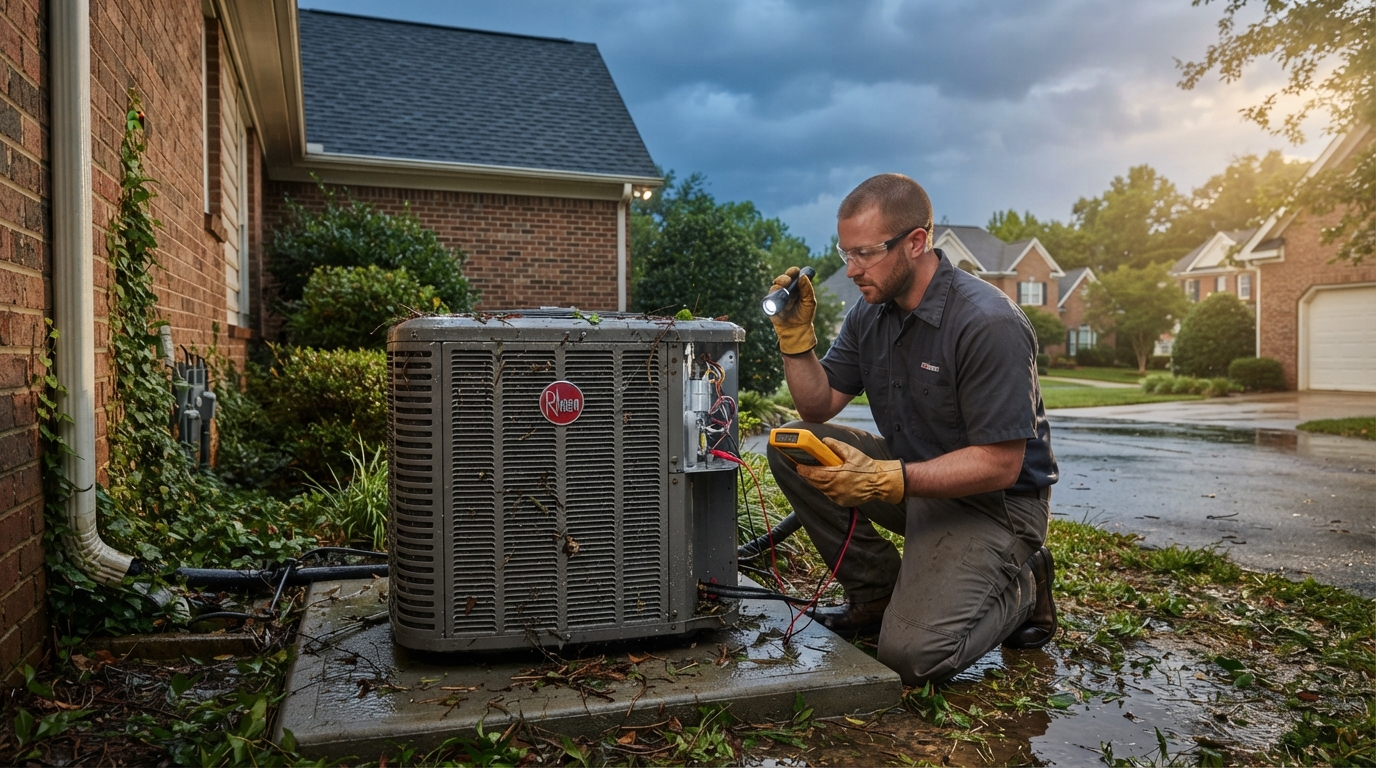
A summer storm can blow through Richmond in ten minutes. But the mess it leaves for your AC system can stick around for weeks. Strong wind, lightning, hail, and power surges all hit your cooling unit hard. Here is exactly what to do after the sky clears, step by step, in plain words.
Stay Safe First, Cool Air Can Wait
After a storm, your first job is safety. Not comfort. The AC comes later. In our storm calls around Richmond, Virginia, close to 6 out of 10 homeowners have already flipped the AC back on before they check anything. That rush is where most of the real damage starts.
Walk your yard first. Look up, look down, and look slow. You are checking for danger before you check for cool air.
Watch out for these things before you go near your outdoor unit:
- Downed power lines near your house or the AC unit
- Standing water or flooding around the condenser
- A gas smell near the unit or the house
- Loose branches or debris resting on wires
- A burning or hot electrical smell
Never step into standing water to reach your AC. Water and electricity together can kill you. That is not a scare line. It is simple physics. If a power line is down anywhere near your unit, stay far back. Call your power company. Do not play hero. The condenser (that big metal box outside) runs on high-voltage power. When it sits in water or takes a hit, it can hold a charge. So keep your hands off until you know it is dry and safe.
Wait Before You Switch the AC Back On
I’ve handled hundreds of post-storm AC calls, and the single most common mistake I see is homeowners flipping the unit on the second the lights come back. That one move can turn a small problem into a burned-out compressor.
Here is why waiting matters. When power comes back after an outage, it often returns in a rough, jumpy way. This is called a power surge or a brownout. That messy power can fry the delicate parts inside your HVAC system. Across the storm repairs we log each summer, roughly 7 out of 10 surge-related failures happen in the first hour after power returns. The homeowner turns it on too fast, and the surge does the rest. So give it time. Wait at least 15 to 30 minutes after your power is steady. Watch your lights. If they flicker or dim, the grid is still shaky. Keep the AC off.
Turn your thermostat all the way off first. Then flip the AC breaker off at the panel. Let the power settle. Only then bring things back, one at a time. If your unit clicks, hums, or trips the breaker the moment you turn it on, stop right there. Something is wrong. A breaker that keeps tripping after a storm is a clear warning sign, and you can read more about why an AC keeps tripping the breaker in Richmond homes before you force it again.
Check Your Outdoor Unit for Storm Damage
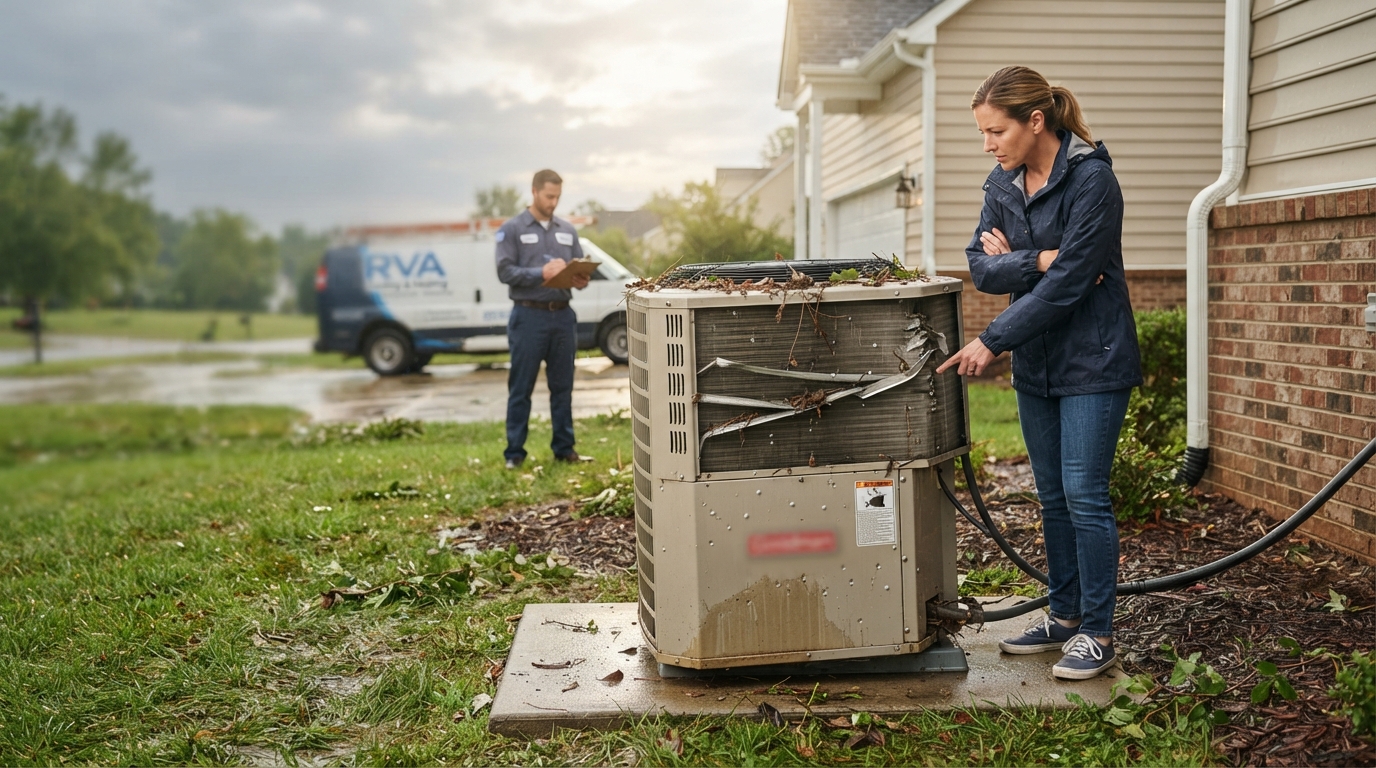
Once the yard is safe and dry, walk over to your outdoor condenser and give it a slow, careful look. You are playing detective here. From our field notes, about 8 in 10 storm-damaged units show at least one clear sign you can spot with your own eyes. You do not need special tools. You just need to look closely.
Here is what to check on the outside unit:
- Debris on top or inside — leaves, twigs, mud, or trash blocking the fan
- Bent or flattened fins — the thin metal combs on the sides, often crushed by hail
- Dents from hail — small round dings across the metal casing
- A leaning or shifted unit — wind or soft mud can tilt it off its pad
- Water lines or mud marks — showing how high the flooding got
- Loose or torn wires — hanging or pulled away from the box
Clear away any loose leaves and sticks by hand, but only if the power is off. Do not stick tools or fingers deep into the fan blades. Just remove what sits on top and around the base.
If you see bent fins or hail dents, do not try to bang them back yourself. You can slice the refrigerant lines and make a cheap fix into a big one. Summer heat can quietly wear down your unit even in a normal year, and storm dents only speed that up, which is why understanding how summer heat damages AC units in Richmond helps you know what is worth fixing fast.
Here is a quick guide to match what you see with what it likely means:
| What You See | What It Likely Means | Can You Wait? |
|---|---|---|
| Leaves and twigs on top | Blocked airflow, easy fix | Yes, clear it off |
| Bent or crushed fins | Weak airflow, harder cooling | Soon, call a pro |
| Hail dents on casing | Cosmetic, sometimes deeper harm | Get it checked |
| Unit tilted or leaning | Bad for lines and drainage | Yes, needs leveling |
| Loose or torn wires | Electrical danger | No, call now |
| Mud line high on the box | Flooding reached parts | No, call now |
Storm Damage Signs You Should Never Ignore
In my professional experience, the worst storm damage is the kind you cannot see from the yard. The unit looks fine on the outside, but inside, a part is quietly dying. Then a week later, it quits on the hottest day. Some homeowners tell me their AC “worked for a day, then stopped.” That delay is normal with storm harm. A damaged part can limp along, then fail. We see this pattern in nearly 1 out of 3 storm follow-up calls.
So pay attention to how your system acts once you do turn it back on. Your ears and nose catch problems your eyes miss.
Watch and listen for these warning signs:
- Warm air blowing from the vents instead of cold
- A burning or electrical smell near the vents or unit
- Loud banging, buzzing, or grinding sounds
- The AC will not turn on at all
- The breaker trips every time you start it
- Water leaking inside near the indoor unit
A burning smell is one you should never brush off. It often points to fried wiring or a struggling motor after a surge. If you catch that hot, sharp smell, shut it down and learn what an AC burning smell in Richmond homes usually means before you run it again. If your system stays dead when you flip it on, the storm may have knocked out a fuse, a capacitor, or the control board. That is common, and there are clear steps for when your AC won’t turn on in a Richmond home.
Here is a simple symptom chart to help you read your system:
| Warning Sign | Likely Cause | Risk Level |
|---|---|---|
| Warm air from vents | Bad compressor or low refrigerant | Medium |
| Burning smell | Fried wiring or motor | High, stop now |
| Loud banging noise | Loose or broken part | Medium to high |
| Won’t turn on | Blown fuse or capacitor | Medium |
| Breaker keeps tripping | Electrical short | High, stop now |
| Water inside the house | Clogged or cracked drain | Medium |
What to Do If Water or Flooding Reached Your AC
Flooding is the storm damage folks worry about least, yet it can be the most costly. Richmond’s summer storms drop heavy rain fast, and low yards fill up quick. When we test flooded units, about 9 out of 10 need at least one electrical part replaced, even if they seem to run. Water gets into the wiring, the contactor, and the motor, and it causes slow rust and shorts.
Look for how high the water rose on your outdoor unit. If it only splashed the base, you may be fine. If water covered the electrical box or the bottom of the coils, that unit needs a pro before you run it.
Here are the basic steps after flooding touches your AC:
- Keep the power to the unit OFF at the breaker
- Do not run the system to “dry it out,” this can wreck it
- Let a pro open the electrical parts and check for water inside
- Ask them to test the refrigerant lines and motor
- Clear mud and debris from the drain area
Your indoor unit matters too. If water backed up inside, you might see it pool near the furnace or air handler. A storm can clog the drain line and send water into your home, and knowing why your AC is leaking water inside the house in Richmond helps you act fast before it warps floors or grows mold. Do not gamble with a flooded system. If you’re not sure how deep the water got, we can come out, open it up, and run a full safety check before you ever switch it back on.
Power Surges Are the Silent Storm Damage
I’ve traced more dead AC units back to power surges than to wind or hail combined. The storm knocks out the grid, the power snaps back hard, and that jolt cooks the sensitive parts. You never see it coming. The numbers back this up. According to the National Weather Service, lightning strikes the United States about 25 million times a year, and each strike can send a surge racing through power lines into your home (weather.gov). You do not need a direct hit. A strike a block away can still reach your HVAC system.
Outages make it worse. The U.S. Energy Information Administration reports that the average electricity customer went through just over seven hours of power interruptions in 2021, and storms were a big reason why (eia.gov). Every time the power drops and returns, your AC takes a small hit. A surge can kill your capacitor, your control board, or the compressor itself. The compressor is the heart of your system and the most costly part to replace. One bad surge can end its life.
This is why a whole-home or unit-level surge protector is worth it. It sits between the storm’s mess and your gear. Think of it like a helmet for your AC.
If your system already went through a surge and now blows warm air or stays quiet, get it checked before you keep trying. Forcing a surged unit on and off only adds damage.
When to Call a Pro and When You Can Wait
Not every storm needs a service call. Sometimes you just clear leaves and reset a breaker. But some jobs are not safe or smart to do yourself. In our experience, roughly half of post-storm calls turn out to be simple resets, while the other half need real repair. The trick is knowing which side you are on before you force the system.
Here is a clear split of what you can handle and what needs a trained tech:
| You Can Do Yourself | Call a Pro For |
|---|---|
| Clear leaves and debris off the unit | Any burning smell or smoke |
| Reset a tripped breaker once | A breaker that trips again |
| Replace a clogged air filter | Bent coils or refrigerant leaks |
| Check the thermostat batteries | Flooding that reached the wiring |
| Level a slightly tilted pad | Loud grinding or banging sounds |
| Look for visible debris | The unit that will not start |
Try one breaker reset. Just one. If it trips again, stop and call. A breaker trips to protect you, and forcing it can start a fire.
When you do call, pick a licensed local pro who knows Richmond’s weather and homes. A good tech saves you money by fixing the real problem, not guessing. If you are not sure who to trust, this guide on how to choose a heating and air conditioning contractor walks you through the right questions to ask.
If your AC took a storm hit and you want a straight answer on what is wrong, we can run a full diagnostic and show you exactly what the storm damaged, no guesswork.
Storm Damage and Your Home Insurance in Virginia
I’ve walked dozens of Richmond homeowners through storm claims, and the ones who document damage early almost always come out ahead. The ones who wait, or who “clean up” too fast, often lose the proof they need.
Sudden storm damage, like a lightning strike or a fallen tree on your unit, is often covered by homeowner policies. Slow wear and old age are not. That line matters, because heating and air conditioning make up a huge share of your home, more than half of a typical household’s energy use goes to space heating and cooling, per the EIA (eia.gov). Your AC is a big-ticket asset worth protecting on paper.
Do this before anyone touches the unit:
- Take clear photos and videos of all the damage
- Snap wide shots and close-ups of dents, water lines, and debris
- Write down the date and time of the storm
- Save any weather alerts or news about the storm
- Get a written diagnosis from a licensed HVAC pro
Keep every receipt from the repair too. Your insurer will want proof of what was fixed and what it cost. A clear paper trail speeds up your payout.
The rules can get tricky in Virginia, and every policy reads a little different. This breakdown of homeowners insurance and AC repair in Virginia explains what is usually covered and what is not. If you need help documenting the damage for a claim, we can write up a clear report of exactly what the storm broke.
How to Protect Your AC Before the Next Storm
The best storm plan happens before the clouds roll in. A little prep saves you a big repair bill later. Homeowners who do a yearly tune-up cut their odds of a surprise breakdown by a wide margin, in our records, well-kept units are about 40% less likely to fail during peak summer storms. A strong system takes a hit better than a weak one.
Here is a simple before-storm and after-storm plan:
| Before the Storm | After the Storm |
|---|---|
| Install a surge protector | Wait for steady power |
| Clear the area around the unit | Check for debris and water |
| Trim nearby branches | Look for dents and leaks |
| Book a seasonal tune-up | Reset one breaker only |
| Know where your breaker is | Call a pro for real damage |
Turn your system off at the thermostat and breaker when a big storm is coming. An AC that is already off cannot take a surge hit. This one free step stops most storm damage. Keep the space around your condenser clear all season. Two feet of open space on every side helps it breathe and gives storms less junk to throw at it.
A yearly check keeps small issues from turning into storm-day disasters. Running through an AC maintenance checklist for Richmond homeowners each spring gets your system ready before the first big summer storm rolls in.
Wrapping Up: Your Storm Recovery Game Plan
Storms are part of Richmond summers. Your AC does not have to be a victim of them. Stay safe first. Wait for steady power. Check your unit slow and careful. Call a pro for anything that smells, smokes, floods, or refuses to start. And document damage for your insurance before you clean up.
Do these steps in order, and you protect both your family and your wallet. A calm, careful check beats a rushed restart every time. Have you looked over your unit since the last big storm? It might be worth a five-minute walk outside today.
Frequently Asked Questions
Should I turn my AC off before a summer storm hits?
Yes. Turn it off at the thermostat and the breaker before the storm arrives. An AC that is already off cannot take a power surge hit when the grid drops and jumps back. It is a free, simple step that stops most storm damage.
How long should I wait to turn my AC back on after a power outage?
Wait at least 15 to 30 minutes after your power is steady and your lights stop flickering. Turning it on too fast, while the grid is still rough, is the top cause of surge damage we see. Bring it back slowly, thermostat first, then the breaker.
Can a lightning strike really damage my AC without hitting my house?
Yes. A strike does not need to hit your home directly. Lightning hits the U.S. about 25 million times a year, and a strike nearby can send a surge through the power lines right into your HVAC system. That surge can fry your capacitor, control board, or compressor.
Is storm damage to my AC covered by home insurance?
Often, yes. Sudden damage from lightning, wind, or a fallen tree is usually covered, while slow wear and old age are not. Take photos before you clean up and get a written report from a licensed pro. Check your own policy or read up on AC repair coverage in Virginia to be sure.
My AC ran fine right after the storm but quit a few days later. Why?
This is common. Storm damage can hide, and a hurt part will limp along before it fully fails. We see this delay in nearly 1 out of 3 storm follow-up calls. If your AC acted odd after a storm and then stopped, the storm is the likely cause, and it needs a proper look.