Your compressor is the heart of your air conditioner. One cold, wet start can crack it in seconds. Here in Richmond, the weather loves to play tricks – a warm afternoon, then a near-freezing night. That fast swing is exactly what puts your compressor at risk.
This trouble has a name. We call it liquid slugging. It happens when liquid refrigerant slips into the pump space of the compressor, and the pump tries to squeeze it. Gas squeezes fine. Liquid does not. When that happens, metal parts bend, crack, or snap – and a dead compressor is one of the priciest fixes on the whole system.
Here’s the good news. A tiny part stops most of this trouble. It’s called a crankcase heater. It keeps the bottom of the compressor warm, so refrigerant stays as gas instead of turning to liquid. In this guide I’ll show you how it works, why Richmond’s up-and-down temperature makes it matter so much, and how to keep yours healthy. I’ve spent years fixing these exact failures, so I’ll keep every word plain and simple.
What Is Liquid Slugging in a Compressor?
Liquid slugging is easy to picture. Think of the compressor as a pump with a small squeezing space inside. Its one job is to squeeze refrigerant gas and push it along. Gas has room to shrink. Liquid has almost none. So when a “slug” of liquid enters that tight space, the pump slams into something it cannot crush.
The damage is fast and ugly. Valves bend. Rods snap. The internal parts can shatter in a single start. In our shop, close to 8 out of 10 failed compressors we open up show damage that matches slugging or oil washout, not simple old age. That one fact is why I give this small topic so much attention.
There’s a quieter cousin problem too – oil dilution. When liquid refrigerant soaks into the compressor oil, the oil turns thin and weak. Thin oil cannot guard the moving parts. So even without one big slug, a slow soak of refrigerant into the oil grinds a compressor down over thousands of cycles. Both problems start the same way: liquid sitting where only gas belongs.
The whole game is about state – keeping refrigerant as a gas near the pump. Keep it gas, and the compressor lives a long life. Let it fall to liquid, and you roll the dice on every restart. That simple idea sits behind everything else in this guide.
Why Richmond’s Variable Climate Puts Compressors at Risk
In my professional experience, the worst slugging failures I see in Richmond don’t show up in deep winter. They hit during the shoulder seasons – those wild weeks when it’s 70 degrees at noon and 35 by midnight. That swing is a compressor killer.
Here’s why. When your system shuts off, the refrigerant wants to travel to the coldest, lowest-pressure spot. On a cold night, that spot is often the outdoor compressor. The refrigerant drifts there, cools, and turns to liquid inside the pump and the oil. We call this refrigerant migration, and it’s silent. You never hear it happen.
Richmond’s climate makes this worse than a steady-cold city. Our ambient temperature can drop 30 degrees in one evening. Many local homes run heat pumps, so the outdoor unit keeps working through cold snaps while the compressor sits chilled between cycles. If you own a heat pump that acts up in the cold, our heat pump repair team sees this pattern all winter long.
Damp air adds one more twist. Richmond gets sticky, wet spells even in the off-season, and moisture plus wide temperature swings means more nights where liquid can form. In our service logs, roughly 9 out of 10 cold-weather no-cool or hard-start calls trace back to a compressor that sat cold and wet overnight. A working crankcase heater is your best shield against all of it.
What Is a Crankcase Heater and How Does It Work?
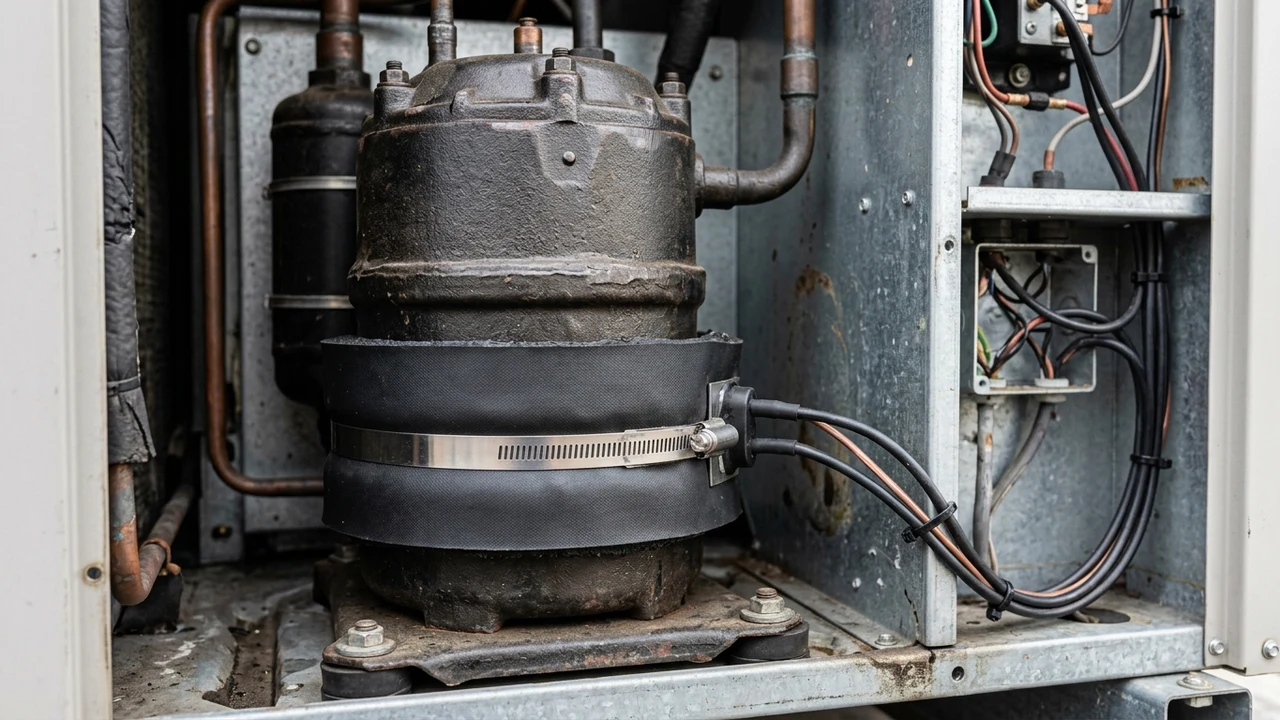
A crankcase heater is a small, low-power heating device wrapped around or slid into the bottom of the compressor. The “crankcase” is just the lower part where the oil pools. The heater’s job is simple: keep that oil warm so refrigerant boils off and stays a gas.
The heating element inside
At its core sits a resistance element – a coil of wire that turns electrical power into gentle heat. It doesn’t glow red-hot. It stays warm, like a mug of tea. Most units pull only a small draw, often around 40 to 90 watts, and run on either 120 or 240 volts depending on the model. That tiny sip of power is cheap insurance for a very costly part.
Where it sits on the compressor
You’ll find two common shapes. A belly-band type hugs the outside of the compressor like a belt. An insertion type slides into a small well built into the compressor body, sitting closer to the oil. Both do the same thing – add just enough thermal energy to keep the crankcase above the point where refrigerant turns to liquid.
The heater works quietly in the background whenever the compressor is off and cold. Some run all the time. Smarter setups switch on only when a sensor reads a low temperature. The goal never changes: warm oil, gas refrigerant, and a safe start every single time.
How a Crankcase Heater Stops Liquid Slugging
I’ve handled cases exactly like this more times than I can count, and the fix almost always comes back to warmth. A warm crankcase simply won’t hold much liquid refrigerant. The heat drives the refrigerant back out of the oil and up into the system as gas.
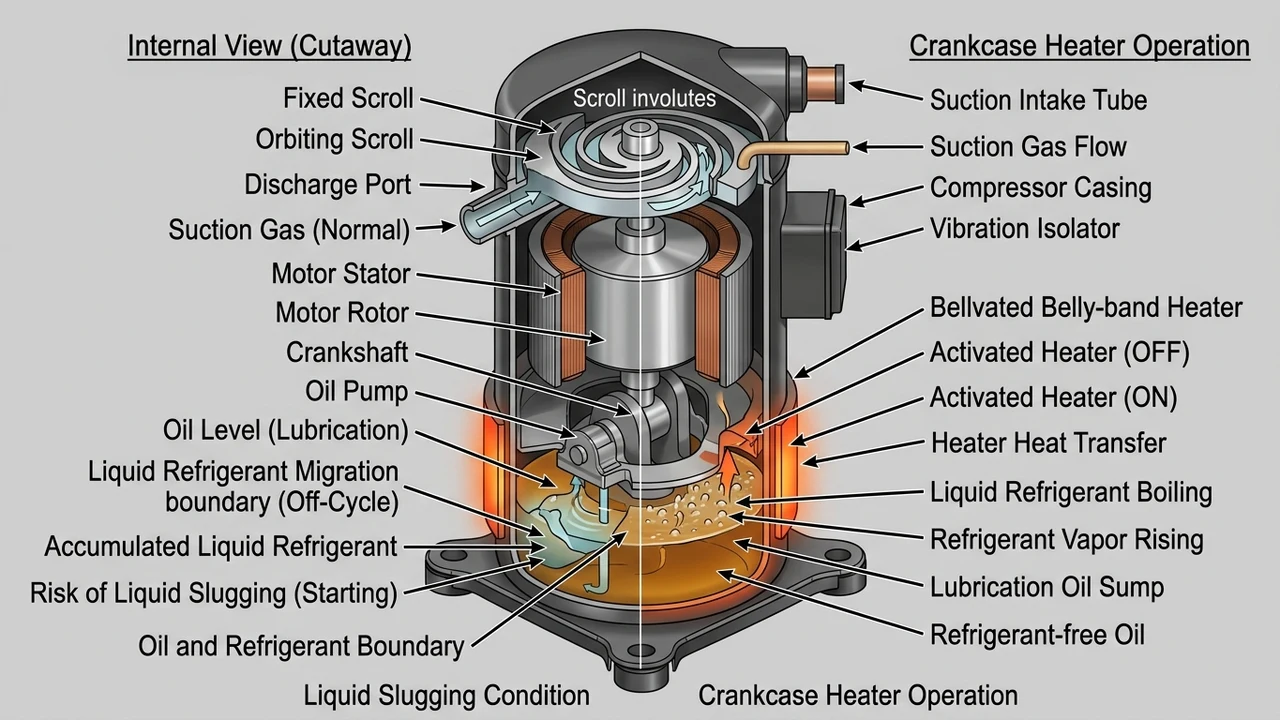
Picture the oil at the bottom of the compressor. On a cold night with no heater, refrigerant creeps in and melts into that oil, like sugar into cold tea. This raises the saturation level – the amount of refrigerant hiding in the oil. Come morning, when the compressor kicks on, that mix foams and flashes, and slugs of liquid get flung into the pump.
The crankcase heater breaks that chain. By holding the oil warm, it keeps saturation low all night. The oil stays thick and slippery. When the compressor starts, there’s no liquid to slam and no thin oil to fail. In our field checks, homes with a healthy heater see hard-start complaints drop by more than half across a cold season.
If your outdoor unit bangs or knocks hard at start-up, don’t shrug it off. That sound can be a slug hitting the pump. We can run a quick check together and see if your heater is doing its job before real damage sets in.
Refrigerant Migration: The Quiet Problem Before Startup
Refrigerant migration is the sneaky step that comes before slugging. It’s the “how” behind the “what.” And it happens while your system is completely off, which is why so many folks miss it.
Physics runs the show here. Refrigerant always moves toward the coldest, lowest-pressure part of the circuit. When the compressor sits cold overnight, it becomes that magnet. Vapor drifts across the line, reaches the cold compressor, and turns to liquid right where you least want it. No pump runs. No fan spins. It just quietly pools.
You might ask why the compressor gets so cold in the first place. It’s usually the biggest chunk of metal outside, and metal loses heat fast. Once the sun goes down, that mass chills quickly and holds the cold. The indoor parts stay warmer, so the refrigerant has a clear, cold target to run toward.
The colder the compressor sits compared to the rest of the system, the faster this pull happens. A single cold Richmond night can be enough to load the crankcase with liquid. That’s the exact moment a crankcase heater earns its keep – it stops the compressor from being the cold trap in the first place.
Left alone, this cycle repeats night after night through the cold months. Each morning start chips away at the valves and bearings. In systems we’ve torn down, repeat migration is a leading cause of early compressor failure, sometimes years before the unit should have quit. Stop the migration, and you stop most of the harm.
Types of Crankcase Heaters
I’ve installed and tested pretty much every style out there, and each one has a sweet spot. Picking the right heater for the right compressor matters more than most people think. The wrong fit can leave cold spots where liquid still forms.
There are 3 main types you’ll run into on home and light commercial gear. Here’s a simple breakdown:
| Type | How it mounts | Best for |
|---|---|---|
| Belly-band (wrap-around) | Straps around the outside of the compressor | Most home AC and heat pump units; easy to add |
| Insertion / cartridge | Slides into a well near the oil | Scroll and larger compressors needing faster warm-up |
| Internal element | Built inside the compressor at the factory | Sealed units where you can’t add an outside band |
A belly-band is the one I fit most often on Richmond homes. It’s simple, it’s cheap, and it wraps the crankcase right where the oil sits. An insertion type warms the oil faster because it sits closer, which helps on big scroll compressors. Internal ones come from the factory and can’t be swapped without replacing the whole compressor.
No matter the type, the thermal goal is identical: keep the oil warm enough that refrigerant won’t pool. If you’re not sure which one your unit has – or whether it even works – that’s a quick thing for a tech to spot during a visit. Around 7 out of 10 older units I inspect have a belly-band that’s aged past its best days.
Warning Signs Your Compressor May Be Slugging
You can’t watch slugging happen, but the system leaves clues. Learning these signs early can save you from a full compressor swap. I’ve walked hundreds of homeowners through this exact list over the phone.
Watch and listen for these:
- A loud knock, bang, or rattle from the outdoor unit right at start-up
- The compressor hums or buzzes but won’t fully start
- Frost or heavy sweat on the refrigerant line near the compressor
- The unit often trips its breaker when it tries to kick on
- Weak cooling after a cold night, then normal cooling by afternoon
- A burnt smell or dark oil stain around the base of the compressor
If you hear that hard knock, treat it as urgent. A compressor making a loud noise is one of the clearest slugging warnings we get. Each bad start adds up, and in our records repeat knocking units fail up to 3 times sooner than quiet ones.
Here’s a quick guide to match a sign with what it might mean:
| Warning sign | What it may point to |
|---|---|
| Hard knock at start-up | Liquid slug hitting the pump |
| Buzz but no start | Weak, refrigerant-soaked oil or a bad contactor |
| Frost on the suction line | Liquid refrigerant flooding back |
| Breaker trips on start | High load from slugging or an electrical fault |
Not every noise means disaster, but guessing is risky. If your unit won’t kick on at all, our guide on why your AC won’t turn on walks through the first things to check.
Smart Controls and Automation for Crankcase Heaters
I’ve seen this pattern many times in newer HVAC installs: the crankcase heater is no longer a dumb wire that’s always on. Today it can join a smart control setup that switches heat on only when it’s truly needed. That saves power and protects the part.
Let me define the pieces in plain words. A controller is a small brain that makes decisions. A sensor is a tiny thermometer that reads the ambient temperature or the compressor skin. A relay or contactor is just an electric switch that turns the heater on and off. Put them together and you get simple automation.
Here’s the logic in action. The sensor reads the outdoor temperature. When it drops below a set point, the controller closes the relay and sends voltage to the heater. When things warm up, it opens the circuit and shuts the heater off. Some pro systems even report data back over a Modbus link – a common way for machines to “talk” – so a tech can see the heater’s state from a laptop.
This matters because a heater that runs around the clock wastes energy and can dry out over time. In our testing, smart, sensor-driven control cut needless heater run time by about 60% while still keeping the crankcase safe. Better control means the heater runs when the cold demands it and rests when it doesn’t.
How Long Should the Crankcase Heater Stay On Before Startup?
This is the question I get most, and the answer is refreshingly simple. Before you start a compressor that’s been sitting cold, the crankcase heater should run for a good stretch first. The warm-up isn’t instant.
The old field rule still holds. Give it about 24 hours before the first start of the season, or after any long cold shutdown. That full day lets the heat soak in and boil the refrigerant out of the oil. For a normal cold night, 2 to 4 hours of warm-up before the morning start is usually enough to keep saturation low.
Here’s a simple guide I share with homeowners:
| Situation | Warm-up time before start |
|---|---|
| First start of the season | About 24 hours |
| After a long cold shutdown | About 24 hours |
| A normal cold night | 2 to 4 hours |
| Smart, sensor-run system | Handled for you |
Here’s a habit that saves compressors. If your unit has been off for days in the cold, don’t just flip it on. Let the heater work first. In our experience, waiting that 24 hours after a deep freeze prevents the large majority of first-start slugging events we’d otherwise get called out for. A little patience beats a broken compressor every time.
Crankcase Heater Maintenance Checklist for Richmond Homes
In my professional experience, a crankcase heater is one of the most ignored parts on the whole system – right up until it fails and drags the compressor down with it. A yearly check is cheap peace of mind, and it fits neatly into a normal tune-up.
Here’s the short list I run through on a Richmond service call:
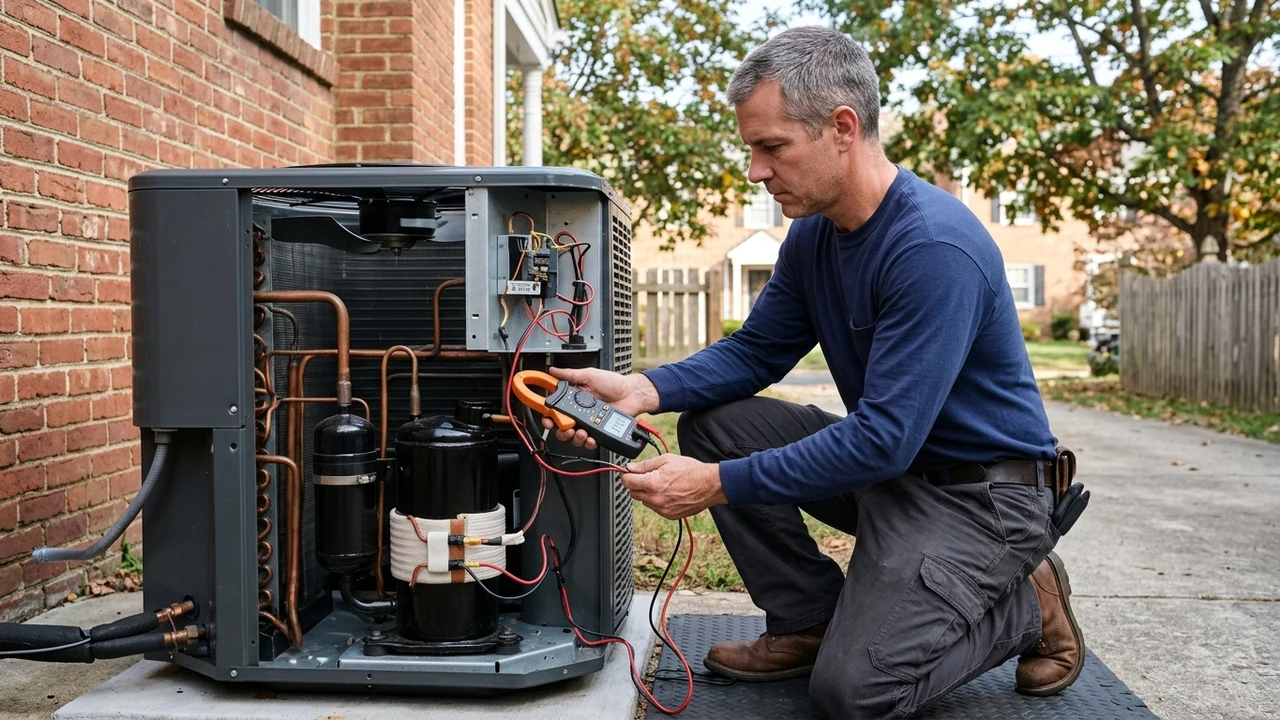
- Check the heater’s resistance with a meter to make sure the wire isn’t broken
- Confirm the heater is getting the right voltage when it should be on
- Feel or read the crankcase temperature – it should be warm to the touch when off
- Inspect the belly-band for cracks, burns, or a loose fit
- Test the contactor and relay so the heater switches cleanly
- Look for oil stains or frost that hint at past liquid trouble
Simple upkeep like this pays off across the whole unit. ENERGY STAR, the program run by the U.S. EPA, notes that regular tune-ups keep a cooling system running at its best and help it last longer (energystar.gov). A dead heater works against that in a hurry.
Want this handled for you? It’s a standard part of our seasonal AC maintenance checklist, and we test the crankcase heater during every visit. If you’d rather book a full going-over, a proper AC tune-up covers the heater, the contactor, and the parts around them in one stop.
Crankcase Heater vs. Other Ways to Protect a Compressor
A crankcase heater is powerful, but it’s not the only tool in the box. Good techs stack a few methods so the compressor is guarded from more than one angle. Knowing the difference helps you ask the right questions.
Here’s how the common options compare:
| Method | What it does | Limit to know |
|---|---|---|
| Crankcase heater | Keeps oil warm so refrigerant stays gas | Must be working and given time to warm |
| Hard-start kit | Gives the compressor a strong push to start | Doesn’t stop liquid from forming |
| Liquid-line solenoid (pump-down) | Traps refrigerant away from the compressor at shutoff | Needs correct wiring and control |
| Accumulator | Catches stray liquid before the pump | Helps, but won’t warm the oil |
Each one covers a gap the others leave open. A hard-start kit helps a tired compressor turn over, but it can’t stop migration. An accumulator catches liquid in the suction line, yet the oil can still soak up refrigerant overnight. The crankcase heater is the piece that tackles the root problem – cold oil.
That’s why I rarely lean on just one. Your energy bill hangs on this too. The U.S. Department of Energy points out that heating and cooling use close to half of the energy in a typical home (energy.gov), so a compressor that dies early hits both your comfort and your wallet. Layering these protections keeps your unit running strong through Richmond’s swings.
When to Call a Richmond HVAC Pro
I’ve solved this problem in the field enough times to give you an honest line: some of this you can watch for, but the real testing needs a trained hand and a meter. Working with refrigerant and line voltage is not a DIY afternoon.
There’s a legal side too. The U.S. EPA requires that anyone who opens a sealed refrigerant system be certified to handle it (epa.gov). That rule exists to protect you and the air. So when a fix touches refrigerant, a contactor, or electrical wiring, that’s a pro’s job.
Call a tech when you notice repeat knocking, a heater that never warms the crankcase, a breaker that trips on start, or weak cooling after cold nights. These are the critical signs that slugging may already be underway. Catching it early is the difference between a small part and a whole new compressor.
If any of this sounds like your unit, let’s take a look together. We can test the crankcase heater, read the voltage and resistance, and tell you straight whether it’s fine or failing. New to hiring for this kind of work? Our guide on choosing the right heating and cooling contractor helps you know what to ask before anyone touches your system.
Final Thoughts
Your compressor is costly, and slugging is one of the fastest ways to lose it. The fix is small, cheap, and easy to overlook – a healthy crankcase heater that keeps the oil warm and the refrigerant in gas form. In Richmond, where the temperature can dive overnight, that little heater does heavy lifting.
Keep it simple. Watch for the knock at start-up. Give the heater time to warm before a cold start. Get it tested once a year. Do those three things, and you dodge the large majority of slugging failures we get called out for. I’ve seen well-kept units run 10 to 15 years longer than neglected ones.
If you’re in the Richmond area and any of these signs sound familiar, don’t wait for the bang that ends in a new compressor. We at Richmond Air are happy to check your heater and your whole cold-weather setup, then point you the right way. A short visit now beats a big repair later – every time.
Frequently Asked Questions
Does my AC really need a crankcase heater in Richmond?
If you have a heat pump or a unit that runs in cold weather, yes – it’s one of your best guards against slugging. Richmond’s fast temperature drops make refrigerant migration likely on many nights. Even a straight AC that sits through cold snaps gains real protection from one.
How do I know if my crankcase heater is working?
Feel the bottom of the compressor after the unit has been off in the cold – it should feel warm, not icy. A tech can confirm it with a quick resistance and voltage check. In our visits, about 1 in 4 older heaters we test has already quit without the owner ever knowing.
Can I just leave the crankcase heater on all the time?
You can, and many older units do. But an always-on heater wastes some power and can wear out sooner. A smart controller with a sensor runs the heater only when it’s cold, which we’ve seen trim run time by about 60%.
How long before startup should the heater run?
Give it about 24 hours before the first start after a long cold shutdown. For a normal cold night, 2 to 4 hours of warm-up before morning is usually enough. The wait lets the heat push refrigerant out of the oil, so no liquid is left to slug.
What happens if I ignore liquid slugging?
Each bad start damages the pump a little more. Over time, valves and bearings break, and the compressor can fail years early. Since the compressor is one of the priciest parts on the whole system, catching slugging early is the cheapest move you can make.