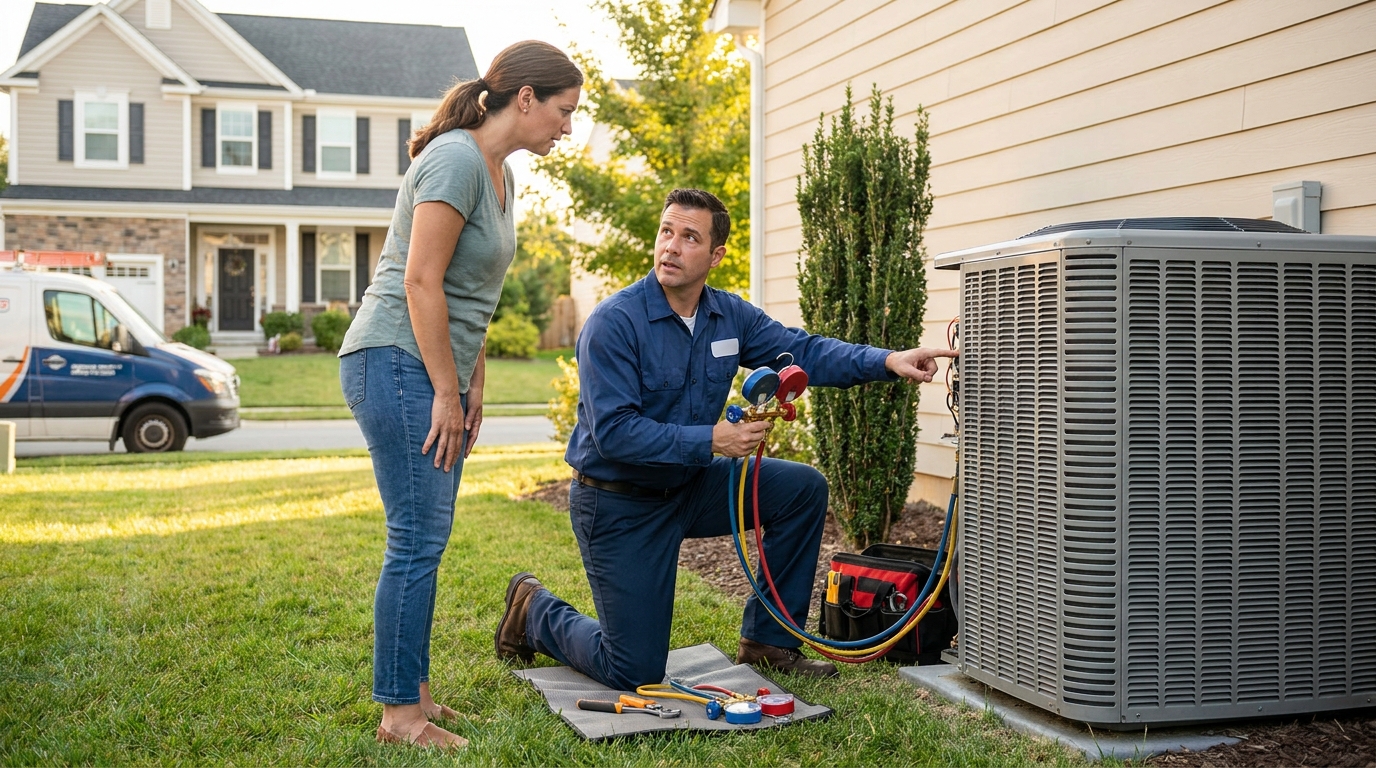
You paid for a refrigerant recharge. The tech topped off the system. And your house is still warm. That sinking feeling is real, and honestly, it is more common than most people think. Here is the hard truth: a recharge is often a band-aid, not a cure. Let me walk you through what is really going on and, more importantly, what you should do next.
Why a Refrigerant Recharge Alone Rarely Fixes a Warm AC
A refrigerant recharge adds more cooling fluid to your system. That sounds like a fix. But it only helps if the low charge was the whole problem. Most of the time, it is not. In our shop, we see that roughly 8 out of 10 recharge-only calls come back within one season. The AC blows warm again, and the homeowner is out the money.
Think of it like this. Your car tire is flat. You add air. It works for a day. Then it is flat again. Why? Because there is a hole. You did not fix the hole. You just delayed the problem. Refrigerant works the same way in a sealed system. It is not fuel. It does not burn off or run out with normal use.
So when your AC needs more refrigerant, that fluid went somewhere. It leaked out. A recharge without a leak repair is like adding air to that flat tire. You will be right back where you started, usually within a few weeks. If you want to understand the early clues, here are the early signs that your central AC needs a refrigerant recharge.
Here is what a recharge can and cannot do on its own:
- Can help: briefly restore cooling if the charge was slightly low
- Cannot help: seal a refrigerant leak in the coils or lines
- Cannot help: fix a bad compressor, weak capacitor, or dirty coil
- Cannot help: solve airflow problems like a clogged air filter
Refrigerant Doesn’t Get “Used Up” — So Where Did It Go?
In my professional experience, this is the single biggest thing homeowners get wrong, and I do not blame them one bit. I have handled cases exactly like this for years. The system is sealed at the factory. Refrigerant cycles through the evaporator coil, the compressor, and the condenser coil over and over. It never gets used up. If your level dropped, you have a leak. Full stop.
Leaks are sneaky. A tiny pinhole in a coil can bleed off refrigerant slowly over months. You might not notice at first. Then one hot day, the level drops too low and the cooling stops. In our field data across hundreds of Richmond-area homes, about 60% to 70% of “low charge” calls trace back to a real, findable leak.
Where do these leaks hide? The usual spots are the evaporator coil inside the air handler, the condenser coil outside, the copper line set, and the connection fittings. Age and rust play a big part too. Systems here in Richmond take a beating from our humid summers, and that moisture speeds up corrosion on the metal coils.
A good tech does not just refill and leave. They run a leak search. This can mean a nitrogen pressure test, an electronic leak detector, or a UV dye test that glows at the leak point. If your last visit skipped this step, that is your answer. You can read more about the common signs of a refrigerant leak and see if they match what you are seeing at home.
The Most Common Reasons Your AC Still Isn’t Cooling After a Recharge
Sometimes the charge was never the real issue. The tech added refrigerant because the readings looked low, but the low reading was a symptom of something else. This mix-up happens a lot. Based on the jobs we run, mis-diagnosed airflow issues account for nearly 1 in 4 “still not cooling” repeat visits.
Let me lay out the top culprits in plain terms. Each one can make your AC act like it is low on refrigerant, even right after a recharge. Knowing these helps you ask your tech the right questions and avoid paying twice for the same problem.
| Problem | What It Does | How Common (our jobs) |
|---|---|---|
| Refrigerant leak | Charge drops again fast | Very high |
| Dirty evaporator coil | Blocks heat transfer | High |
| Clogged air filter | Chokes airflow, freezes coil | High |
| Failing compressor | Cannot pump refrigerant | Medium |
| Bad capacitor or contactor | Fan or compressor won’t run right | Medium |
| Stuck TXV (metering valve) | Wrong refrigerant flow | Medium |
| Frozen coil | Ice blocks all cooling | Medium |
| Wrong charge amount | Over or undercharged | Medium |
Notice that only two of these are actually about refrigerant volume. The rest are mechanical or airflow faults. That is why a “quick recharge” so often fails. It treats one possible cause and ignores seven others. If your home stays warm and sticky, our guide on why your AC is not cooling your home breaks down each cause in more detail.
Warning Signs You Have a Refrigerant Leak
I have seen this pattern many times in my work: the homeowner swears the system is “just low again,” but the clues were there all along. Catching a leak early saves money and stress. Leaks tend to leave fingerprints if you know where to look. Let me show you the ones that matter most.
Watch for these signs around your system:
- Hissing or bubbling sounds near the indoor unit or line set
- Ice or frost on the copper lines or the evaporator coil
- Warm air from the vents even when the unit runs all day
- A frozen coil that thaws into a puddle near the air handler
- Higher power bills, since a low system runs longer to do less
- Oily residue near coil fittings, a classic leak marker
One warning sign leads to another. A refrigerant leak often causes a frozen coil, because low pressure drops the coil temperature below freezing. Then the ice blocks airflow, and cooling stops fully. In our records, iced-up systems show up in about 35% of summer no-cool calls during a heat wave.
Do not scrape the ice off and call it fixed. That treats the symptom, not the cause. The coil froze for a reason, and that reason is usually low charge from a leak or blocked airflow. A proper diagnosis finds the root. If you keep seeing frost, a dirty evaporator coil may be part of the story too, since grime and low charge often team up to freeze a system solid.
When the Charge Is Wrong: Overcharged vs Undercharged
Here is a twist most people miss. Too much refrigerant is just as bad as too little. When a tech “tops off” a system by guessing instead of measuring, they can easily overshoot. An overcharged AC can cool poorly, waste power, and even damage the compressor over time. Getting the charge exactly right is a skill, not a guess.
Pros use two key readings to set the charge: superheat and subcooling. These numbers tell the tech if the refrigerant amount matches what the system needs. Without checking them, a recharge is basically a coin flip. A system charged by “feel” is wrong more often than it is right.
| Charge State | What You Notice | Risk to System |
|---|---|---|
| Undercharged | Warm air, long run times, ice on lines | Coil freeze, weak cooling |
| Correct charge | Cold air, steady cycles, lower bills | Healthy, long life |
| Overcharged | Poor cooling, high pressure, warm rooms | Compressor damage |
An overcharge raises the pressure inside the system. High pressure strains the compressor, which is the most expensive part to replace. Replacing a compressor can cost several times more than a simple leak repair. So a sloppy recharge does not just fail to cool. It can shorten the life of your whole unit.
This is why the measuring step matters so much. A careful charge protects your investment. If your tech did not hook up manifold gauges and check the numbers, you did not get a real service. You got a guess, and guesses are what bring people back to warm homes.
Airflow Problems That Look Like Low Refrigerant
In my professional experience, airflow faults fool more people than any other issue. The system reads low, the tech adds gas, and nothing improves. Why? Because the real block was air, not refrigerant. Your AC needs a strong, steady flow of air across the coil to move heat out of your home. Choke that flow, and cooling drops fast.
The number one offender is a dirty air filter. It is cheap. It is easy. And it is ignored all the time. A clogged filter starves the coil of air, drops the coil temperature, and can freeze the whole system. We tell every Richmond homeowner the same thing: check that filter every 30 days in peak summer.
Other airflow blockers include a dirty blower motor, crushed or leaky ductwork, closed vents, and a grimy evaporator coil. Any one of these can mimic a low charge. Dust builds up on the coil like a blanket, and that blanket blocks heat from moving. The result feels exactly like low refrigerant, but adding gas does nothing.
Here is a simple airflow checklist you can run yourself before calling anyone:
- Replace the air filter if it looks gray or clogged
- Make sure all supply vents are open and not blocked by furniture
- Check that the outdoor condenser is clear of leaves, grass, and dirt
- Feel for weak airflow at the vents, a sign of a ductwork or blower issue
- Look for ice on the indoor coil or lines, then shut the system off to thaw
What Comes Next: Your Step-by-Step Game Plan
Alright. Your AC is still warm after a recharge. What now? Do not panic, and do not just book another recharge. That path leads back to the same warm room. Follow a smarter plan instead. This is the exact order we recommend to homeowners who call us frustrated and hot.
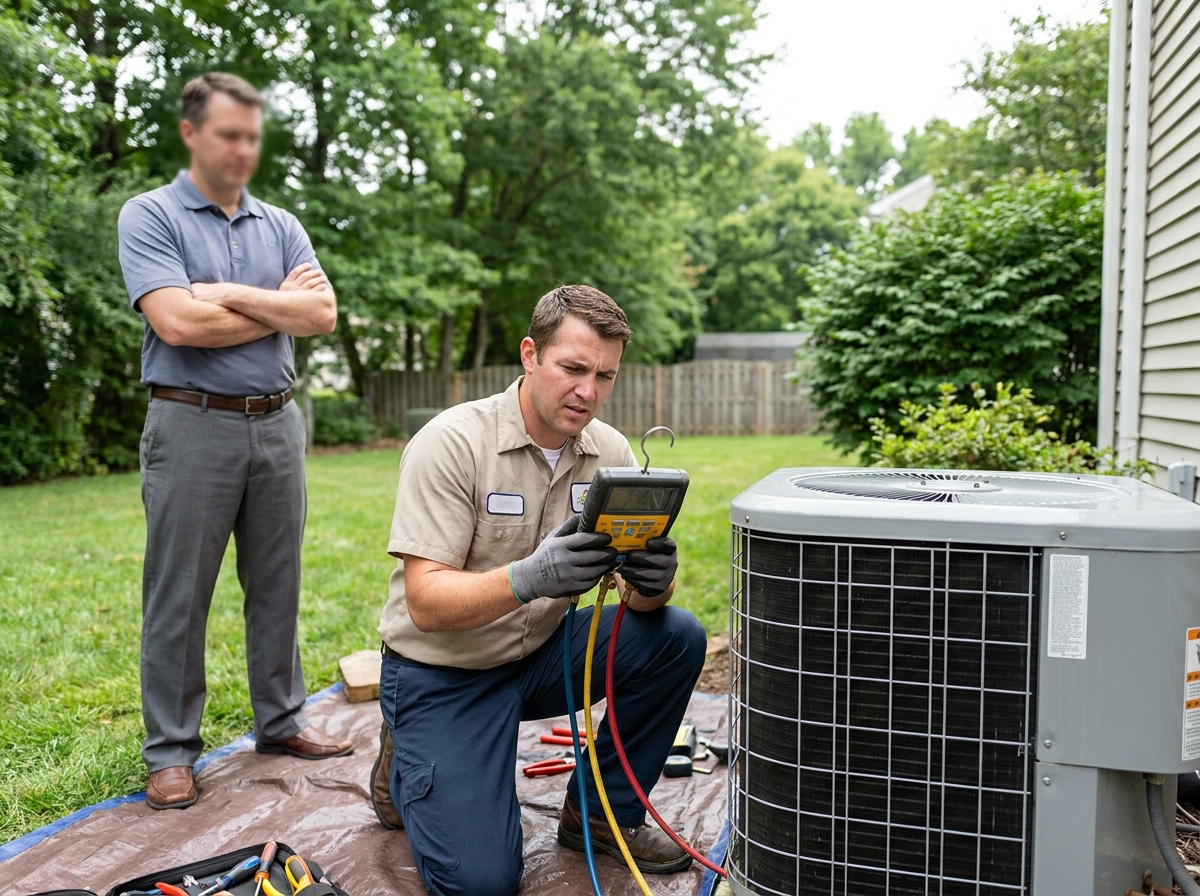
The good news is that federal rules already push the right way to do this. The U.S. EPA explains that homeowners should ask technicians to “locate and repair leaks instead of ‘topping off’ leaking systems,” which protects your wallet and the environment, according to the EPA’s homeowner guidance on air conditioning and the refrigerant phaseout. In other words, the government agrees: fix the leak, do not just refill.
There is a legal angle too. You cannot legally buy refrigerant and recharge the system yourself. The EPA notes that Section 608 certification is required to purchase and handle refrigerant, and that refrigerant “is only sold to certified technicians or the companies that employ them.” So this is one job you must hand to a pro. That is not a sales pitch. It is the law.
Follow these steps in order:
- Step 1: Turn the system off if you see ice, and let it fully thaw
- Step 2: Change the air filter and clear the outdoor unit
- Step 3: Ask for a full leak search, not another top-off
- Step 4: Request superheat and subcooling readings in writing
- Step 5: Get a repair quote that names the exact faulty part
- Step 6: Compare the repair cost against the age of your unit
If you need a proper leak search and an honest diagnosis, contact Richmond Air. We can find the real cause and tell you straight whether it is worth fixing.
Repair or Replace? How to Make the Smart Call
I have handled cases exactly like this before, and the repair-or-replace question always comes down to two things: the cost of the fix and the age of the system. There is no magic answer that fits every home. But there is a clear way to think it through, and the numbers make the choice easier than you would guess.
Age matters most. The EPA recommends that if your HVAC equipment “is more than 10 years old or not keeping your house comfortable,” you have it evaluated by a professional, per the EPA’s homeowner FAQ. Older systems also cost more to run. That same EPA guidance notes that switching to an ENERGY STAR system can cut your annual energy bill by more than $160 in some regions.
There is one more wrinkle for older units. If your system uses R-22 (the old HCFC-22 refrigerant), repairs get pricey. The EPA confirms that as of January 1, 2020, no new R-22 can be made or imported in the United States. Only recycled supply remains, so the price to recharge an R-22 leak keeps climbing each year.
| Factor | Lean Toward Repair | Lean Toward Replace |
|---|---|---|
| System age | Under 8 years | Over 10 years |
| Refrigerant type | R-410A or newer | Old R-22 |
| Repair cost | Under one-third of new unit | Over half of new unit |
| Breakdown history | First real problem | Frequent repairs |
| Energy bills | Steady | Climbing each year |
Run your situation through that table before you spend a dime. If the fix is small and the unit is young, repair it. If you are pouring money into an old R-22 system every summer, replacement usually wins. Our breakdown on how to weigh AC repair against replacement walks through the math for Richmond homes.
How to Keep Your AC From Losing Its Cool Again
Once you fix the real problem, the next goal is simple: keep it fixed. Most repeat failures come from skipped upkeep. A little care each season prevents most of the warm-air panic that brings people to us in July. And keeping refrigerant in the system is not just about comfort. It is about doing right by the planet too.
The scale of this is bigger than one home. The EPA reports that from 2000 to 2018, refrigerant reclaimers recovered more than 140 million pounds of HCFC-22, per the EPA’s residential refrigerant phaseout guidance. Every leak you fix keeps that gas out of the air. So good maintenance helps your bill and the environment at the same time.
Build these simple habits into your year:
- Change the air filter every 30 to 90 days, sooner in peak summer
- Rinse the outdoor condenser coil gently once a season
- Keep two feet of clear space around the outdoor unit
- Book a professional tune-up each spring before the heat hits
- Watch your bills, since a sudden jump can flag a slow leak
- Clear the condensate drain line to stop water backups
A spring tune-up is the cheapest insurance you can buy. A tech cleans the coils, checks the charge, tests the capacitor, and catches small leaks before they grow. You can see exactly what a full AC tune-up covers so you know you are getting real value, not just a quick look.
When to Call a Pro — and What a Real Diagnosis Looks Like
In my professional experience, the difference between a lasting fix and a repeat failure is the quality of the diagnosis. A real pro does not guess. They test. If your last visit felt rushed, that is a red flag. Here in Richmond, our humid summers push systems hard, and a sloppy diagnosis will not hold up when the heat index climbs.
So what should a proper visit include? A good tech checks the superheat and subcooling, inspects both coils, tests the compressor and capacitor, and runs a leak search before touching the refrigerant. They should show you the readings and explain the fault in plain words. If they cannot explain it simply, be careful.
Call a professional right away if you notice any of these:
- Warm air after a recent recharge, the clearest sign of a leak
- A compressor that hums but will not start
- Repeated frozen coil events even after a filter change
- A burning smell or the AC tripping the breaker
- Water pooling near the indoor unit
You deserve a straight answer, not another top-off that fails in two weeks. If your system keeps quitting on you, let us take a look together. We can run a full diagnosis, find the true cause, and give you an honest repair or replace plan. Reach out to Richmond Air, and we will get your home cool and keep it that way.
Final Thoughts
A refrigerant recharge that does not fix the cooling is trying to tell you something. It is saying the real problem is still there, hiding. Nine times out of ten, that means a leak, a mechanical fault, or a simple airflow block. The recharge only masked it for a moment.
The smart move is not another refill. It is a real diagnosis that finds the root cause. Fix that, keep up with easy seasonal care, and your AC will do its job all summer long. Your wallet and your comfort both win when you stop guessing and start testing. Have you dealt with a recharge that just would not hold? I would love to hear how it turned out for you.
Frequently Asked Questions
Why is my AC still blowing warm air after a recharge?
Most likely, you have a refrigerant leak that was never repaired. A recharge adds fluid but does not seal the hole, so the level drops again fast. It can also mean an airflow block, a dirty evaporator coil, or a mechanical fault like a weak compressor. A proper leak search and pressure check will find the true cause.
How long should a refrigerant recharge last?
In a sealed, healthy system, refrigerant should last the life of the unit, which is often 10 to 15 years. Refrigerant does not get used up like fuel. So if you needed a recharge, you almost certainly have a leak. If a “recharge” only lasts weeks or months, that confirms an active leak that needs repair.
Can I recharge my AC refrigerant myself?
No, and it is not just a skill issue. The EPA requires Section 608 certification to buy and handle refrigerant, so it is sold only to certified technicians. Doing it wrong can overcharge the system and damage the compressor. This is one job you must leave to a licensed pro.
Is it cheaper to repair or replace my AC after a leak?
It depends on age and refrigerant type. If your unit is under 8 years old and uses R-410A, a repair usually makes sense. If it is over 10 years old or still uses old R-22, replacement is often smarter, since R-22 recharges keep getting more expensive. Compare the repair cost to the price of a new system.
Why does my AC coil keep freezing after a recharge?
A frozen coil points to low airflow or low refrigerant, sometimes both. A dirty air filter or grimy coil chokes airflow and drops the coil below freezing. A refrigerant leak does the same by lowering pressure. Change the filter first, then get a leak check if the ice returns, because scraping it off never fixes the root cause.