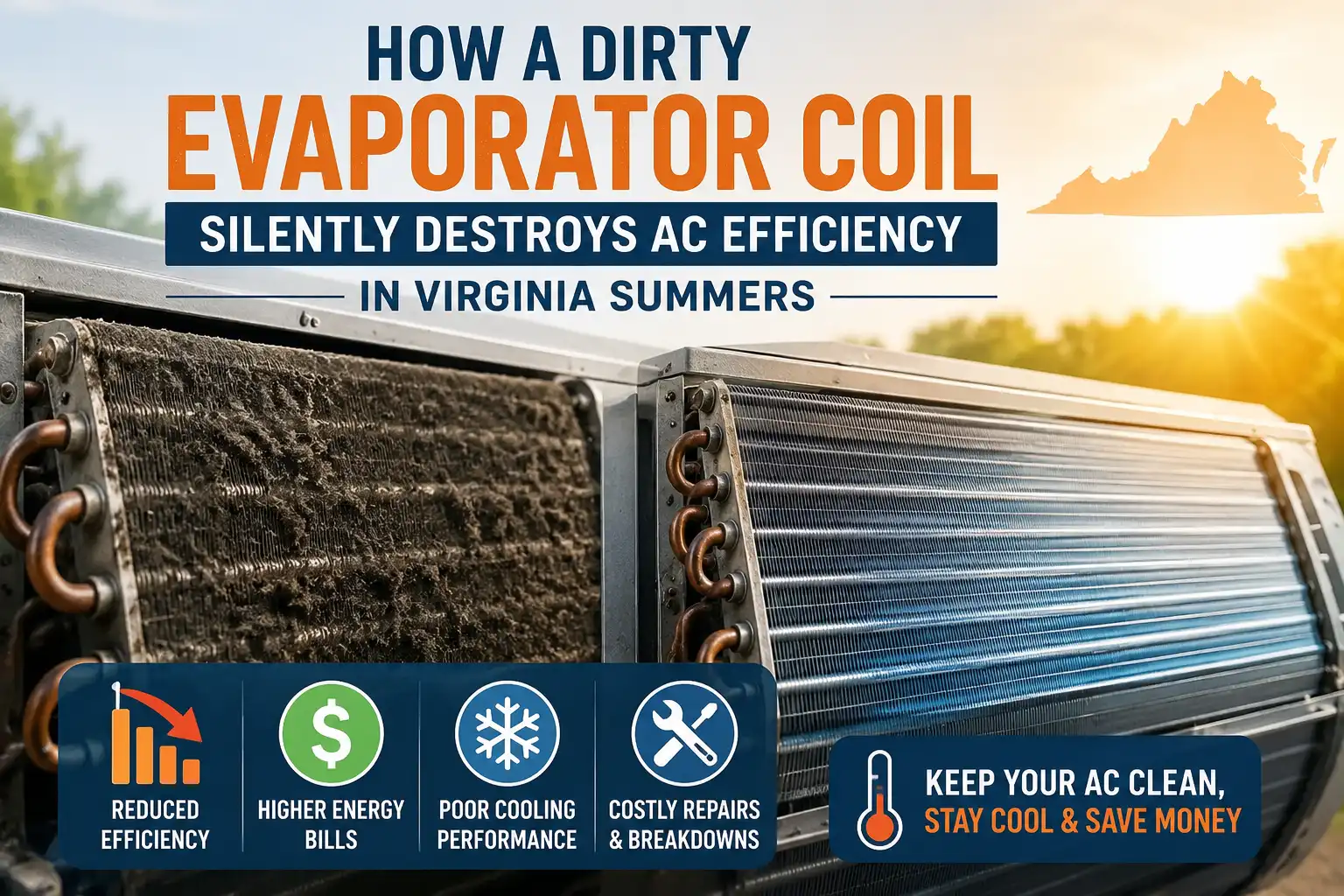
Your AC is running. The thermostat says it’s set to 72. But the house still feels warm and sticky. You turn the temperature down a few more degrees. The system keeps running, but nothing really changes. Sound familiar?
In many Richmond-area homes, the problem isn’t a broken compressor or a dead fan motor. It’s something much quieter, a dirty evaporator coil hiding inside your indoor unit. This single part can silently cut your AC’s cooling power by up to 30% while driving your electric bill higher every month. And in Virginia summers, where heat and humidity hit hard from June through September, it’s one of the most common, and most overlooked, causes of poor AC performance.
What Is an Evaporator Coil and What Does It Do?
The evaporator coil sits inside your indoor air handler or furnace. It’s a set of thin metal fins and tubes that hold cold refrigerant. When your AC turns on, warm air from your home blows across this coil. The refrigerant absorbs the heat, and the air comes out cool on the other side.
Think of it like a cold glass of water on a hot day. The glass gets wet because moisture in the air sticks to the cold surface. Your evaporator coil does the same thing, it pulls heat and moisture out of your indoor air at the same time. That’s why your AC both cools and dehumidifies.
The coil is shaped like the letter A or N, with hundreds of thin aluminum fins packed tightly together. The spacing between those fins is usually only about 1 to 2 millimeters. That tight spacing is great for heat transfer, but it also means the coil traps dust, pet hair, and other particles very easily.
How an Evaporator Coil Gets Dirty
In my professional experience, I’ve found that most homeowners don’t even know this coil exists until it causes a problem. The dirt builds up slowly, over months and years, and you never see it because the coil is sealed inside the air handler.
Here’s how it happens. Your air filter catches most of the dust and particles before they reach the coil. But no filter is perfect. Over time, tiny particles slip past the filter and stick to the wet surface of the coil. Remember, the coil is always damp when the AC is running because of condensation. That moisture acts like glue for dust.
If you skip changing your air filter, or use a cheap fiberglass filter that only catches about 20% of particles, the buildup happens much faster. Homes with pets, smokers, or a lot of foot traffic tend to clog the coil sooner. I’ve opened up systems that looked like someone had laid a felt blanket over the coil. That’s not unusual if the filter hasn’t been changed in a year or more.
Richmond’s climate makes this worse. Our summers bring high pollen counts from April through June, and Virginia’s average relative humidity sits around 70% to 80% in July and August. More moisture on the coil means more dust sticks. More pollen in the air means more material reaches the coil. It’s the perfect recipe for buildup. If your home stays humid even with the AC running, a dirty coil could be the reason.
Cooking grease, cleaning product residue, and even candle soot can settle on the coil over time. These sticky substances are harder to remove than plain dust and often need a professional-strength coil cleaner. If you’ve noticed your AC giving off a burning smell, built-up residue on the coil heating up during long run cycles could be the source.
What Happens When the Evaporator Coil Gets Dirty
I’ve seen this pattern many times in my work, a homeowner calls because their AC “isn’t working right,” and the real problem turns out to be a coil that’s been slowly choking for months. Here’s what actually happens inside your system when that coil gets coated in grime.
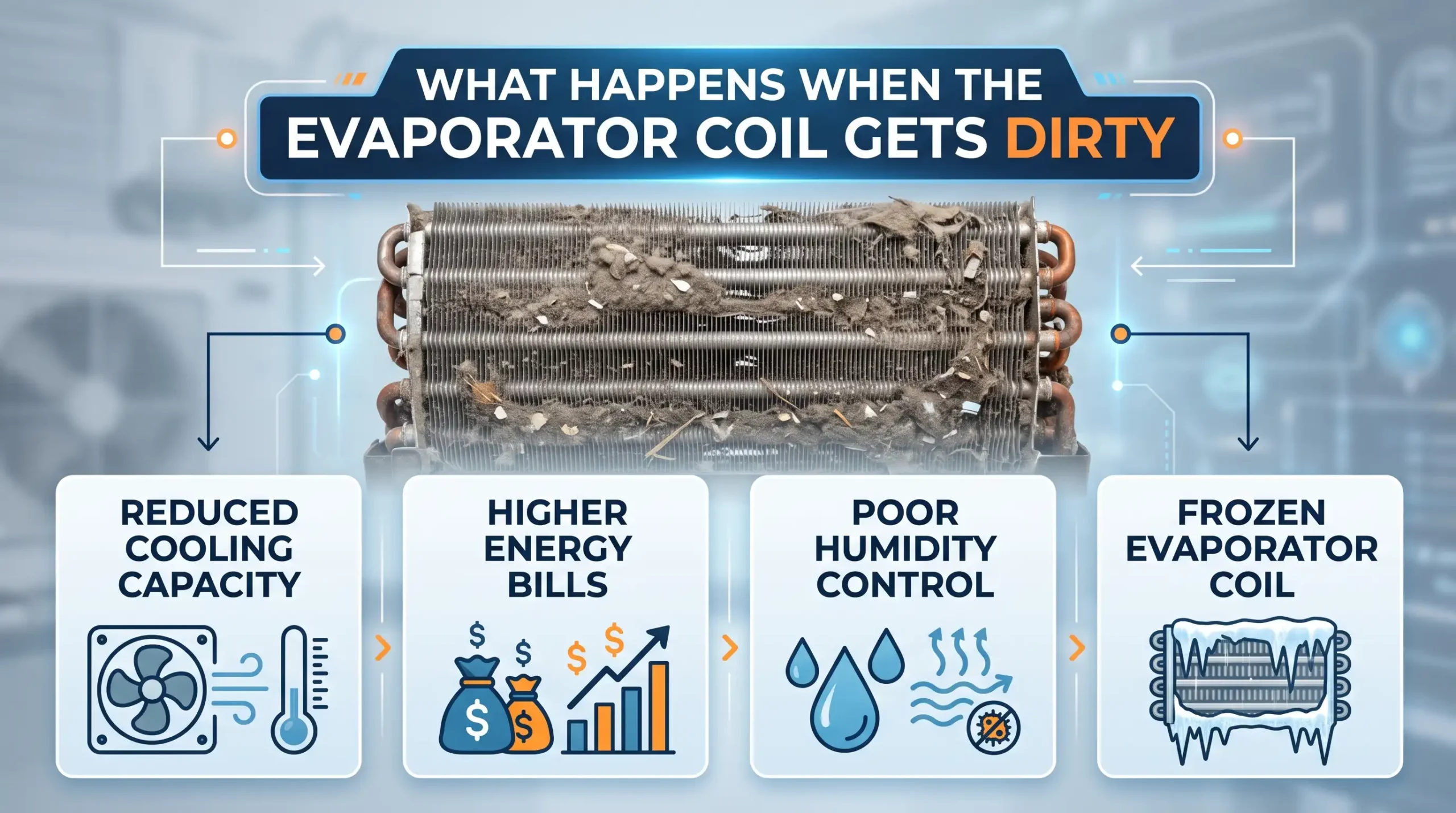
Reduced Cooling Capacity
The layer of dust and dirt on the coil acts like insulation. It blocks the cold refrigerant from touching the warm air flowing over it. Your AC is still using the same amount of electricity, but it’s pulling less heat out of your home.
Studies show that dirty coils can reduce cooling capacity by 20% to 40%. That means your 3-ton AC might only be performing like a 2-ton unit. You’ll notice the house takes longer to cool down, or it never quite reaches the set temperature.
Higher Energy Bills
When the coil can’t absorb heat properly, the AC runs longer to try to cool your home. Longer run times mean higher electricity use. The U.S. Department of Energy estimates that a dirty evaporator coil or condenser coil can increase energy use by up to 30% (DOE, Maintaining Your Air Conditioner).
In Virginia, where summer cooling can account for 40% to 60% of a home’s total electric bill, that extra 30% adds up fast. We’re talking $50 to $100 more per month in many cases, just because of a dirty coil.
Here in Richmond, Dominion Energy residential rates average around $0.12 to $0.14 per kilowatt-hour. A central AC unit that runs 8 hours a day already uses a lot of power. Add a 30% efficiency loss from a dirty coil, and you’re paying for cooling you’re not getting. Over a full Virginia summer, that can add up to $300 to $600 in wasted electricity.
Poor Humidity Control
This is the one that really matters in Richmond. A clean evaporator coil doesn’t just cool your air, it removes moisture. When warm, humid air passes over the cold coil, water condenses and drips into a drain pan.
A dirty coil can’t pull moisture out as well. The air still gets a little cooler, but the humidity stays high. That’s why your house might feel “clammy” even though the AC is running all day. Indoor humidity should stay between 30% and 50%. A dirty coil can push it above 60%, which creates the perfect environment for mold and dust mites.
Frozen Evaporator Coil
This one sounds backwards, but it’s real. When dust blocks airflow over the coil, the refrigerant inside gets too cold because it’s not absorbing enough heat. The condensation on the coil freezes into a solid block of ice.
A frozen coil stops all cooling. Your AC might blow warm air, or you might see ice forming on the refrigerant lines outside. If your AC unit is freezing up, a dirty evaporator coil is one of the first things to check. Running the system while it’s frozen can damage the compressor, and that’s cause expensive repair.
Why Virginia Summers Make This Problem Worse
Not all climates are equally hard on evaporator coils. Virginia’s summer weather is especially tough for two reasons: heat and humidity.
Richmond’s average high temperature in July is around 90°F, and we often see stretches of 95°F to 100°F in late July and August. That means your AC runs for long stretches, sometimes 12 to 16 hours a day. The more hours the AC runs, the more air passes over the coil, and the more dust and pollen builds up.
The humidity factor is just as big. According to the EPA, high indoor humidity promotes the growth of mold, bacteria, and dust mites (EPA, Mold and Moisture). A dirty coil that can’t dehumidify properly doesn’t just make your home uncomfortable, it can create health problems, especially for people with asthma or allergies.
Virginia also has a long pollen season. Oak, pine, and grass pollen fill the air from March through June. By the time summer heat kicks in, your coil may already have a layer of pollen buildup from spring. Add summer dust and humidity on top of that, and the coil can clog much faster than in drier parts of the country.
This is also why AC problems spike every June and July in the Richmond area. Systems that ran fine in April suddenly struggle when the real heat arrives. The coil was already getting dirty, but mild spring temperatures masked the problem. Once you need the AC to run 10 to 14 hours a day, that’s when a dirty coil shows its true impact. If you’ve noticed your system is struggling to cool your home as summer heats up, the coil should be one of the first things checked.
Signs Your Evaporator Coil Needs Cleaning
I’ve handled cases exactly like this hundreds of times. Homeowners often describe the symptoms without knowing the cause. Here’s what to look for.
- The house won’t cool to the set temperature: Your thermostat says 72, but the house sits at 76 or 77 and never gets lower. The AC runs non-stop but can’t keep up.
- Higher than usual electric bills: If your summer bills jumped by $40 to $100 compared to last year and you haven’t changed your habits, a dirty coil might be the cause.
- Weak airflow from your vents: A clogged coil restricts how much air can pass through the system. You might notice that some rooms feel warmer than others, or the air coming from the vents feels weaker than normal.
- Musty or stale smell from the vents: The damp dust on a dirty coil is a breeding ground for mold and mildew. If your AC smells musty, the coil is often the source.
- Ice on the refrigerant lines or indoor unit: As I mentioned earlier, restricted airflow over the coil can cause it to freeze. If you see frost or ice, turn the system off and call for service.
- The AC runs constantly without cycling off: A healthy AC should cycle on and off throughout the day. If yours runs constantly without stopping, it could be working overtime because the dirty coil is cutting its cooling power.
How a Professional Evaporator Coil Cleaning Works
Cleaning an evaporator coil is not a DIY job. The coil sits inside a sealed compartment of your air handler, and getting to it usually means removing access panels and sometimes cutting into ductwork. Here’s what happens during a professional cleaning.
First, the technician shuts off the system and opens the air handler. They inspect the coil to see how much buildup is there. In mild cases, a no-rinse coil cleaner spray is enough, the foam breaks down the dirt and drips into the drain pan.
In heavier cases, and honestly, most of the coils I see in Richmond homes that haven’t been cleaned in 3 to 5 years fall into this category, the technician uses a pump sprayer with a coil cleaning solution and rinses the coil with low-pressure water. They also clean the drain pan and check the condensate drain line to make sure it’s not clogged.
A proper coil cleaning takes about 45 minutes to an hour and typically costs between $100 and $250 depending on how dirty the coil is and how easy it is to access. That’s a small price compared to the $50 to $100 per month you could be wasting on extra energy. If you need your system checked, schedule an AC maintenance visit and we’ll include a coil inspection. For more on common coil issues, read our full guide on AC coil problems in Richmond.
How to Protect Your Evaporator Coil Between Cleanings
In my professional experience, the number one thing you can do is change your air filter on time. I can’t say this enough. A clean filter is the coil’s first line of defense.
Use a pleated filter with a MERV 8 to MERV 11 rating. That’s the sweet spot, high enough to catch most dust and pollen, but not so thick that it restricts airflow. Fiberglass filters (the cheap blue or green ones) only catch about 20% of particles. Pleated filters catch 85% or more.
Change the filter every 30 to 60 days during heavy use months (May through September in Virginia). If you have pets, lean toward the 30-day side. Check out our AC maintenance checklist for Richmond homeowners for a full seasonal breakdown.
Keep your return vents clear. Don’t put furniture, curtains, or rugs in front of them. Blocked return vents reduce airflow across the coil, which speeds up both dirt buildup and potential freezing.
Schedule a professional AC tune-up once a year, ideally in spring, before the summer heat hits. A tune-up includes a coil inspection, refrigerant check, and drain line cleaning. It catches problems before they get expensive.
The Real Cost of Ignoring a Dirty Evaporator Coil
I’ve seen this play out too many times. A homeowner ignores the signs for a year or two, then calls when the AC stops working entirely. By then, the damage has spread beyond the coil itself.
A coil cleaning can cost a few hundred dollars. A frozen coil that damages the compressor can cost significantly more. A full system replacement because years of neglect wore everything out early can cost several thousand dollars. The math is simple.
Then there’s the energy waste. Even a modest increase in your monthly electricity bill during the summer can add up to hundreds of dollars each year. Over several years, that wasted energy can easily cost more than what you would spend on several professional cleanings and a top-quality air filter subscription.
If you think your system might be underperforming, take a look at our guide on whether to repair or replace your AC to understand your options. Sometimes a good cleaning is all you need. Other times, an older system with a badly neglected coil might be better off replaced. Either way, our air conditioning repair team can help you make the right call.
Frequently Asked Questions
How often should I have my evaporator coil cleaned?
For most Richmond homes, once every 1 to 3 years is a good schedule. If you have pets, smoke indoors, or use a cheap air filter, lean toward yearly. A professional tune-up each spring will include a coil inspection so you know when it’s time.
Can I clean my evaporator coil myself?
It’s not recommended. The coil is inside a sealed section of the air handler, and accessing it usually requires tools and HVAC knowledge. Using the wrong cleaner or too much water pressure can damage the delicate aluminum fins. It’s best to leave this one to a trained technician.
Will a dirty evaporator coil cause my AC to freeze?
Yes. When dirt blocks airflow over the coil, the refrigerant gets too cold and the condensation on the coil turns to ice. A frozen coil stops all cooling and can damage the compressor if you keep running the system. Turn it off and call for repair.
How much does an evaporator coil cleaning cost?
Most professional cleanings cost between $100 and $250. The exact price depends on how dirty the coil is and how easy it is to access. It’s one of the most affordable maintenance tasks, and one that pays for itself in lower energy bills.
What is the best air filter to protect my evaporator coil?
A pleated filter rated MERV 8 to MERV 11 is the best choice for most homes. It catches dust, pollen, and pet dander without restricting airflow. Change it every 30 to 60 days during summer for the best results. If you need help choosing the right filter, Richmond Air can recommend one during your next service visit.