You wake up one morning, walk to the basement, and see a little puddle sitting right under your water heater tank. Your first thought is probably, “Okay, how bad is this?” Well, I’ve been there, and I can tell you from experience, a leaking water heater is not something you should shrug off and Google later. Depending on where the leak is coming from and how long it has been dripping, things can go from a small inconvenience to a real safety problem fast.
Yes, a Leaking Water Heater Is Dangerous. Here’s Why
The short answer to this question is yes, a leaking water heater can be dangerous. But the full picture is a bit more layered than that. The danger depends a lot on the location of the water heater leak, the type of heater you have (gas or electric), and how quickly you act after spotting it. Some leaks are small and fixable without calling anyone. Others need immediate attention because they can put your family and home at serious risk.
One thing most homeowners get wrong is thinking that a small drip is “just water.” But water is surprisingly destructive when it goes unchecked. It spreads silently under floors, soaks into walls, weakens your home’s structure, and invites mold growth into places you can’t even see. And if you have a gas water heater, a leak can sometimes be a sign of much bigger problems, like a gas leak or carbon monoxide buildup.
The Real Dangers of a Leaking Water Heater at Home
Let me walk you through the actual risks, one by one. I think once you see the full list, you’ll stop treating that puddle like a minor chore.
Water damage is the most obvious and immediate danger. Even a slow, steady drip can soak wood floors, rot wall studs, and damage drywall over time. According to the U.S. Environmental Protection Agency (EPA), household leaks can waste nearly 10,000 gallons of water per year, and the damage to your home’s structure can end up costing thousands in repairs.
Mold and mildew growth is the sneaky follow-up danger. Mold loves warm, damp spots, and a water heater leaking near walls or under floors creates exactly that environment. You might not see the mold, but you and your family will breathe it in. Long-term mold exposure can cause respiratory problems, allergies, and in some cases, serious illness, especially for children and the elderly.
Electrical hazards are just as serious. If you have an electric water heater and water gets near the electrical components, wiring, or nearby outlets, you’re looking at the risk of a short circuit, electric shock, or even a house fire. I’ve read stories of homeowners who delayed fixing a leak only to find the water had been slowly dripping onto the circuit board inside the heater. That’s not just expensive it’s dangerous.
For those with a gas water heater, there is an added layer of concern. A faulty temperature and pressure relief valve (T&P valve) or a cracked tank can sometimes mean that gas is also leaking or that carbon monoxide (CO) is building up. CO is a colorless, odorless gas that you simply cannot detect without a detector. The CDC reports that CO poisoning sends thousands of Americans to emergency rooms every year. If you smell rotten eggs near your gas water heater, that’s a red flag. Leave the house and call for help immediately.
Finally, there is the rare but real danger of a water heater tank explosion. If the T&P relief valve fails and pressure inside the tank keeps building up, the tank can rupture. This is not common, but it does happen, especially in older units that have not been serviced. The damage from a burst tank can be catastrophic.
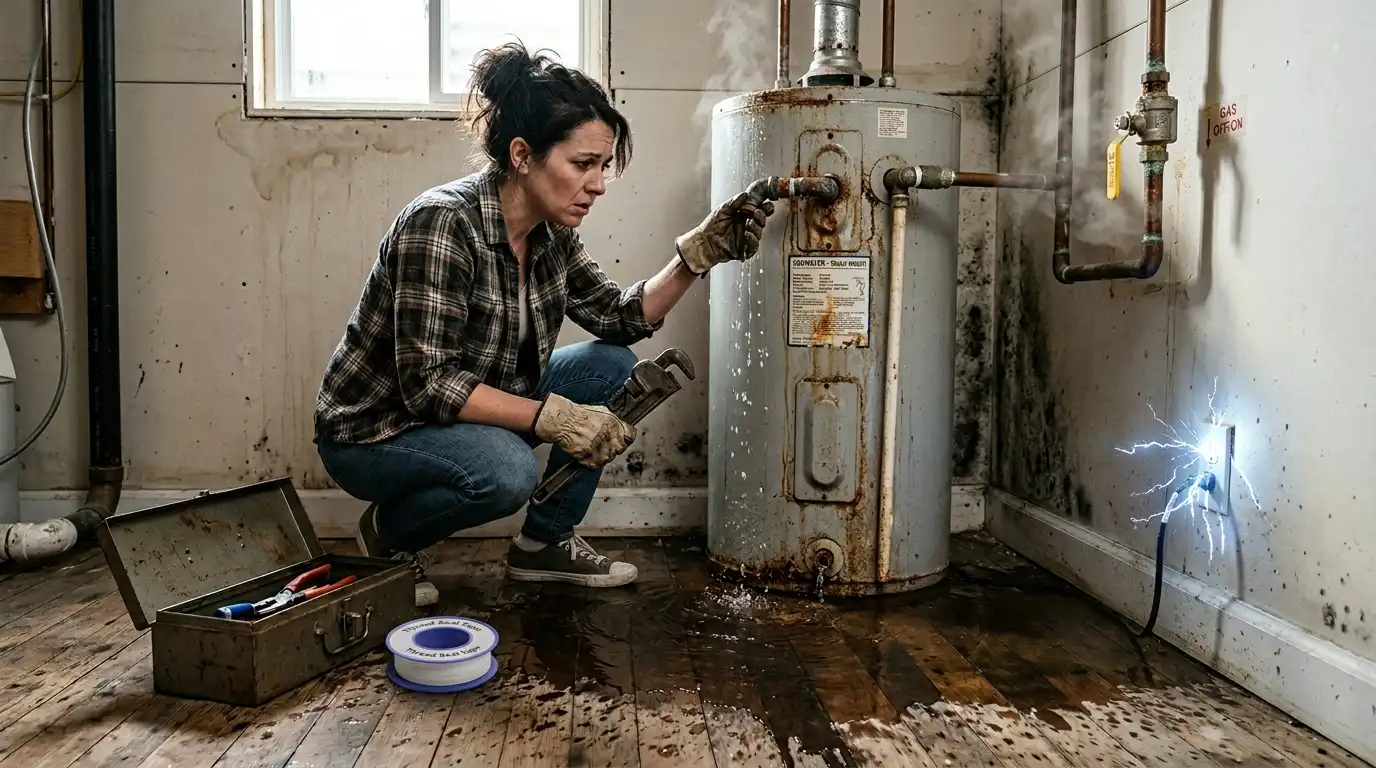
Common Causes of a Water Heater Leak
Why Is My Water Heater Leaking in the First Place?
Honestly, water heaters are tough appliances. They work every single day without much thanks. But they do wear down, and when they do, leaks usually show up as the first warning sign. Knowing why a water heater leaks can help you figure out how serious the problem is and what to do about it.
Corrosion and rust inside the tank are one of the most common culprits. Over time, especially in areas with hard water, minerals settle at the bottom of the tank. This sediment buildup causes the tank to overheat and the metal to weaken. Once corrosion sets in, the tank starts to form tiny holes. When that happens, no patch or repair will fix it permanently; you usually need a full water heater replacement.
A faulty drain valve is another common cause. The drain valve is used when you flush the tank during maintenance. If it’s not fully closed or it wears out, it will drip. This one is actually one of the easier fixes; sometimes just tightening the valve stops the leak. But if the valve itself is cracked, it needs to be replaced.
Loose inlet and outlet connections at the top of the tank can also be the source. These pipes carry cold water in and hot water out. Over years of use, the connections can loosen or corrode, letting water seep out around the fittings. A pipe wrench and a quick tighten can fix this sometimes, but corroded fittings usually need replacement.
And then there is high water pressure. Most home water heaters are designed to work within a specific pressure range. If your home’s water pressure is too high, it puts extra stress on the tank and fittings, and the result is often a leak. Installing a pressure-reducing valve is a smart, long-term fix for this issue.
Where Is the Leak Coming From? Top, Bottom, or Sides?
The location of the leak tells you a lot. I learned this the hard way after spending an hour looking at the wrong part of the tank.
If your water heater is leaking from the top, the most likely causes are loose or corroded inlet and outlet connections or a faulty T&P relief valve. Top leaks are often easier to fix because the problem is usually in the fittings, not the tank itself.
If your water heater is leaking from the bottom, it usually means sediment buildup has caused internal damage, or the drain valve is leaking. Bottom leaks can also mean that the tank itself is corroded and cracking, which typically means the unit is at the end of its life and needs full replacement.
Side leaks often point to a problem with the temperature and pressure relief valve. This valve is usually found on the side of the tank. If it’s dripping continuously, it could mean the valve is malfunctioning or it could mean the tank pressure is genuinely too high, which is actually the valve doing its job. Either way, this needs a professional look right away.
What to Do When You Notice a Leaking Water Heater
Immediate Steps to Stay Safe and Limit Damage
The moment you see a leak, your first move should be to stay calm but act fast. Here is exactly what I’d do (and what I’d tell a friend to do):
First, turn off the power supply. For an electric water heater, flip the breaker switch to the OFF position. For a gas water heater, find the gas shutoff valve near the unit and turn it off. This step is non-negotiable. Water and electricity near each other are a genuine safety hazard.
Second, shut off the cold water inlet valve. You’ll find this at the top of the tank on the pipe bringing cold water in. Turn the handle clockwise or rotate it 180 degrees to stop the water flow. This slows or stops the leak from getting worse while you figure out the next step.
Third, clean up the standing water and watch carefully to see where new water begins to pool again. This helps you find the exact source of the leak. Check the drain valve, T&P valve, and the inlet/outlet connections at the top of the tank. Look for signs of rust, corrosion, or cracks.
Finally, call a licensed plumber. Unless you are confident the leak is just a loose connection you can tighten yourself, get a professional involved. A plumber can tell you whether the unit needs a minor repair or a full water heater replacement. Trying to patch a corroded tank yourself is almost always a waste of time and money.
According to the U.S. EPA’s WaterSense program, fixing easily corrected household water leaks can save homeowners around 10% on their water bills and prevent thousands of gallons of wasted water each year.
Can You Still Use Water If Your Water Heater Is Leaking?
Yes, but with conditions. If you shut off the cold water inlet valve to the heater, your main water supply is not affected. You can still run your washing machine, flush toilets, and use your sink or shower. The catch is that you’ll only have cold water since the heater is no longer heating anything. For most families, this is manageable for a short time.
However, if the leak does not stop even after you shut off the inlet valve, or if you suspect the leak involves electrical components or a gas line, stop using water until a professional has cleared it. Your safety is worth more than the inconvenience of waiting a day for hot water.
Signs Your Water Heater Is Leaking (Even If You Can’t See It)
Early Warning Signs You Should Never Ignore
Not all leaks show up as a big puddle. Some are sneaky. Here are the signs I always tell people to watch for, especially if their unit is more than 8–10 years old.
Rust-colored or discolored water coming from your hot water taps is a major red flag. It usually means the inside of your tank is corroding, and a leak may not be far behind. Rusty water can also come from corroded pipes, so check both, but always start with the heater.
Strange noises like popping, banging, hissing, or rumbling from the tank are a sign that sediment buildup has gotten bad. Water trapped under the sediment boils and causes those sounds. Left alone, this speeds up damage to the tank and leads to leaks.
A musty smell or rotten egg odor near the heater is serious. Musty smells often point to mold growing from a slow, hidden leak. A rotten egg smell from a gas water heater<span style=”font-weight: 400;”> could mean a gas leak, and that needs immediate action. Don’t ignore either smell.
Unexpectedly high water or energy bills can also be a hidden sign of a leak. The heater may be working overtime to compensate for heat loss or leaking water, driving up both your utility costs and water usage without any visible sign of a problem.
According to the U.S. Centers for Disease Control and Prevention (CDC), carbon monoxide is responsible for more than 400 deaths and approximately 100,000 emergency room visits in the United States each year, many of which are linked to faulty gas appliances, including water heaters.
How to Tell If It’s a Leak or Just Condensation
This is a question I get asked a lot, and it’s a fair one. During cold months, your water heater tank can sweat moisture from the warm tank surface. When cold air creates condensation that looks exactly like a slow drip or a puddle.
Here’s a simple test: wipe the outside of the tank completely dry. Wait 20–30 minutes. Then check again. If you see even moisture spread uniformly across the surface, it’s likely just condensation. If you see water dripping from one specific point, a valve, a fitting, or the bottom, that’s a real leak, and it needs attention.
The same logic applies near washing machines, HVAC systems, and air conditioners. Before assuming your heater is the source, rule out the neighbors. Check that no other appliance nearby is the actual culprit.
How to Prevent Water Heater Leaks Before They Start
Simple Maintenance Habits That Actually Work
Prevention is genuinely the best strategy here. I know it sounds obvious, but most water heater leaks I’ve seen could have been caught earlier or prevented entirely with basic, regular maintenance. The good news is, it doesn’t require a lot of technical skill.
Flush your tank once a year. Sediment builds up at the bottom of every tank over time. An annual flush removes that mineral buildup and keeps the heater running efficiently. If you’ve never flushed yours and your unit is older than 5 years, start there. It takes about 30 minutes and can extend the life of your unit significantly.
Check and replace the anode rod every 3–5 years. The anode rod is a sacrificial metal rod inside the tank. Its job is to attract corrosive elements in the water so that the tank walls don’t corrode. When the rod wears out, the tank becomes vulnerable. Replacing it on schedule is one of the cheapest and most effective ways to extend your heater’s life.
Test the T&P relief valve regularly. Lift the valve handle slightly and let it snap back. You should hear a brief rush of water or steam. If nothing happens, the valve may be stuck or faulty, and that’s a safety risk, since this valve is what prevents the tank from building dangerous pressure.
Keep the temperature set between 120–130°F. This range is recommended because it’s hot enough to kill harmful bacteria in the water but not so hot that it causes excessive pressure buildup or scalding injuries. Going higher puts extra stress on the tank and its components.
When Should You Replace Your Water Heater?
Most tank-style water heaters last about 8–12 years with proper maintenance. If your unit is over a decade old and starting to show signs of leaking, especially from the tank itself, the honest answer is that repair may not be worth the investment. Patchwork fixes on a corroded or cracked tank rarely hold for long.
If the leak is coming from internal corrosion, a completely broken T&P valve, or major cracks, it’s time to replace. A plumber can tell you definitively whether repair or replacement makes more financial sense based on the unit’s age, the severity of the damage, and the cost of parts.
Newer models, including tankless water heaters, are far more energy-efficient and less prone to the same corrosion and sediment issues that plague older tank units. Making the switch can actually save you money on energy bills over time, even after factoring in the upfront cost.
Conclusion
A leaking water heater is not something you can afford to leave alone. It might start as a tiny drip, but the risks that come with it, such as water damage, mold growth, electrical hazards, gas leaks, and even the rare chance of a tank explosion, are very real. The good news is that if you act quickly, most situations are completely manageable.
Turn off the power and water supply the moment you spot a leak. Check the source. Call a professional if you’re unsure. And do not skip your annual maintenance, it is the single best way to keep your heater running safely for years. From personal experience, catching a problem early always saves a lot of stress, money, and risk later on.
If you’ve dealt with a leaking water heater yourself, I’d love to hear what you found and how you handled it. Drop your thoughts or questions in the comments. Your experience might help someone else out.
Frequently Asked Questions (FAQs)
1. Is it safe to leave a leaking water heater on overnight?
No, it is not safe to leave a leaking water heater running overnight. Even a slow leak can worsen quickly, causing water damage, mold, and in the case of electric units, a risk of electrical shock or fire. The safest step is to turn off the power and the cold water inlet as soon as you spot the leak, then call a plumber the next morning.
2. Can a leaking water heater explode?
Yes, though it is rare. A water heater explosion can happen when the T&P relief valve fails, and pressure inside the tank builds up without release. If you hear a whistling or rattling sound from your heater, or if the T&P valve is not functioning correctly, call a professional immediately. Regular testing of the valve greatly reduces this risk.
3. How long can a water heater last after it starts leaking?
It depends on the source and severity of the leak. If it’s a loose connection or a worn drain valve, the heater can last for years after a simple repair. But if the leak is from internal corrosion or a crack in the tank, the unit may fail within weeks or months. An older unit showing tank leaks is usually better off replaced than repaired.
4. What does it mean if my water heater smells like rotten eggs?
A rotten egg smell near a gas water heater is a serious warning sign. It usually indicates a gas leak, caused by mercaptan, the chemical added to natural gas so people can detect it. If you smell this, do not try to fix it yourself. Leave the house, avoid turning on any switches, and call your gas company or emergency services immediately.
5. How can I tell the difference between a water heater leak and condensation?
Dry the outside of your water heater tank completely and wait about 20–30 minutes. If moisture reappears evenly across the surface of the tank, it’s likely condensation, especially in cold weather. But if water is dripping from one specific point, like a valve, fitting, or the bottom of the tank, that’s a real leak that needs attention right away.