

Last summer in Richmond, my electric bill hit $320 for one month. I couldn’t believe it. My AC was running nonstop, and I was throwing money away. That’s when I learned about SEER ratings, and honestly, I wish someone had told me about this years ago.
If you’re a Richmond homeowner, understanding SEER ratings can save you hundreds of dollars every summer. It’s not complicated, I promise. Let me walk you through everything you need to know.
What Is a SEER Rating?
SEER stands for Seasonal Energy Efficiency Ratio. Think of it like the miles per gallon rating for your car, but for your air conditioner. It tells you how well your AC uses energy to cool your home.
The number shows how much cooling you get for every dollar of electricity you spend. A higher SEER number means better efficiency. Your AC does more cooling while using less power.
Most Richmond homes have systems rated between 13 and 18 SEER. Older units might be as low as 8 or 10. New systems can go up to 25 or higher.
How SEER Is Calculated
Here’s the simple math. SEER compares total cooling output (measured in BTUs) to total energy used (measured in watt-hours) over a full cooling season.
The formula looks like this: SEER = Cooling Output ÷ Energy Input
According to the U.S. Department of Energy, this calculation happens under different temperature conditions. It’s not just one test. The system runs through hot days, mild days, and everything in between.
Testing includes indoor temps at 80°F and outdoor temps ranging from 65°F up to 104°F. This gives you a realistic picture of how the system performs all summer long, not just on the hottest day.
The Simple Math Behind Your AC’s Efficiency
Let me make this super easy. Say you have a 3-ton AC with a 14 SEER rating. Over one season, it might produce 42,000 BTUs of cooling per hour.
To get that cooling, it uses 3,000 watts of power per hour. Do the math: 42,000 ÷ 3,000 = 14 SEER.
Now compare that to a 16 SEER unit. Same cooling output, but it only uses about 2,625 watts. You get the same comfort but pay less on your electric bill.
The difference might seem small on paper. But when your AC runs 8-12 hours a day in Richmond’s summer heat, those savings add up fast.
Why Richmond Homeowners Should Care About SEER Ratings
Richmond isn’t Phoenix, but our summers are no joke. July and August bring heat and humidity that makes your AC work overtime. I’ve lived here for 12 years, and every summer feels hotter than the last.
Your AC is probably your biggest energy user from May through September. The SEER rating controls how much that costs you. A good rating can cut your summer bills by 30% or more.
Richmond’s Hot Summers Mean Higher Cooling Costs
Richmond averages about 35-40 days above 90°F each summer. Some years we hit triple digits. Add in our humidity, and it feels even hotter.
According to recent National Weather Service data, Richmond sees around 1,200 cooling degree days per year. That’s a measure of how much cooling homes need.
When I talk to neighbors, most run their AC from mid-May through late September. That’s roughly 140 days. If your system runs 10 hours a day, you’re looking at 1,400 hours of operation.
With an older 10 SEER unit, that adds up to serious money. A newer 16 SEER system cuts that cost by nearly 40%. For many Richmond families, that’s $400-600 in savings every summer.
How SEER Directly Impacts Your Monthly Electric Bill
Let me give you real numbers. Say your current electric rate is $0.12 per kilowatt-hour. That’s pretty typical for Richmond.
A 3-ton, 10 SEER system uses about 3.5 kilowatts per hour. Run it 10 hours a day for a month, and you’re using 1,050 kilowatt-hours. At $0.12 each, that’s $126 just for AC.
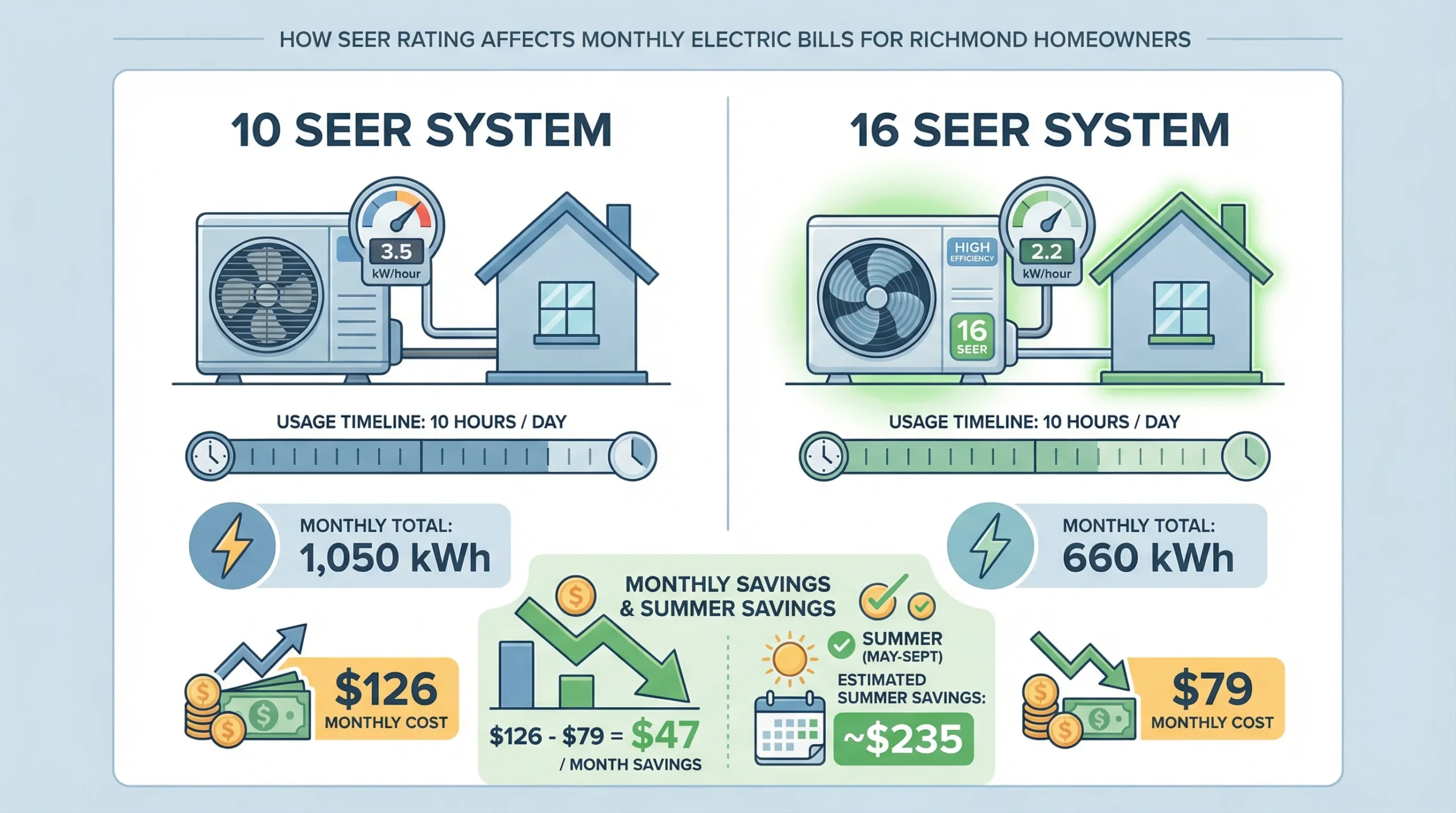
Now switch to a 16 SEER unit. Same cooling, but it only uses 2.2 kilowatt-hours. That drops your monthly cost to about $79. You save $47 every single month.
Over a full summer (May through September), that’s around $235 in your pocket instead of going to the power company. And if electricity rates go up, your savings grow even more.
Understanding SEER vs SEER2: The 2023 Changes
In January 2023, the rules changed. The government introduced a new standard called SEER2. If you’re shopping for a new AC, you’ll see both ratings.
Don’t panic. The idea is the same. SEER2 just measures things a bit differently to give you more accurate numbers.
What Changed in January 2023
The old SEER test didn’t account for real-world stuff like ductwork resistance. SEER2 adds external static pressure to the testing. This matches how your system actually works in your home.
Based on information from SEER2.com, the new test gives you numbers closer to what you’ll really experience. It’s more honest.
The minimum standards also went up. In the South (that includes Virginia), new systems must be at least 14.3 SEER2. Northern states require 13.4 SEER2.
If you bought a system before 2023, it has the old SEER rating. That’s fine. Your system still works the same. The rating just uses the old testing method.
How to Convert Old SEER Ratings to New SEER2
Here’s a quick trick. To estimate SEER2 from an old SEER rating, divide the SEER number by 1.05.
So if you have a 16 SEER system, it’s roughly 15.2 SEER2. A 14 SEER unit becomes about 13.3 SEER2.
This isn’t exact, but it gets you close. When comparing old and new systems, this helps you see if you’re actually upgrading or just getting the same efficiency under a different name.
Honestly, most Richmond homeowners don’t need to worry about this conversion unless you’re comparing quotes from different contractors. Just know that SEER2 is the new standard, and the numbers will be slightly lower than old SEER ratings for the same efficiency.
What Is a Good SEER Rating for Richmond Homes?
I get this question all the time from friends and neighbors. They want to know what number to aim for when buying a new system.
The short answer: 15-17 SEER (or 14.3-16.2 SEER2) is the sweet spot for most Richmond homes. You get solid efficiency without breaking the bank on the upfront cost.
Minimum SEER Requirements in Virginia
Virginia follows the southern state requirements. That means new AC systems installed in Richmond must be at least 14 SEER (or 13.4 SEER2) for split systems and 14 SEER for packaged units.
These are legal minimums. You can buy higher, but you can’t go lower for new installations. Some contractors might try to sell you 13 SEER units if they’re old stock, but technically, those shouldn’t be installed after January 2023.
The truth is, minimum ratings aren’t great investments. They save you money upfront but cost more to run. In Richmond’s climate, I’d skip the minimum and go at least one or two steps higher.
The Sweet Spot: Balancing Cost and Efficiency
Here’s what I learned when I replaced my system last year. A 16 SEER unit cost about $1,200 more than a 14 SEER model. That felt like a lot.
But my HVAC guy ran the numbers. The 16 SEER system would save me roughly $250 per summer on electric bills. So the extra cost pays for itself in less than five years.
For Richmond homeowners, 15-17 SEER hits the best balance. You pay a reasonable price upfront and see real savings every month. Going above 18 SEER starts to cost a lot more, and the payback period gets longer.
If you’re planning to stay in your home for at least 5-7 years, a 16 SEER system is usually worth it. If you’re selling soon, stick with 14-15 SEER. It improves your home’s value without over-investing.
How SEER Ratings Affect Your Energy Bills
Let’s talk real money. This is where SEER ratings stop being technical and start mattering to your wallet.
Every SEER point you go up saves you about 6-8% on cooling costs. That might not sound like much, but it adds up when you’re running your AC for months.
Real Savings: Comparing 14 SEER vs 16 SEER in Richmond
I did my own test last year. My old 12 SEER unit was dying, so I had to replace it. I got quotes for both 14 SEER and 16 SEER systems.
The 14 SEER unit would cost about $4,500 installed. The 16 SEER was $5,700. That extra $1,200 made me think twice.
But then I looked at my summer electric bills from the past three years. I was spending about $900 per summer on AC alone. My contractor estimated the 16 SEER would drop that to around $650.
That’s $250 saved every summer. In five years, I’d save $1,250. The system paid for the upgrade, and after that, I’m just pocketing the savings.
For a Richmond home using AC 140 days a year, the math almost always favors going to 16 SEER if you can afford the upfront cost.
Payback Period for Higher SEER Systems
Here’s how to think about payback. Take the extra cost of the higher SEER unit and divide it by your annual savings.
Example: 16 SEER costs $1,200 more than 14 SEER. It saves you $250 per year. Payback time = $1,200 ÷ $250 = 4.8 years.
Most AC systems last 12-15 years if maintained well. That means you get 7-10 years of pure savings after the system pays for itself.
Going from 14 SEER to 18 SEER might cost an extra $3,000-4,000. The savings are bigger, but the payback stretches to 8-12 years. For most families, that’s cutting it close.
In my experience, 16 SEER is the best bang for your buck in Richmond. Higher ratings make sense if you’re really into green living or plan to stay in your home forever. Otherwise, stick with 15-17 SEER.
SEER Rating and Richmond’s Climate
Richmond has a humid subtropical climate. That means hot, sticky summers and mild winters. Your AC works harder here than it would in, say, Colorado.
High humidity makes your AC do double duty. It’s not just cooling the air, it’s pulling moisture out. That takes extra energy, which is why SEER ratings matter so much in our area.
Why Higher SEER Makes Sense in Virginia’s Humid Summers
I noticed something interesting after upgrading to a higher SEER system. My house felt more comfortable even at the same temperature setting.
Higher SEER units often have better dehumidification. They run longer, gentler cycles instead of blasting cold air in short bursts. This pulls more moisture from the air.

In Richmond’s 70-80% humidity summers, that matters. Dry air feels cooler than humid air at the same temperature. So you can set your thermostat a degree or two higher and still feel comfortable.
That extra degree or two saves you another 3-5% on cooling costs. It all adds up.
Cooling Degree Days and Your AC System
Richmond averages around 1,200 cooling degree days per year. This number tells you how much cooling demand your location has.
Compare that to Miami at 4,000 or Minneapolis at 600. We’re right in the middle. Not the hottest climate, but definitely hot enough to justify investing in efficiency.
When cooling degree days are above 1,000, higher SEER ratings pay off faster. Below that threshold, the savings take longer to materialize. Richmond is in the zone where upgrading makes financial sense.
Common Mistakes Richmond Homeowners Make About SEER
I’ve seen neighbors make some expensive mistakes when shopping for AC systems. Let me help you avoid them.
Why the Highest SEER Isn’t Always the Best Choice
My neighbor Jim bought a 22 SEER system last year. He paid almost $9,000 for it. I asked him why he went so high.
He said he wanted the most efficient system possible. The thing is, his house is only 1,400 square feet, and he’s planning to downsize in a few years.
That 22 SEER unit will take 12-15 years to pay for itself through energy savings. Jim will probably never see the return on his investment. A 16 SEER system would’ve saved him $3,000 and still been plenty efficient.
Ultra-high SEER systems (20+) make sense for big homes, people who plan to stay forever, or folks who just really care about the environment. For average Richmond homeowners, they’re overkill.
Installation Quality Matters More Than You Think
Here’s something that shocked me. A 16 SEER system installed poorly can perform worse than a 14 SEER system installed correctly.
Things like duct leaks, wrong refrigerant charge, or improper airflow can kill your efficiency. I’ve seen systems lose 20-30% of their rated efficiency due to bad installation.
When shopping for a new AC in Richmond, don’t just focus on the SEER number. Ask about the contractor’s training, certifications, and installation process. A good installer is worth their weight in gold.
Make sure they do a load calculation to size your system correctly. Too big or too small, and your efficiency drops no matter what the SEER rating says.
How to Find Your Current AC’s SEER Rating
Curious what you have now? It’s easy to find out.
Checking the Yellow Energy Guide Sticker
Walk outside to your AC unit. Look for a yellow and black sticker, usually on the side. This is the Energy Guide label.
It’ll show you the SEER rating in big numbers. Mine said “14 SEER” right on it. If the sticker is faded or missing, don’t worry.
Check inside where your furnace or air handler is. Sometimes there’s a duplicate sticker there. If you can’t find either, move to plan B.
What to Do If Your System Has No Rating
Older systems might not have visible ratings. If your AC was installed before 1992, it probably doesn’t have a SEER rating at all.
You can look up the model number online. It’s usually stamped on a metal plate on the outdoor unit. Google the model number plus “SEER rating” and you’ll often find spec sheets.
Or just call a local HVAC company. They can tell you the rating based on the model and age. Most will do this for free, hoping you’ll use them for your next replacement.
As a rule of thumb, systems from the 1990s are usually 8-10 SEER. 2000s are 10-12 SEER. After 2006, minimums went to 13 SEER.
SEER Ratings and Rebates Available in Richmond
Here’s some good news. You can get money back for buying an efficient system.
Federal Tax Credits for High-Efficiency Systems
The federal government offers tax credits for Energy Star certified systems. For 2026, you can get up to $600 back if you install a qualifying system.
According to Energy Star, your system needs to be at least 16 SEER (or 15.2 SEER2) to qualify. The split system must also meet efficiency standards.
This isn’t a rebate you get at the store. It’s a tax credit you claim when you file your federal taxes. Keep your receipts and the manufacturer’s certification statement.
The credit runs through December 31, 2032, so you’ve got time. But don’t wait too long. These programs can change or run out of funding.
Virginia and Local Utility Rebate Programs
Check with Dominion Energy if you’re in their service area. They sometimes offer rebates for high-efficiency HVAC upgrades. The programs change year to year, so call them before you buy.
Some local governments in the Richmond area also have energy efficiency programs. The City of Richmond occasionally runs rebate programs for homeowners making green upgrades.
Your HVAC contractor should know about available rebates. Good ones will help you apply and make sure your system qualifies. That’s another reason to choose a reputable installer.
Conclusion
SEER ratings might seem technical, but they’re really just about saving money and staying comfortable. For Richmond homeowners, they matter because our hot, humid summers make AC a necessity, not a luxury.
A good SEER rating means lower electric bills, better comfort, and a system that fits our climate. For most people, 15-17 SEER is the sweet spot. It’s efficient enough to save real money without costing a fortune upfront.
Don’t just chase the highest number. Think about your budget, how long you’ll live in your home, and what makes sense for you. And remember, installation quality matters just as much as the rating on the box.
If you’re in the market for a new AC, take your time. Get multiple quotes, ask about SEER ratings, and check what rebates you qualify for. A little research now can save you thousands over the life of your system.
Ready to upgrade your AC system and start saving on energy bills? Our Richmond HVAC experts can help you choose the perfect SEER rating for your home and budget. We’ll calculate your potential savings, explain all available rebates, and ensure professional installation that maximizes your system’s efficiency. Contact us today for a free consultation and quote – let’s find the right cooling solution for your Richmond home.
FAQs About SEER Ratings
What is the minimum SEER rating required in Richmond, VA?
Richmond follows Virginia state requirements, which align with southern region standards. New AC systems must be at least 14 SEER (13.4 SEER2) for split systems. These minimums took effect on January 1, 2023. Packaged units need to meet 14 SEER as well. You can install higher-rated systems, but going below these minimums isn’t allowed for new installations. Existing systems with lower ratings don’t need to be replaced, they’re grandfathered in.
Is 16 SEER worth the extra cost in Virginia?
For most Richmond homeowners, yes. A 16 SEER system typically costs $1,000-1,500 more than a 14 SEER unit. But it saves about $200-300 per summer on electricity. That means payback in 5-6 years. Since AC systems last 12-15 years, you get 7-10 years of savings after breaking even. If you plan to stay in your home and can afford the upfront cost, 16 SEER is usually a smart choice.
How much can I save by upgrading from 10 SEER to 16 SEER?
The savings are significant. A 16 SEER system is about 37% more efficient than a 10 SEER unit. For a typical Richmond home spending $900 per summer on AC with a 10 SEER system, upgrading to 16 SEER could drop that to around $570. That’s roughly $330 saved each cooling season, or $1,650 over five years. The exact savings depend on your home size, how much you run your AC, and current electricity rates.
Do higher SEER ratings work better in humid climates?
Yes. Higher SEER systems often include features like variable-speed compressors and longer run cycles that remove more moisture from the air. Richmond’s humid summers make this valuable. Better dehumidification means your home feels cooler at higher temperature settings, saving additional energy. Plus, removing excess moisture improves indoor air quality and prevents mold growth. So in humid climates like ours, higher SEER units deliver comfort benefits beyond just energy savings.
Can I get tax credits for installing a high SEER system in 2026?
Yes. The federal government offers a tax credit of up to $600 for Energy Star certified systems. Your system must be at least 16 SEER (or 15.2 SEER2) to qualify. The credit applies to systems purchased and installed between January 1, 2023, and December 31, 2032. You claim it when filing your federal income taxes. Also check for Virginia state rebates and local utility programs, which can add to your savings. Keep all receipts and certification documents.
