You call for AC help, and the first thing you think is, “How much will this cost me?” That worry is normal. I’ve stood in hundreds of Richmond homes and watched that same look cross people’s faces. So let me pull back the curtain and show you what really shapes the price.
What “AC Service” Really Means in Richmond
“AC service” is a big phrase. People use it to mean many different things. Some mean a quick tune-up. Some mean a broken unit that stopped cooling. Others mean a full system swap. Each one costs a very different amount, and that is the first thing to understand before you judge any price.
A service call in Richmond usually starts with a diagnostic visit. A tech comes out, checks your system, and finds the problem. On most jobs I run, this first visit takes about 60 to 90 minutes, and it is where the real answers come from. You are not just paying for a part. You are paying for someone to correctly find what is wrong.
Think of it like a doctor visit for your cooling system. The compressor, the evaporator coil, the condenser, the refrigerant, and the thermostat all work together. When one part slips, the whole system struggles. A good tech checks all of them, not just the loud one. That full check is what separates a real fix from a guess.
Here is the honest truth. Two homes on the same street can get two very different bills for what sounds like “the same problem.” Why? Because the cause underneath is different. One home needs a $20 capacitor. The other needs a coil. Same symptom, very different repair.
The Real Cost Drivers: What You’re Actually Paying For
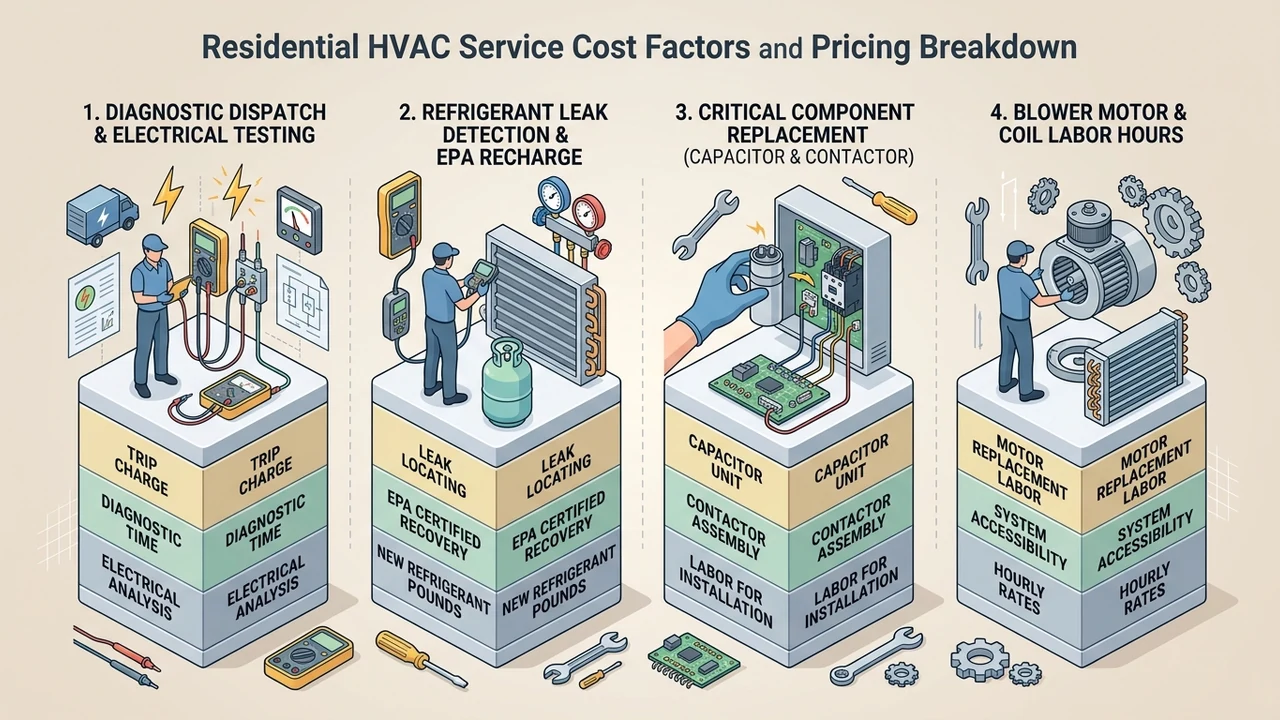
Let me break down where your money goes. When I write up a job, the price is built from a few clear pieces. Parts are only one slice. Labor, skill, and travel matter just as much. On a typical repair, parts make up only about 30% to 40% of the total, and the rest is the hands-doing the work.
Here are the main things that push the price up or down:
- The part itself — a small capacitor is cheap; a compressor is not.
- Labor time — some fixes take 30 minutes, some take a full day.
- Diagnostic work — finding a hidden leak takes real skill and tools.
- Refrigerant — the type your system uses changes the cost a lot.
- Access — a unit stuffed in a tight attic costs more to reach.
- Parts availability — a rare part for an old system means waiting and paying more.
The table below shows rough ranges I see on real Richmond jobs. These are my own numbers from the field, not a national chart. Your home may land higher or lower, but this gives you a fair map before anyone knocks on your door.
| Common AC Service | Typical Richmond Range (my field pricing) | What Drives It |
|---|---|---|
| Diagnostic / service call | $75 – $150 | Time, travel, skill |
| Capacitor replacement | $150 – $350 | Small part, quick labor |
| Refrigerant leak repair | $400 – $1,500 | Finding + fixing the leak |
| Blower motor replacement | $450 – $900 | Part cost + labor time |
| Evaporator coil replacement | $1,000 – $2,800 | Big part, long labor |
| Compressor replacement | $1,500 – $3,500 | Expensive part, heavy work |
Notice the wide gaps. A capacitor and a compressor are miles apart in price. That is why a phone quote is almost always a guess. Any honest shop will tell you the same. Roughly 8 out of 10 calls I take start with the customer surprised that “it depends” is the real answer. It truly does depend, and now you can see why.
Access matters more than people expect. If your air handler sits in a cramped attic in July, the work is slower and hotter. A job that takes 1 hour in an open garage can take 2 hours squeezed under a roof. You are paying for that extra sweat and time, not for anything shady. If your coil is the trouble spot, our guide on how a dirty evaporator coil silently hurts your AC walks through what that repair involves.
Why Richmond’s Weather Changes the Price
In my professional experience, I’ve found that Richmond’s summer is one of the biggest hidden cost drivers of all. Our heat is not the dry kind. It is thick, sticky, and long. That heavy air makes your AC work harder for more months than in cooler states.
Long run times mean more wear. A system that runs hard for 5 months ages faster than one that runs for two. I see parts here wear out sooner than the maker’s charts predict. On many local units, I find capacitors and fan motors giving up 20% to 30% faster than you’d expect, simply because our season is so long and damp.
Humidity is the quiet troublemaker. Your AC does two jobs. It cools the air, and it pulls water out of it. When Richmond hits those muggy 90-degree stretches, your system fights moisture all day long. That extra load stresses the drain line, the coil, and the blower. If your house still feels damp with the AC on, our piece on why Richmond humidity makes AC service matter explains what’s going on.
Pollen is another local piece. Spring in central Virginia coats everything in yellow. That film builds on your outdoor condenser coil and blocks airflow. A dirty coil can push energy use up and cooling power down. Most homes I visit lose real efficiency this way without the owner ever knowing.
So Richmond weather hits your bill twice. First, parts wear out sooner. Second, dirt and damp make your system work harder for the same cool air. Both mean more service over the life of the unit. It’s not bad luck. It’s just our climate.
Refrigerant: The Sneaky Cost Nobody Warns You About
Refrigerant is the stuff inside your AC that actually carries the heat away. Most older Richmond systems use a gas called R-410A. Here is the part few people know: that refrigerant is being phased out, and that change is quietly pushing service prices up.
This is not a sales trick. It’s federal law. The U.S. EPA, under a rule called the AIM Act, is cutting these HFC refrigerant gases by 80% to 85% by 2047, according to the EPA’s own program on HFCs and the AIM Act. Less supply of the old gas means a higher price when your system needs a top-up.
The EPA has also started to limit which refrigerants can go into brand-new home air conditioners, part of its Technology Transitions program for cooling equipment. New systems now use lower-impact gases like R-454B or R-32. That’s good for the planet. But it also means old and new systems don’t share the same refrigerant, and that split adds cost.
Here’s what this means for your wallet in plain terms:
- Older systems that still use R-410A face rising refrigerant prices as supply shrinks.
- A refrigerant leak is no longer a cheap top-off; the gas itself keeps getting pricier.
- If a tech just “adds gas” without finding the leak, you’ll pay again next year.
I’ve handled cases exactly like this many times. A homeowner pays to “recharge” the system each summer. It feels cheaper. But over 3 years, those top-offs often cost more than fixing the leak once. If you spot warning signs, our guide on AC refrigerant leak signs in Richmond helps you catch it early. Chasing the leak is the honest fix, and it saves money long term.
Repair vs. Replace: The Money Question
I’ve seen this pattern many times in my work: a homeowner spends good money repairing a system that was already done. It’s the hardest call in this trade, and I never take it lightly. The right choice usually comes down to age, repair cost, and how often it’s already broken.
My simple rule of thumb is this. If a repair costs more than half the price of a new system, and the unit is over 10 years old, replacement usually wins. A new system runs cleaner and cools better. But if your unit is young and the fix is small, repair is almost always the smart move.
| Factor | Lean Toward Repair | Lean Toward Replace |
|---|---|---|
| System age | Under 8 years | Over 12 years |
| Repair cost | Small (under $500) | Large (near half a new unit) |
| Breakdowns | First real issue | Third fix in two years |
| Efficiency | Still cools well | High bills, weak cooling |
| Refrigerant | Modern type | Old R-410A, hard to service |
Age is the biggest signal. Most home AC units last about 12 to 15 years in our climate, and Richmond’s long summers can shave a year or two off that. Once a system passes that mark, parts fail more often. You end up paying in pieces what a new unit would cost all at once.
Efficiency matters too. An old unit may still blow cold, but it drinks power to do it. This is where the money hides. Nationwide, heating and cooling is the single largest home energy use — about 52% of a home’s energy goes to just heating and cooling, per the U.S. Energy Information Administration. A worn-out AC quietly bloats that half of your bill every single month.
Don’t guess on this one. The math is different for every home. If you want a clear-eyed look at your options, our breakdown of AC repair vs. replacement in Richmond lays out the numbers side by side. And if you run a heat pump instead, our heat pump repair service covers those special needs.
Emergency Calls, After-Hours, and Weekend Rates
Let me be straight with you about emergency pricing. When your AC dies at 9 p.m. on a Saturday in July, the fix costs more. That’s not greed. It’s the real cost of pulling a tech away from home, off-hours, to help you fast.
After-hours rates usually run higher than daytime rates. On most jobs, an emergency call adds roughly 30% to 50% to the labor part of the bill. The part still costs the same. The premium is on the speed and the timing, and honestly, that’s fair for anyone giving up their evening.
Here’s my honest tip. Not every problem is a true emergency. If your home is safe and the weather is mild that night, waiting until morning can save you real money. But if you have older folks, babies, or a health issue in the house during a heat wave, don’t wait. Comfort and safety win.
Summer is peak season, and demand shapes price too. During a Richmond heat wave, every AC company in town is slammed. When 10 out of 10 phone lines are ringing, same-day slots get scarce. Booking a check-up in spring, before the rush, almost always costs less and gets you faster help.
How to Tell a Fair Quote From a Rip-Off
In my professional experience, the biggest reason people overpay is not the repair itself. It’s not knowing what a fair quote looks like. So let me hand you the same checklist I’d give my own family. A trustworthy quote is clear, written, and calm.
Watch for these green flags of an honest shop:
- A written estimate before work starts, not a number scribbled after.
- A clear diagnosis that names the actual failed part.
- Options, not pressure — a good tech offers choices.
- No fear tactics like “your whole system could blow up today.”
- A company that will help you choose the right contractor even when it’s not them.
Now the red flags. Be careful if someone quotes a big repair over the phone without seeing the unit. Be careful if they push a full replacement on the first visit for a small issue. In my years doing this, I’d say about 1 in 5 “you need a new system” claims I’ve reviewed as a second opinion turned out to be a simple, cheap fix.
Price alone is not the whole story either. The cheapest quote can cost more later if the work is sloppy. A leak “fixed” without finding the source comes right back. I’d rather you pay a fair price once than a low price three times. Value beats cheap every single time in this trade.
Ask questions. A real pro is happy to explain. If a tech gets annoyed when you ask “why,” that tells you something. You are the customer, and it’s your home and your money. If you’re ever unsure about a quote, we’re glad to take a look and give you a straight second opinion.
Simple Ways to Keep Your AC Service Bills Low
Here’s the good news. You control more of your AC costs than you think. Small habits keep the big bills away. The number one thing? Change your filter. A clean filter is the cheapest insurance in your whole house.
A dirty filter chokes airflow and makes your system strain. That strain leads to frozen coils, worn motors, and higher power use. I tell every Richmond homeowner the same thing: check your filter every 30 days in summer. A filter costs a few dollars. The repair it prevents can cost hundreds.
Yearly maintenance is the next big saver. A spring tune-up catches small problems before they grow. On the systems I service each spring, I catch small faults early on roughly 7 out of 10 units — a loose wire, a weak capacitor, a dirty coil. Fixing those in April is cheap. Finding them after a July breakdown is not.
Here’s a simple upkeep plan I give my clients:
- Monthly: Check and change the air filter.
- Spring: Book a professional tune-up before the heat hits.
- Summer: Keep the outdoor unit clear of leaves, grass, and pollen.
- After storms: Glance at the outdoor unit for debris or damage.
- Anytime: If it sounds or smells odd, call early, not late.
Keeping the outdoor condenser clean is easy and it pays off. Trim plants back about 2 feet on all sides so air can move. Gently rinse off pollen and grass with a hose. Good airflow means the system runs cooler and lasts longer. Want the full routine? Our AC maintenance checklist for Richmond homeowners covers every step. If you’d rather leave it to us, we’re always here to help you set up a simple maintenance plan.
The Bottom Line on Richmond AC Costs
AC service costs are not random, and they’re not a mystery. They come from real things — parts, labor, refrigerant, your home’s setup, and our long, sticky Richmond summers. Once you see those pieces, a quote stops feeling scary and starts making sense.
The smartest money move is simple. Maintain your system, act early on small problems, and work with a shop that explains things in plain words. Do that, and you’ll spend far less over the life of your AC. Honest work at a fair price — that’s what you deserve, and that’s what we aim to give every Richmond home.
Frequently Asked Questions
How much does a basic AC service call cost in Richmond?
A basic diagnostic visit in Richmond usually runs about $75 to $150 on the jobs I handle. That covers the tech’s time, travel, and the skill to find your problem. Any repairs cost extra on top of that. Ask for a written estimate before the real work starts, so there are no surprises.
Why is my AC repair more expensive than my neighbor’s?
Same symptom does not mean same cause. Your neighbor may have needed a $20 capacitor, while your unit needs a coil or a leak fix. Age, part type, and how easy the unit is to reach all change the price. That’s why an in-person check beats any phone quote.
Is it cheaper to repair or replace my old AC?
If your unit is over 12 years old and the repair costs near half of a new system, replacing usually wins. A newer system also cuts your power bills, since heating and cooling make up about 52% of home energy use. For a younger unit with a small issue, repair is almost always the better deal.
Why does refrigerant make repairs cost more now?
The old R-410A refrigerant is being phased out under federal EPA rules, with HFC gases set to drop 80% to 85% by 2047. Less supply means a higher price when your system needs more. That’s why fixing a leak, not just topping it off, saves you money over time.
When is the best time to book AC service in Richmond?
Spring is the sweet spot, before the summer rush hits. You’ll get faster appointments and avoid the 30% to 50% emergency premium that comes with after-hours calls. A spring tune-up also catches small faults early, while they’re still cheap to fix. Book before the heat, and you’ll thank yourself in July.