Your AC runs all day. The air feels weak. The bill keeps climbing. Somewhere deep inside your system, a tiny part is deciding how much cold you get, and most homeowners have no idea it exists. That small part is your metering device, and it is often the real reason your AC underperforms.
What Is a Metering Device in Your AC?
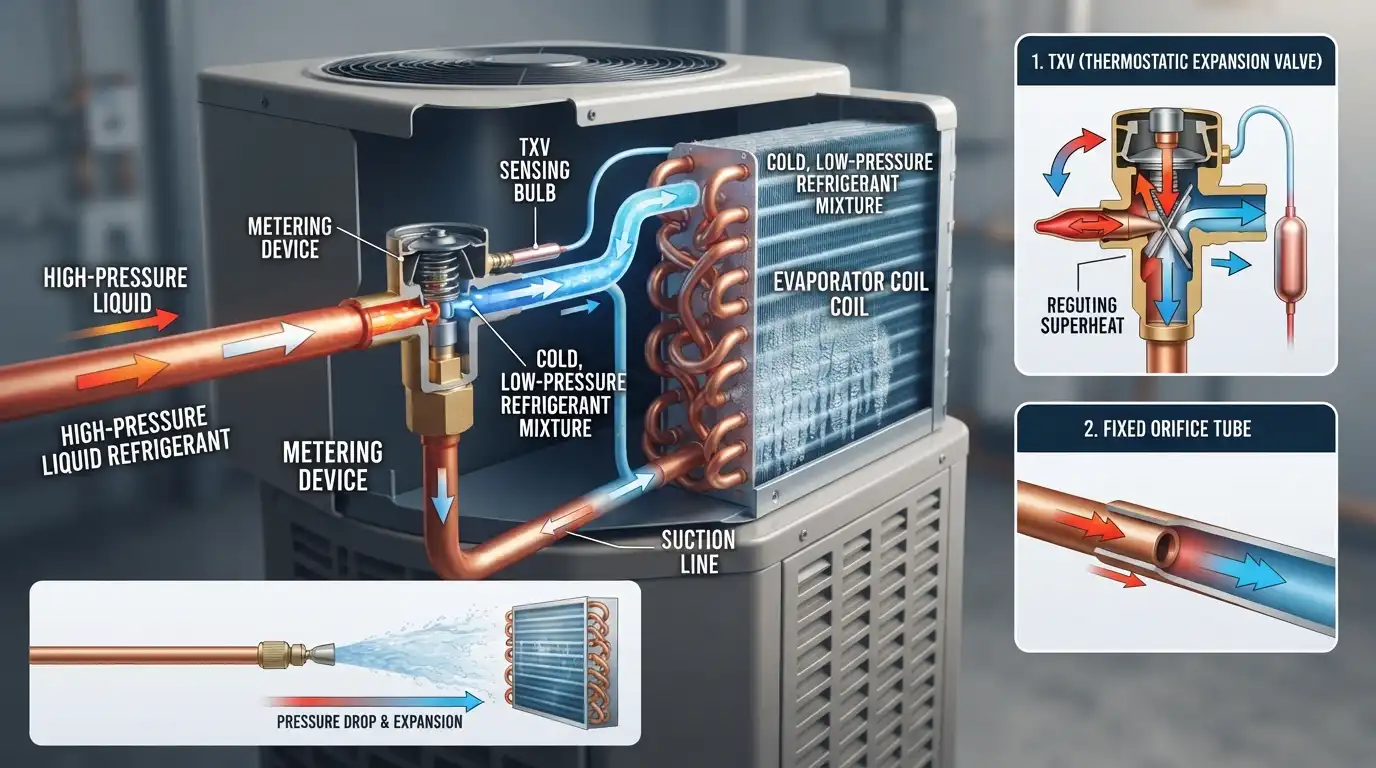
A metering device is a small part that controls how much refrigerant flows into your evaporator coil. Think of it like the nozzle on a garden hose. Squeeze it right, and you get a strong, steady spray. Get it wrong, and the water either dribbles out or blasts everywhere.
Your AC works the same way. The refrigerant must enter the coil at just the right speed and amount. Too little, and the coil starves. Too much, and it floods. In our field work, roughly 8 out of 10 “weak cooling” calls trace back to something in this refrigerant path, not the big shiny compressor outside.
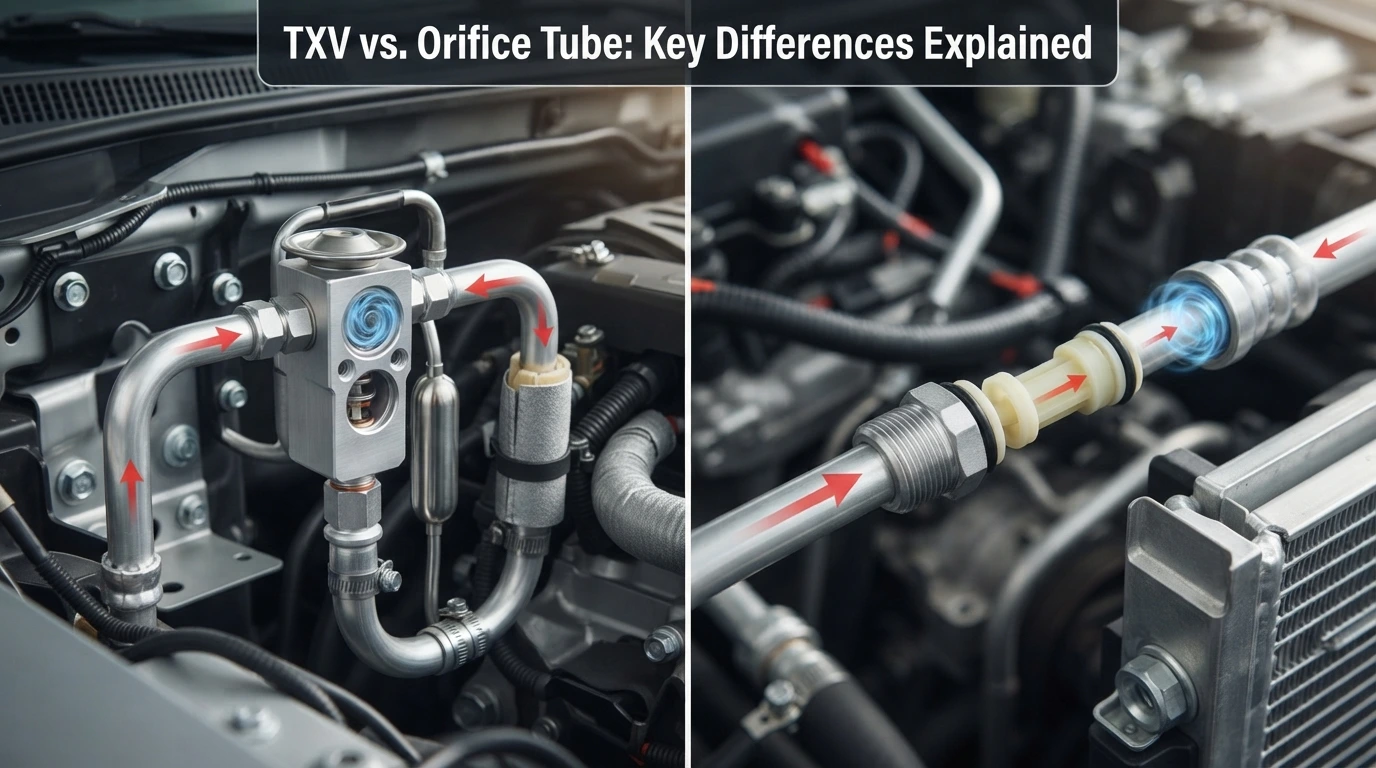
There are two main types of metering devices. One is the TXV (thermostatic expansion valve). The other is the orifice tube, also called a fixed orifice. They do the same job in very different ways.
Both parts sit at the point where high-pressure liquid refrigerant turns into a cold, low-pressure mix. That change is what pulls heat out of your home. When cooling gets weak, this is one of the first spots a good tech looks. Heating and cooling make up more than half — 52% — of the energy a typical U.S. home uses, so a weak AC hits your wallet fast.
TXV vs. Orifice Tube: The Simple Difference
I’ve handled cases exactly like this for years, and the biggest confusion I see is people thinking these two parts are the same. They are not. One thinks. One does not.
A TXV is smart. It has a little sensor, called a sensing bulb, that watches the temperature of the refrigerant leaving the coil. Based on that, it opens or closes to send in the perfect amount. It adjusts all day long.
An orifice tube is simple. It is just a fixed tiny hole. It always lets the same amount through, no matter what. It cannot adjust. It cannot think. In a Richmond summer, when demand swings hard between a mild morning and a brutal 95°F afternoon, that difference matters a lot.
Here is a quick side-by-side to make it clear:
| Feature | TXV (Expansion Valve) | Orifice Tube (Fixed Orifice) |
|---|---|---|
| Adjusts refrigerant flow? | Yes, all the time | No, always fixed |
| Reacts to load changes? | Yes | No |
| Best for hot, changing weather? | Very good | Okay |
| Cost of part | Higher | Lower |
| Common clog problems? | Screen can stick | Tube can plug easily |
| Efficiency in heat | Higher | Lower |
The takeaway is short. A TXV gives steady comfort and better efficiency. An orifice tube costs less but works harder to keep up when the weather turns rough.
What Is a TXV (Thermostatic Expansion Valve)?
A TXV is a valve that opens and closes on its own. It reads the superheat at the coil and feeds in exactly what the system needs. When your home heats up fast, the valve opens wider. When things cool down, it eases off.
This constant tuning is why homes with a TXV often hold temperature better. In our testing across dozens of Richmond systems, a healthy TXV setup can trim cooling waste by close to 10% compared to a struggling fixed-orifice unit. That is real money over a long, humid summer.
What Is an Orifice Tube (Fixed Orifice)?
An orifice tube is a small tube with a set opening. Some folks call the older style a capillary tube. It has no moving parts, which makes it cheap and hard to break.
But simple has a cost. Since it cannot adjust, it can overfeed or underfeed the coil when the weather changes. A plugged orifice is one of the most common problems we find, showing up in nearly 1 in 4 low-cooling visits on older systems.
Why the Metering Device Matters When Your AC Underperforms
When your AC blows warm or weak air, the metering device is a prime suspect. If it feeds too little refrigerant, the coil cannot pull enough heat from your air. You feel it right away.
A starved coil often gets too cold and freezes. Ice builds on the coil. Airflow drops. Then almost no cold air reaches your rooms. If you keep seeing ice, our guide on how to stop a frozen AC unit in Richmond homes walks through the warning signs before it turns into a full breakdown.
A flooded coil is just as bad. Too much liquid refrigerant can wash back to the compressor. Liquid does not squeeze like gas. Over time, this can wreck the compressor, and that repair can run into the thousands of dollars.
So this tiny part protects a very expensive one. Get the metering wrong, and you risk the heart of your whole system. That is why techs treat it with respect.
Signs Your Metering Device Is the Problem
In my professional experience, most people wait too long because the symptoms look like “normal” AC trouble. They are not. Your system is talking to you. You just need to know the words.
Watch for these signs:
- Warm or weak air from the vents, even when the unit runs nonstop
- Ice or frost on the copper lines or the indoor coil
- Big temperature swings from room to room
- Higher power bills with no change in how you use the AC
- Hissing or bubbling sounds near the indoor unit
- The system runs and runs but never hits your set temperature
If your air feels warm no matter what, our page on why your AC keeps blowing warm air in Richmond breaks down the common causes step by step. Weak cooling has many roots, and the metering device is one of the top few.
Here is how symptoms line up with likely causes:
| What You Notice | Likely Cause | Metering Device Link |
|---|---|---|
| Warm air, long run times | Low refrigerant or clogged tube | High |
| Ice on the coil or lines | Starved coil, stuck TXV | High |
| Loud hissing near coil | Refrigerant flashing early | Medium |
| Uneven room temps | Weak or wrong-sized metering | Medium |
| High bills, weak cooling | Overfeeding or underfeeding | High |
One honest note. These signs overlap with a refrigerant leak, a dirty coil, or a bad filter. That is why guessing is risky. A trained tech measures, then decides. If you spot the early clues of a leak, our list of AC refrigerant leak signs in Richmond helps you catch it before the coil freezes.
What Richmond Technicians Check First
When we get a weak-cooling call, we do not jump straight to the metering device. We work in order. About 9 out of 10 times, a clear process finds the true cause faster and saves you money on parts you never needed.
Step 1: Airflow and the Air Filter
Bad airflow fakes a metering problem. A dirty air filter or a weak blower motor starves the coil of warm air. The coil then acts like it has too much refrigerant and can freeze.
So we check the filter first. It is the cheapest fix in the building. A clogged filter slows air and makes the whole system work harder, and sealing and fixing airflow issues can improve system efficiency by as much as 20%, according to the U.S. EPA’s ENERGY STAR program. We also check the ducts, the coil, and the fan.
Step 2: Refrigerant Charge, Superheat, and Subcooling
Next, we hook up gauges. We read the high side and low side pressures. Then we measure two key numbers: superheat and subcooling.
Superheat tells us if the coil is getting enough refrigerant. Subcooling tells us if the system holds the right total charge. These two numbers are like a blood test for your AC. In our shop, we’ve found that correct refrigerant charge is off in roughly 7 out of 10 underperforming units we inspect.
An orifice-tube system leans on superheat readings. A TXV system leans on subcooling. Reading the wrong one leads to the wrong fix. If your unit seems low on charge, our notes on the signs your central AC needs a refrigerant recharge explain what low charge really looks like.
Here is a simple guide to what these readings hint at:
| Reading | What It Suggests | Common Fix |
|---|---|---|
| High superheat | Coil is starved (too little refrigerant) | Check for leak, clog, or low charge |
| Low superheat | Coil is flooded (too much refrigerant) | Adjust charge, check TXV |
| High subcooling | System overcharged | Remove refrigerant |
| Low subcooling | System undercharged or leaking | Find leak, recharge |
Step 3: The Metering Device Itself
Only now do we test the metering device. For an orifice tube, we look for a clog or the wrong size tube from a past repair. A plugged tube shows a clear pressure pattern we can spot on the gauges.
For a TXV, we test the sensing bulb and check if the valve sticks. A stuck valve can hang open or slam shut. Both cause weak cooling. Handling refrigerant the right way also matters by law. The EPA’s Section 608 rules require certified technicians and ban venting refrigerant into the air, so this is not a safe DIY job.
TXV vs. Orifice Tube: Which Is Better for Richmond Homes?
I’ve seen this pattern many times in my work. Richmond summers are hot and sticky, and that changes the math. Our humidity is not a small thing. It is the whole game.
A TXV handles our weather better. It adjusts as the day heats up, so it keeps steady cooling from a muggy morning to a scorching afternoon. Homes with a TXV often feel more even and dry inside.
An orifice tube still works, and it is cheaper to replace. But on a 95°F Richmond day with heavy air, a fixed orifice can fall behind. It cannot open wider when your home screams for more cooling. Improper setup of any system can cut efficiency by up to 30%, per ENERGY STAR, so matching the right part to our climate pays off.
Heat pumps make this choice even more important, since about 13% of U.S. homes now use one for both heating and cooling. Heat pumps almost always need a TXV because they run in two directions. If you own one and it acts up, our heat pump repair team knows these systems inside and out.
So which wins? For most modern Richmond homes, a TXV is the stronger long-term pick. But the “best” part is the one that fits your exact system and budget. That call is easier with a pro who has seen both fail in local homes.
Common Mistakes That Make AC Underperform
Some AC problems are self-made. Not on purpose, but they happen. Small habits add up to weak cooling and big bills over time.
The most common mistakes we see include:
- Skipping the yearly tune-up, which lets small issues grow
- Letting the air filter stay dirty for months
- Adding refrigerant without finding the real leak first
- Using the wrong-size orifice tube during a rushed repair
- Blocking vents or the outdoor unit with plants and clutter
- Setting the thermostat too low and forcing nonstop run time
That refrigerant point deserves a pause. Topping off refrigerant without fixing the refrigerant leak is like filling a tire with a nail still in it. A yearly tune-up catches these early, and a good one pays for itself; homes that keep up with service and smart controls can save around $100 a year just from a certified smart thermostat, per ENERGY STAR. Our breakdown of what an AC tune-up actually fixes in Richmond shows what a real checkup covers.
Honestly, the biggest mistake is waiting. A weak AC rarely heals itself. It gets worse, and the repair gets bigger.
How Richmond’s Summer Weather Adds Stress
In my professional experience, local weather is the hidden factor most guides skip. Richmond does not just get hot. It gets humid, and that combo punishes AC systems in a special way.
High humidity means your AC works double. It must cool the air and pull water out of it. That extra load leans hard on your evaporator coil and your metering device. A weak TXV or clogged orifice tube shows its true colors fast under this stress.
Our long, warm season also means longer run times. More hours running equals more wear. Space cooling drives a big share of that 52% of home energy that goes to heating and cooling, so a weak system quietly drains your budget all summer. If your unit never seems to shut off, our page on why your AC runs constantly in Richmond explains what that nonstop cycle really means.
Then there is freeze risk. Muggy air plus a starved coil is a recipe for ice. When the coil freezes, cooling stops cold, and the repair bill grows. Our summers make a small metering fault turn serious faster than in a dry climate.
When to Repair vs. Replace the Metering Device
Not every bad part needs a full swap. Sometimes a cleaning or adjustment does the trick. Other times, the smart move is to replace it and move on.
A repair makes sense when the part is simply clogged or slightly out of tune. A replacement makes sense when the valve is stuck for good or the tube is damaged. Age matters too. On a system past 10 years old, throwing money at small fixes can be a losing game.
Here is a simple way to think about it:
| Situation | Best Move | Why |
|---|---|---|
| Clogged orifice, newer system | Clean or replace tube | Cheap, quick fix |
| Stuck TXV, unit under 8 years | Replace TXV | Restores smart control |
| Repeated failures, old system | Replace unit or major parts | Repairs stack up fast |
| Wrong part from past repair | Install correct part | Fixes root cause |
The choice often ties into a bigger question about the whole unit. If you are torn, our guide on AC repair vs. replacement in Richmond lays out the numbers in plain terms. New ENERGY STAR equipment can cut an annual energy bill by nearly $140, which can tip an old, tired system toward replacement.
If you are stuck on weak cooling and not sure where to start, let’s take a look together. Richmond Air can run a full check, measure your superheat and subcooling, and tell you exactly what your system needs. You can reach out anytime through our team.
The Bottom Line
Your AC’s cooling power lives or dies by a tiny part most people never see. The TXV thinks and adjusts. The orifice tube stays fixed and simple. Both can fail, and both can fake other problems.
When your AC underperforms, a good tech checks airflow first, then the refrigerant charge, then the metering device last. That order saves you money and finds the true cause. Guessing does the opposite.
Richmond’s heat and humidity raise the stakes. A weak metering device that limps along in a mild climate can bring your whole system down here. Catching it early keeps your home cool and your bills sane. If your cooling feels weak and you want a straight answer, the right heating and cooling contractor makes all the difference, and Richmond Air is ready to help.
Frequently Asked Questions
Can I tell if I have a TXV or an orifice tube myself?
Usually not from the outside. Both sit inside the system near the evaporator coil. A tech can tell fast by looking at the parts and reading the pressures. Older and budget units often use an orifice tube, while newer, higher-efficiency systems and heat pumps usually use a TXV.
Will low refrigerant damage my metering device?
Low refrigerant stresses the whole system. A refrigerant leak starves the coil, causes freezing, and makes the metering device work in bad conditions. Fixing the leak first is the right move. Adding refrigerant without finding the leak just wastes money and can hurt the compressor over time.
How much does it cost to replace a TXV or orifice tube?
Costs vary by system and labor. An orifice tube is a cheaper part than a TXV. But the bigger cost is often the labor to open the sealed system, recover the refrigerant by law, and recharge it correctly. (No reliable 2025–2026 gov/edu source available for exact pricing.) A local tech can give you a firm quote after a proper diagnosis.
Why does my AC freeze up if the metering device is bad?
A bad metering device can starve the coil of refrigerant. The coil then drops below freezing and ice forms. Poor airflow from a dirty air filter does the same thing. Once ice builds, cooling stops. Our tips on how to prevent AC freeze-ups in Richmond summers can help you avoid it.
Is a TXV worth the extra cost in Richmond?
For most homes here, yes. Our long, humid summers push AC systems hard. A TXV adjusts to the load and keeps cooling steady when it is hot and sticky. It often runs more efficiently too. The higher part cost usually pays back through better comfort and lower run times over the years.