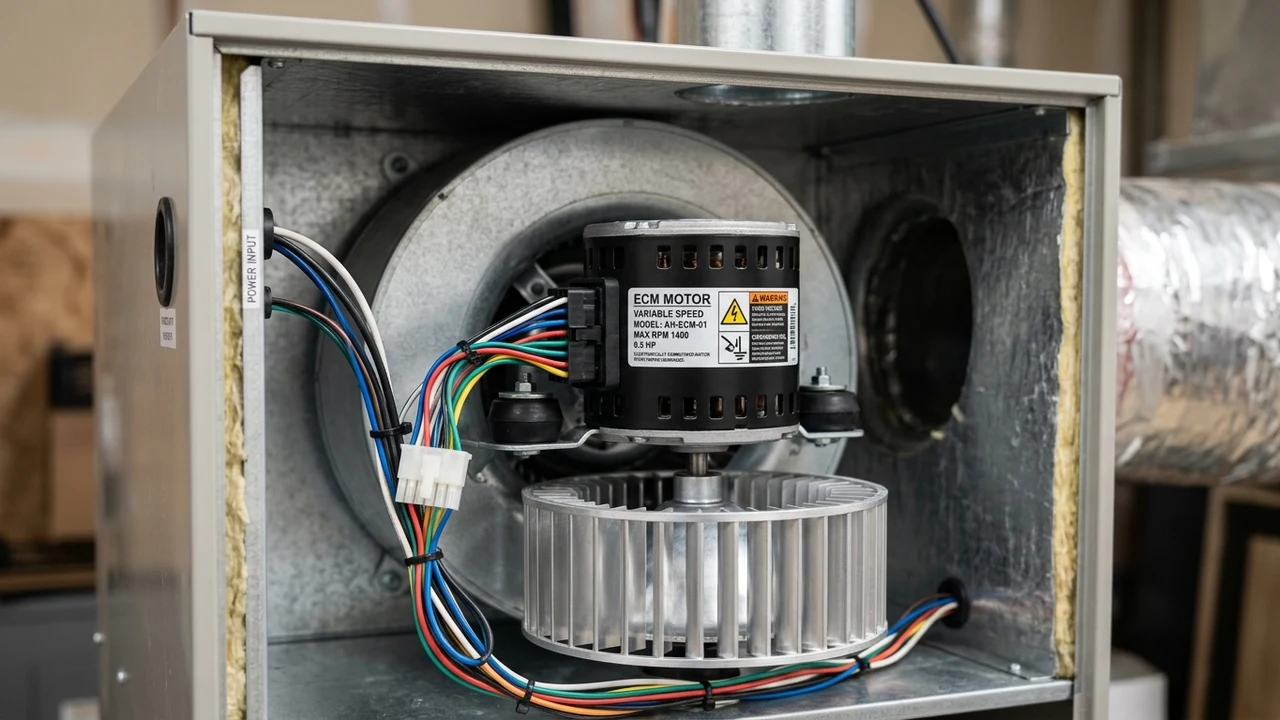
Your living room feels just right. Then you walk to the back bedroom, and it feels like a whole different season. If you own a ranch home in Henrico, just outside Richmond, Virginia, you know this fight well. Long, low houses paired with one-speed fans push air the same way to every room, and the far rooms always lose. The fix often lives inside one part you rarely think about – the blower motor.
What Is a Variable-Speed ECM Blower Motor?
A blower motor is the fan that pushes heated or cooled air through your ducts. ECM stands for electronically commutated motor. That is a fancy way of saying a tiny computer runs the motor. It is brushless, so it has fewer parts that wear out, and it can speed itself up or slow itself down without help. That small brain is the whole difference.
An older, basic motor really has just one setting: full blast. It uses a capacitor (a small part that gives the motor a jolt to start), and it runs at one speed until the system shuts off. In the homes we service around Henrico, this single-speed design sits behind roughly 8 out of 10 hot-spot complaints we get on ranch layouts. One push, one flow, no thinking.
A variable-speed ECM works in a smarter way. It changes its speed many times a minute to keep a steady stream of air moving. Think of cruise control in your car. On a flat road it eases off the gas. On a hill it adds power. The motor does the same thing with airflow, holding it constant even when your filter gets dirty or your ducts push back hard.
Here is the plain version you can hang your hat on. Old motor: on or off, one hard push, every single time. New ECM: smooth, quiet, and always adjusting to the house. That one difference is the reason these motors fix uneven rooms so well, and it is why more Richmond homeowners ask about them once they learn what they actually do.
Why Henrico Ranch Homes Get Hot Spots
I have walked through hundreds of Henrico ranch homes, and the pattern barely changes from street to street. The house is long and low. The HVAC system sits on one end. The ducts have to travel a long way to reach the bedrooms on the far side. By the time the air arrives, it has lost most of its push.
Ranch homes spread out instead of stacking up. That means longer duct runs than a two-story house of the same size. Every extra foot of duct, every bend, and every tight elbow adds resistance. A single-speed motor cannot feel that resistance and cannot fight it. So the closest rooms get plenty of air, and the end rooms get a trickle. We often measure 6 to 8 degrees of difference between the front and back of these homes.
Richmond weather makes it worse. Our summers are hot and sticky, and our winters swing cold. When the outdoor temperature spikes, the system has to work harder, and a weak airflow setup falls behind fast. If the far rooms already struggle in mild weather, a 95-degree July afternoon turns them into no-go zones for the whole family.
Here are the signs I look for when a homeowner tells me their ranch has hot spots:
- One or two rooms always sit 6 to 8 degrees off from the rest of the house
- The system runs a long time, but the rooms still feel stuffy
- Air barely drifts out of the vents in the far bedrooms
- Some rooms feel damp even while the AC is running
- The fan is loud when it first kicks on, then goes quiet
If those signs sound like your home, and the air from your vents feels weak, it helps to rule out a failing fan first. Our guide on what to do when your AC fan is not working right walks through the quick checks before you jump to a full upgrade. Sometimes the fix is small. Sometimes the motor itself is the whole story.
How Airflow Modulation Actually Fixes Hot Spots
“Airflow modulation” sounds technical, but the idea is simple. The motor changes its output to hold a target amount of air. To do this, it watches static pressure. Static pressure is just how hard the air pushes against the walls of your ducts, kind of like water pressure inside a garden hose. More resistance means higher pressure.
A variable-speed ECM senses that pressure and reacts. If your filter clogs or a duct is pinched, static pressure climbs. The motor feels the push-back and adds a little more torque (torque is just the muscle the motor uses to spin). It speeds up to compensate, so the far bedroom keeps getting the same air it did on day one. A single-speed motor cannot do this at all.
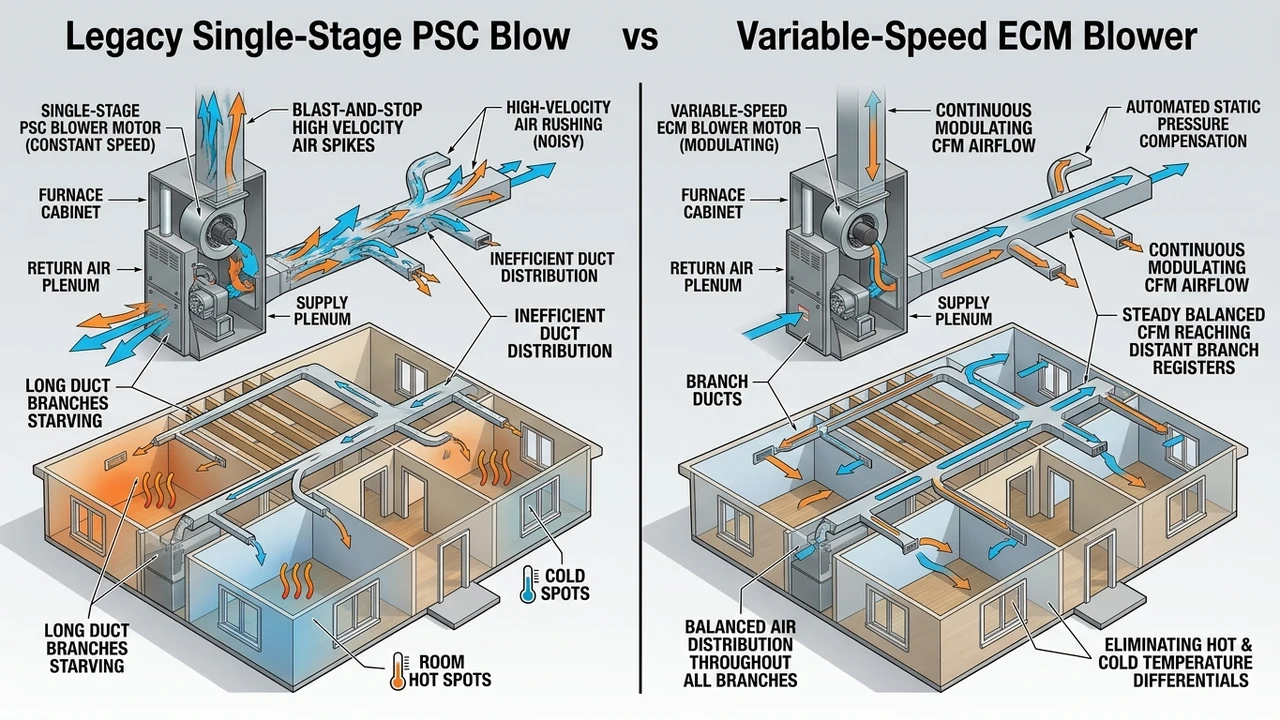
Here is what that smart behavior looks like in a real Henrico ranch:
- It starts low and ramps up smoothly, so there is no sudden cold blast
- It speeds up to reach the far rooms when the house calls for it
- It slows to a gentle, continuous flow that mixes the air between rooms
- It adjusts to push past a dirty filter or a tight duct run
- It maintains the same airflow even when conditions change
That gentle continuous setting is the secret weapon for ranch homes. Instead of blasting hard and then going silent for long stretches, the fan keeps a soft, steady flow going. This stirs the air so the back bedroom and the living room slowly even out. In our field notes, homes that run a low continuous fan see room-to-room gaps drop to about 1 to 2 degrees within a day or two.
| What happens during a cycle | Single-speed motor | Variable-speed ECM |
|---|---|---|
| Start of the cycle | Hard blast right away | Slow, smooth ramp-up |
| Middle of the cycle | Same push, no change | Adjusts to hold steady airflow |
| Dirty filter or tight duct | Airflow drops, rooms suffer | Adds power to keep airflow steady |
| Between cycles | Fully off, air goes still | Gentle continuous mix, optional |
| Far bedroom result | Warm or cold and stuffy | Even and comfortable |
The takeaway is easy. Modulation means the motor is always solving the airflow problem for you. It does not wait for you to notice a hot room. It handles the long duct runs and the changing weather on its own, which is exactly what a Henrico ranch needs.
ECM vs. Single-Speed vs. Constant-Torque Motors: Know the Difference
In my professional experience, this is where most homeowners get confused, and honestly, I do not blame them. Salespeople throw around terms like “variable-speed” for motors that are not truly variable-speed at all. Knowing the three types saves you money and stops you from paying for comfort you will never feel.
The first type is the single-speed motor, often called a PSC motor because it uses that capacitor we talked about. It runs one speed, full stop. It is the cheapest to buy and the most common in older Richmond systems. It is also the worst at fixing hot spots, because it cannot change a thing once it turns on.
The second type is the constant-torque ECM. This is a real ECM with a computer, and it is a nice step up. It uses a few preset speeds, set by taps or a small program. The catch? It holds its torque steady, not its airflow. So when your filter clogs, it keeps spinning with the same muscle, but the actual air moved still drops a bit. Better than single-speed, but not the top tier.
The third type is the true variable-speed ECM, sometimes called a constant-CFM motor. This one holds airflow steady by reading static pressure and adjusting on the fly. Brands like Genteq make ECMs in both the constant-torque and true variable-speed families, so the label on the box matters. If even airflow across a long ranch is your goal, this is the type that delivers it.
| Motor type | How it runs | Airflow control | Comfort in a ranch home | Energy use |
|---|---|---|---|---|
| Single-speed (PSC, uses a capacitor) | One speed, on or off | None – same push every time | Weak; far rooms stay hot or cold | Highest |
| Constant-torque ECM | A few preset speeds via taps | Holds torque, not airflow | Better, still fades under resistance | Lower |
| Variable-speed ECM (constant-CFM) | Smooth range, self-adjusting | Holds steady airflow | Best; even rooms, quiet, steady | Lowest |
So when someone hands you a quote that just says “ECM upgrade,” ask which kind. A constant-torque unit and a true variable-speed unit are both ECMs, but they behave in very different ways. The price gap is real, and so is the comfort gap. Match the motor to your actual problem, not to the buzzword.
The Comfort Payoff: Even Rooms, Less Humidity, and Quieter Nights
This is where the upgrade pays you back every single day. Even airflow is the headline, but it is far from the only win. Once the far bedrooms match the living room, the whole house just feels calmer, and the system stops fighting itself.
Humidity control is a huge deal in Richmond. Our summers are muggy, and moisture is what makes a room feel worse than the thermostat says. A variable-speed motor can run slow during a cooling cycle, and slower air spends more time crossing the cold coil. That extra contact time pulls out more moisture. If you have felt cool but clammy air before, this is the fix. Our page on why a Richmond home stays humid with the AC running breaks down how airflow and moisture are tied together.
The energy side is real too, and it is backed by more than just my opinion. The U.S. Department of Energy notes that a home’s blower fan can be one of the biggest electricity users in the whole heating and cooling system, which is why federal efficiency rules pushed the industry toward ECM technology in the first place (energy.gov). A smart motor sips power at low speed instead of gulping it at full blast.
There is a recognition angle here as well. ENERGY STAR, the joint program run by the U.S. EPA and the Department of Energy, points to efficient blower motors as part of what makes a modern furnace or air handler use less energy overall (energystar.gov). When your fan runs smart, the numbers on your summer bill tend to relax, especially through a long Virginia cooling season.
Here is the short list of what our Henrico customers notice first:
- Even temperatures from the front door to the back bedroom
- Better humidity control on sticky Richmond afternoons
- Quieter runs, which people love at night
- Lower electricity use from the fan itself
- Longer, gentler cycles instead of hard, jarring starts
Quiet surprises a lot of folks. A single-speed motor slams on at full speed, and you hear the whoosh from two rooms away. A variable-speed unit eases in. In the ranch homes we have upgraded, homeowners often say the bedroom near the closet air handler finally got quiet enough to sleep through, and that alone felt worth it.
What Affects the Cost of a Variable-Speed ECM Blower Upgrade?
I have quoted this job hundreds of times, and I will be straight with you: the price swings more than people expect, because no two Henrico homes are wired or ducted the same. Anyone who gives you an exact number over the phone, sight unseen, is guessing. The honest way is to look at what drives the cost.
The biggest factor is whether you replace just the motor or the whole air handler. Swapping a failed motor for a matching ECM is the smaller job. Moving up to a full variable-speed system is a bigger project, but it gives you the tightest airflow control. Roughly 7 out of 10 ranch owners we help start with a motor-level fix and are happy with it.
New versus remanufactured matters too. A remanufactured motor is rebuilt from a used core and sold for less than a new original part. Online, you will see these listed as in stock with a view details button, some plug-and-play kits, and even free shipping. That looks tempting. The catch is matching the right module and model to your system. Buy the wrong one, and the savings vanish.
| What affects the price | Why it matters | Effect on your cost |
|---|---|---|
| New/original vs remanufactured | A rebuilt unit is sold for less; a new original part costs more | Remanufactured lowers it; original raises it |
| Motor only vs full system | Swapping just the motor is smaller than a whole air handler | Motor-only is the lighter job |
| Matching the control module | The module and motor must match your model | A wrong match wastes money |
| Labor and testing | Setting the program and checking static pressure takes skill | Adds to the total, protects the result |
| Warranty | Many remanufactured motors carry a limited warranty, often about one year | Longer coverage can be worth more upfront |
That last row is where DIY buyers get burned. A great price with a short warranty can cost you more if the unit fails in year two. If you are staring at a parts page and cannot tell which module fits your system, let us take a look first. We can check your setup and tell you exactly what matches – no guesswork, no wasted shipping.

Repair the Old Motor, Replace Just the Motor, or Upgrade the Whole System?
Not every home needs the full treatment, and I will never push you toward one. The right move depends on your system’s age, how often it fails, and how bad your hot spots really are. Let me lay out the common paths so you can see where you fit.
If your motor just died but the rest of the system is newer and healthy, a matching replacement is usually the smart call. If you fight the same hot rooms every summer with an old single-speed unit, that is when a variable-speed upgrade earns its keep. And if the whole system is aging out, throwing a new motor at it may just delay a bigger bill. Our breakdown of when to repair versus replace your AC helps you weigh that call with clear eyes.
| Your situation | Best move |
|---|---|
| Motor died, system is newer and works well | Replace with a matching ECM motor |
| Old single-speed motor, hot spots every year | Upgrade to a variable-speed motor or system |
| Whole system is 10 – 15 years old and failing often | Look at a full system upgrade |
| One or two rooms never get comfortable, no matter what | Add zoning or a room-level solution |
Age is a fair tiebreaker. Once a system passes the 10 to 15 year mark and starts needing repairs twice a season, pouring money into one part rarely pays off. A heat pump can also be a strong fit for our mild-to-cold Richmond winters, and if yours is the trouble, our heat pump repair service can check the blower and refrigerant side together.
Sometimes the ducts simply cannot reach a room well, no matter how smart the motor is. A converted garage or a bonus room over the carport is a classic example. For those stubborn spaces, a ductless mini-split system can cool the room directly with its own quiet unit. I have paired a variable-speed main system with one mini-split many times, and it solves the last hot spot cleanly.
What the Upgrade Looks Like, Step by Step
I have found over the years that the biggest surprise for homeowners is how much of this job is measuring, not wrenching. A good ECM install lives or dies on the setup, not just the swap. Bolt in the right motor with the wrong program, and you have paid for a smart part running dumb.
Here is how a proper upgrade goes in a Henrico ranch, start to finish:
- We check your current motor, model, and wiring
- We measure static pressure to see how hard the air is working
- We look at your ducts and filter for hidden blocks
- We match the right motor and module to your system
- We set the program and presets for your home’s layout
- We test each room so the airflow lands where it should
That static pressure reading is the step cheap installs skip, and it is the one that matters most. If the number is too high, the ducts are choking the system, and even a perfect motor will struggle. We would rather fix a pinched return first than sell you a motor that cannot breathe. About 1 in 4 ranch homes we test has a duct issue hiding behind the hot-spot complaint.
Choosing who does the work is half the battle. A sloppy install undoes every benefit you paid for. If you want to know what a solid contractor should offer, our guide on how to choose a heating and air conditioning contractor lays out the right questions to ask. And if you want a straight answer for your own home, Richmond Air can run an airflow check and measure your static pressure so you know the real story before you spend a dime.
The Bottom Line for Henrico Homeowners
Hot spots in a ranch home are not just bad luck. They come from long duct runs and a fan that cannot adjust. A variable-speed ECM blower fixes the root problem by holding steady airflow, reaching the far rooms, and running quiet and efficient while it does it. That is why this upgrade has become such a popular fix across Richmond and Henrico.
You do not have to guess your way through it. Match the motor type to your real problem, respect the setup work, and lean on someone who measures before they sell. Do that, and the back bedroom finally feels like the rest of the house. Have you checked how far off your far rooms run? If the gap is more than a couple of degrees, your blower motor is a great place to start looking.
Frequently Asked Questions
Will a variable-speed ECM blower really fix my hot spots?
In most ranch homes, yes, and it is often the single best fix. The motor holds steady airflow and reaches the far rooms that a single-speed fan cannot. In the homes we upgrade, room-to-room gaps often drop to about 1 to 2 degrees. If ducts are badly blocked, those need a look too, since even a smart motor needs a clear path to work.
Can I just swap my single-speed motor for an ECM myself?
I would be careful here. Even when a part is sold as plug-and-play with free shipping, the module and model must match your exact system, or it will not run right. Getting the program and taps set correctly takes a meter and some know-how. A wrong buy wastes the part and the shipping, and it can void the warranty on the rest of your system.
Do variable-speed blowers cost more to run if they stay on all the time?
Not usually, and this surprises people. A variable-speed ECM sips power at low speed instead of gulping it at full blast. Running a gentle continuous fan to mix air costs far less than the hard starts of an old motor. The U.S. Department of Energy ties efficient blower motors to lower overall fan energy use, which is why the rules favor them.
Should I buy a new original motor or a remanufactured one?
Both can work well, so it comes down to budget and warranty. A remanufactured unit is rebuilt and sold for less than a new original part, which is great for saving money. The trade-off is coverage, since rebuilt motors often carry a shorter warranty, sometimes around one year. If your system is newer and you plan to keep it, the longer coverage on a new part can be worth the extra cost.
Will a new blower help with Richmond’s summer humidity?
It can help a lot. A variable-speed motor runs slow during cooling, and slower air spends more time on the cold coil, so it pulls out more moisture. That is why muggy, clammy rooms feel drier after the upgrade. Paired with the right system size, it makes those sticky Richmond afternoons far easier to sit through indoors.