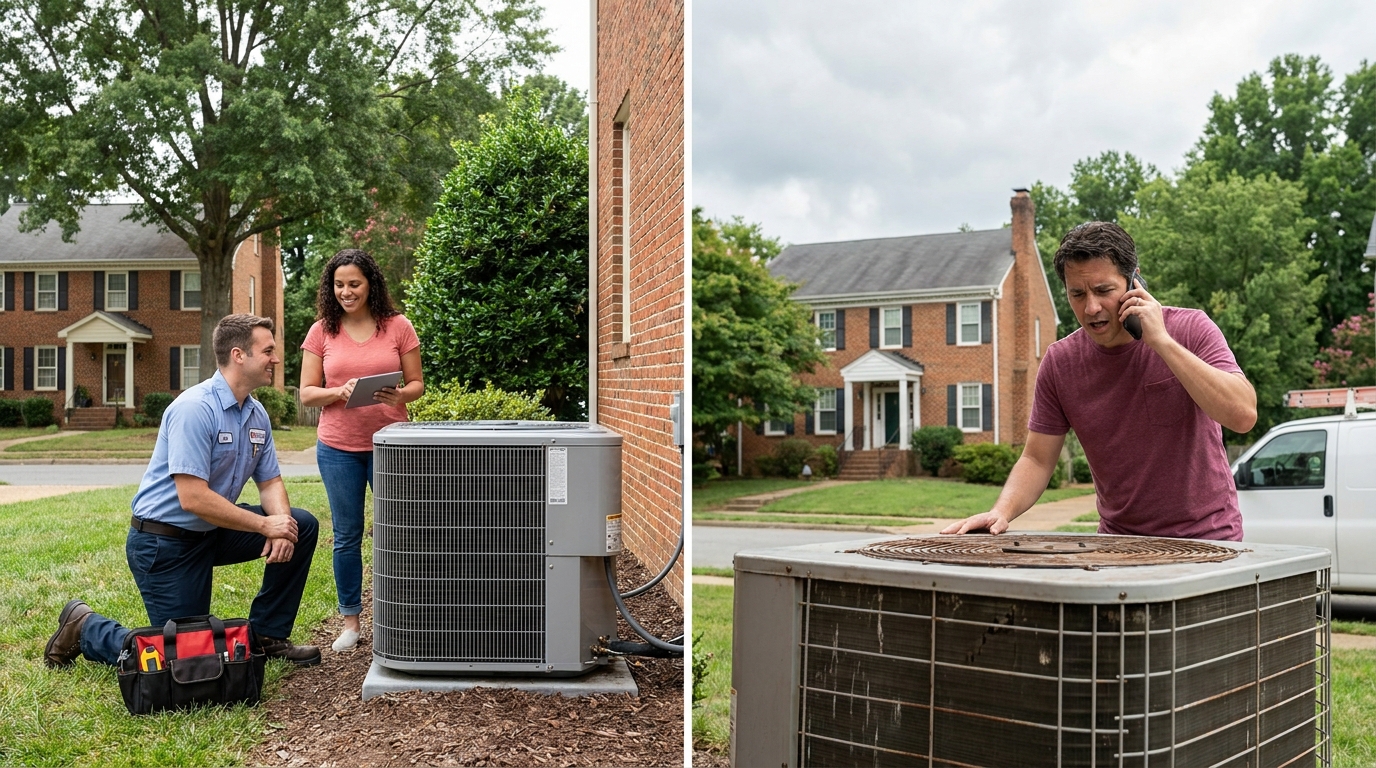
Your AC dies on the hottest day of July. The house is already 85 degrees inside, the kids are cranky, and you are staring at your phone wondering who to call and how much this will hurt your wallet. This is the exact moment when the choice between a service agreement and pay-as-you-go stops being boring paperwork and starts feeling very real. I want to make that choice simple for you today, in plain words, with no sales pressure.
What Is a Service Agreement, Really?
A service agreement is a yearly plan you buy from an HVAC company. You pay a set fee, and in return the company checks and cleans your system on a schedule. Think of it like a gym membership, but for your air conditioner. You are not paying for one fix. You are paying for ongoing care all year long. Most plans in Richmond include one or two maintenance visits, plus perks like discounts and faster service when something breaks.
The idea behind this model is steady, continuous care. Instead of waiting for your AC to fail, a tech comes out and catches small problems early. In our records, about 7 out of 10 breakdowns we see in peak summer trace back to something a spring tune-up would have caught. A loose part. A dirty coil. A slow refrigerant drip. These are the quiet issues that grow into big, costly ones.
Here is what a typical service plan covers during a visit. The tech cleans the coils, checks the refrigerant level, tests the electrical parts, and swaps or cleans the filter. If you want to see the full picture of what gets touched, our breakdown of what a professional AC tune-up actually fixes walks through it step by step. The visit usually takes our techs about 60 to 90 minutes, depending on the age and shape of the unit.
So a service agreement is really about prevention and priority. You trade a small, known yearly cost for fewer surprises. You also skip the panic of finding a service company from scratch when your AC quits. That peace of mind is the real product here, and for a lot of families, it is worth a great deal.
What Does Pay-As-You-Go Mean for Your AC?
In my professional experience, most homeowners already use pay-as-you-go without knowing it has a name. Here is the simple version. Pay-as-you-go (sometimes shortened to payg) means you only pay when you need help. No yearly fee. No contract. Your AC breaks, you make a call, a tech comes out, and you pay for that single visit. That is it. This is also called pay-per-visit, and it is the most common way people handle repairs.
This model shows up in many industries, not just HVAC. In software and cloud billing, a pay-as-you-use plan tracks every action or unit of consumption a customer uses, then charges based on that usage. Companies like Schematic build whole billing systems around this idea, where users only pay for the compute they actually used. Your AC works the same basic way. No usage, no charges.
The upside is clear. You keep your money until you truly need a fix. For a brand-new AC still under warranty, this often makes sense. In our experience, a healthy unit in its first 3 to 5 years rarely needs more than one paid visit, if any. Why pay a yearly fee to protect something that is already covered by the maker’s warranty? That is a fair question, and often the honest answer is you should not.
But pay-as-you-go has a catch. You pay full price for every repair. You wait in the regular line, not the priority one. And in a Richmond heat wave, that regular line can be long. When you do need a repair, knowing how long an AC repair usually takes helps you plan around the hot days. The freedom is nice. The risk is real.
Service Agreement vs. Pay-As-You-Go: A Side-by-Side Look
Sometimes a table makes the choice clear faster than paragraphs. Below is a simple comparison of the two models, based on the plans we see most often across the Richmond area. Look at the row that matters most to you and let it guide your thinking.
| Feature | Service Agreement | Pay-As-You-Go |
|---|---|---|
| Upfront cost | Set yearly fee | $0 until something breaks |
| Maintenance visits | 1–2 included per year | You book and pay each time |
| Repair pricing | Often 10–15% member discount | Full standard price |
| Priority scheduling | Yes, members go first | No, regular line |
| Emergency / after-hours fees | Often waived or reduced | Full fee applies |
| Best for | Older systems, busy families | New units, tight budgets |
| Commitment | Yearly plan or subscription | None, total freedom |
The pattern is easy to spot. A service agreement costs a little every year but softens the big hits. Pay-as-you-go costs nothing until it costs a lot at once. Neither is wrong. In our records, roughly 6 out of 10 Richmond homeowners with a unit older than 8 years end up better off on a plan, simply because older systems need more attention.
Think about your own home for a second. How old is your AC? How well do you handle a surprise bill? Your honest answers point you toward the right column. There is no single winner for every house, and any company that tells you otherwise is selling, not helping.
What Each Option Costs in Richmond
I’ve handled the money side of this question with hundreds of local families, and the numbers matter more than the sales pitch. Let me give you real ranges you can plan around. A typical service agreement in the Richmond area runs somewhere between $150 and $300 per year for one system. A standard pay-per-visit service call usually starts around $85 to $150 just for the tech to show up and look, before any parts.
Here is where it gets interesting. That plan fee is not just for a checkup. It usually unlocks a repair discount of 10 to 15% and cuts or removes emergency fees. In our experience, after-hours or weekend charges can add $100 to $200 to a single visit during peak season. Members often skip that entirely. So the plan can pay for itself with just one bad night.
| Cost Item | Service Agreement | Pay-As-You-Go |
|---|---|---|
| Yearly plan fee | $150–$300 | $0 |
| Basic service call | Often included | $85–$150 |
| Repair labor | 10–15% off | Full price |
| After-hours fee | Reduced or waived | $100–$200 extra |
| Two tune-ups/year | Included | $180–$300 out of pocket |
Look at that last row closely. If you were going to pay for two tune-ups anyway, the plan basically hands you the discounts and priority for free. Money is tight for a lot of us right now, so this math is not small. If you are weighing a big fix against a new unit instead, our guide on whether to repair or replace your AC can save you from spending on the wrong path.
Why Richmond Summers Change the Whole Picture
Richmond weather is not gentle on air conditioners. Our summers are hot and sticky. Daytime highs often sit in the low-to-mid 90s°F, and the humidity here regularly climbs above 70%. That combo makes your AC work overtime for months. A system that would coast in a mild climate gets pushed hard here, and hard-worked parts wear out faster.
Humidity is the sneaky villain. When your AC runs nonstop against thick, wet air, coils freeze, drains clog, and the unit strains. This is exactly why Richmond homes often need more care than the national average suggests. I break down the local reasons in detail in our piece on why AC service matters during Richmond’s humid summers, and the humidity angle surprises most people.
The heavy local usage tilts the math toward a service agreement for many homes. More runtime means more maintenance, and more maintenance means the yearly plan gets used, not wasted. In our records, Richmond homes average 2 to 3 service events in a rough summer, which is higher than what you would see in a cooler city. That extra wear is real, and pretending otherwise just costs you later.
None of this means pay-as-you-go is off the table here. It just means the stakes are higher when your AC is your main defense against a brutal July. If your unit is old and the season is long, the odds of a mid-summer failure go up. Plan for the weather you actually have, not the weather you wish you had.
What’s Really Inside a Good Service Agreement
In my professional experience, the difference between a good plan and a useless one comes down to what the visit actually includes. A cheap plan that only glances at your unit is not worth your money. A strong plan does real, hands-on work. According to ENERGY STAR, as much as half of all household energy use goes toward heating and cooling, so keeping your AC clean and tuned is one of the biggest ways to protect both comfort and your power bill.
Here is what a quality service agreement should cover on each visit:
- Full coil cleaning on both the indoor and outdoor units
- Refrigerant check to catch slow leaks before they starve the system
- Electrical testing of wires, contactors, and capacitors
- Filter swap or cleaning to keep airflow strong
- Drain line clearing so summer condensation does not back up
- Priority booking that puts members ahead of the regular line
That drain line item matters more than folks think. When it clogs, water backs up and can damage your floors or ceiling. A clean line is a small thing that prevents a big mess. You can match your plan against our AC maintenance checklist for Richmond homeowners to make sure nothing important gets skipped during a visit.
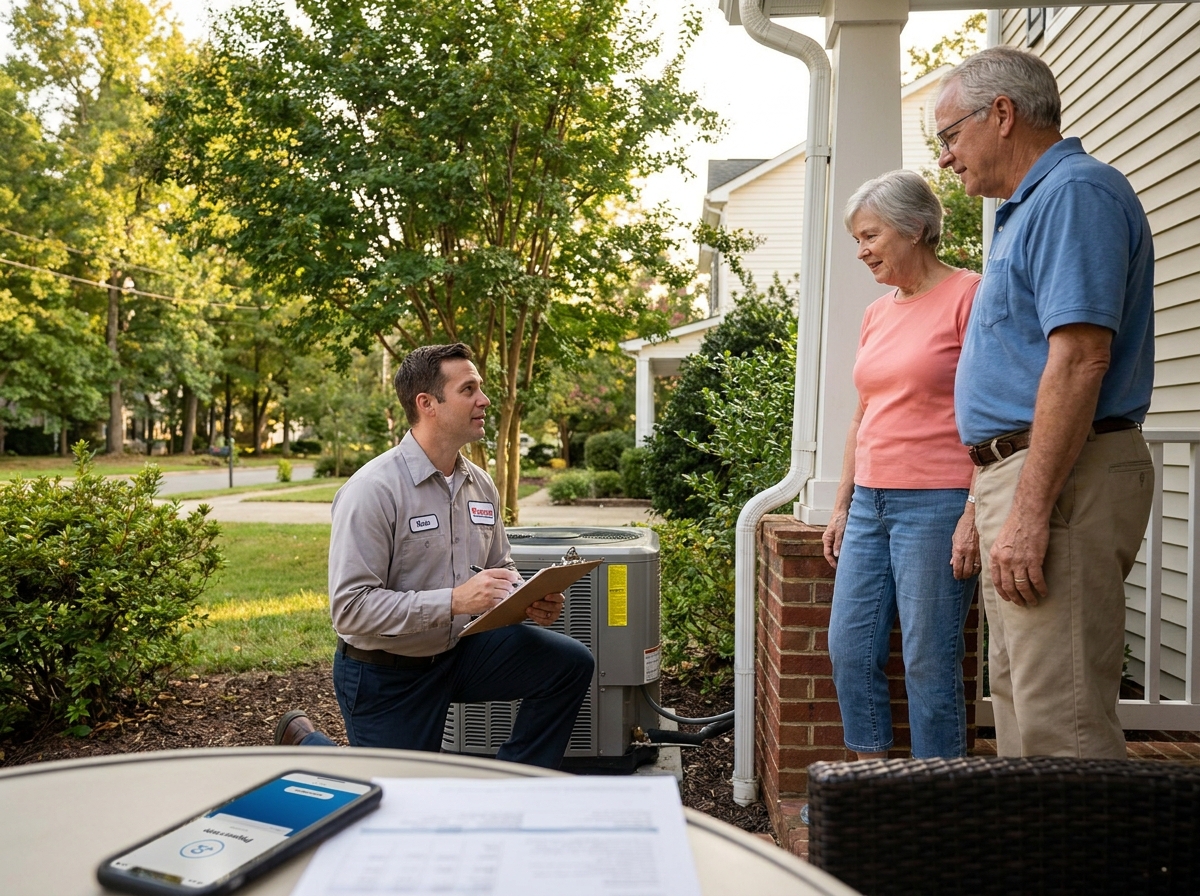
The best plans also keep records. A good company tracks your system’s history, so each visit builds on the last. They know your unit’s quirks, its age, and its weak spots. That memory is part of the value. A random tech on a one-off call starts from zero every single time, and that gap shows.
When Pay-As-You-Go Is the Smarter Pick
Let me be straight with you. Pay-as-you-go is sometimes the better call, and I would tell my own family the same. If your AC is new and under warranty, you are often paying twice for coverage you already have. In our experience, units in their first 3 years need almost no paid repairs, so a plan can feel like money sitting idle.
Here are the cases where pay-per-visit usually wins:
- Your system is under 5 years old and still under the maker’s warranty
- You are renting, and repairs are your landlord’s job anyway
- You are on a tight budget and cannot spare a yearly fee right now
- You are planning to replace the unit soon, so long-term care makes little sense
- You already do basic upkeep yourself, like changing filters monthly
There is real freedom in this model. No commitment. No subscription to remember. You keep full control of your money and only spend when there is a clear need. For a careful homeowner with a young, healthy system, that control is genuinely smart. About 4 out of 10 newer-unit owners we talk to do just fine this way.
The trade-off is exposure. When something big breaks, you face the full bill with no discount and no priority. If your AC quits at 9 p.m. on a Saturday, you pay the full after-hours rate. So this path works best when your system is reliable and your nerves can handle a rare surprise. Know your own risk comfort before you choose it.
When a Service Agreement Saves You More
I’ve seen this pattern many times in my work, and it is remarkably consistent. Once a system passes about 8 years old, repair needs climb sharply, and that is when a service agreement starts saving real money. The EPA notes that Americans spend roughly 90% of their time indoors, where some pollutants sit 2 to 5 times higher than outdoor levels. A well-maintained AC with clean filters is a big part of keeping that indoor air healthy, not just cool.
A service agreement tends to win in these situations:
- Your AC is 8 years or older and needs more frequent attention
- You have a busy household and no time to babysit your system
- You want predictable costs instead of scary one-time bills
- You live in a hot, humid spot where the AC runs almost nonstop
- You value fast service and hate waiting during a heat wave
The priority perk is bigger than it sounds. During a Richmond heat wave, our regular schedule can stretch out for days. Members jump the line. When your house is 85 degrees inside and climbing, getting help today instead of Thursday is worth a lot. That single benefit changes minds fast.
There is also the money you never see leave your pocket. Caught early, a small part costs little. Ignored, that same part can wreck a compressor and lead to a bill in the thousands. In our records, planned maintenance cuts major-repair events by roughly 30% on older units. Prevention is boring right up until the day it saves your whole summer.
The Hidden Costs Most Homeowners Miss
The sticker price is only half the story. The real difference between these two models hides in the costs people forget to add up. Emergency fees, repeat breakdowns, higher power bills, and even water damage all sit in the fine print of real life. Let me lay the common ones out so nothing sneaks up on you.
| Hidden Cost | How It Hits Pay-As-You-Go | How a Plan Softens It |
|---|---|---|
| After-hours emergency fee | Full $100–$200 add-on | Often waived for members |
| Repeat breakdowns | Full price each time | 10–15% off every repair |
| Higher energy bills | Dirty system wastes power | Yearly cleaning keeps efficiency |
| Water damage from clogs | You pay for repairs | Drain cleaning prevents it |
| Emergency search stress | Scramble to find a tech | One known company on call |
Humidity ties into this too. The EPA recommends keeping indoor humidity between 30 and 50 percent for healthy air, and a neglected AC struggles to hold that range. When the system runs dirty, it cools poorly and leaves your home damp and sticky. That dampness invites mold and makes the house feel worse even when the temperature reads fine.
Money surprises hurt most when they arrive all at once. One family I worked with skipped upkeep for years, then faced a $1,900 compressor failure in mid-July. A plan would not have made the part free, but the early catch and member discount could have cut that pain by hundreds. Insurance sometimes helps here too, so it is worth learning whether your homeowners insurance covers AC repair in Virginia before you assume you are on your own.
How to Pick the Right Option for Your Home
I’ve walked hundreds of families through this exact decision, and it always comes down to three honest questions. There is no universal right answer, only the right answer for your home. Answer these truthfully and the path gets clear. Do not let anyone rush you or shame you into a plan you do not need.
Ask yourself:
- How old is my system? Under 5 years, lean toward pay-as-you-go. Over 8 years, a plan usually wins.
- How do I handle surprise bills? Hate them? A service agreement smooths the ride. Fine with risk? Pay-per-visit keeps your cash free.
- How hard does my AC work? Nonstop in Richmond heat means more wear, which favors steady maintenance.
Match your answers to the model that fits. A young unit owned by a careful, budget-focused homeowner leans payg. An older unit in a busy home that runs all summer leans toward a plan. Most people land clearly on one side once they stop guessing and start counting. In our experience, about 8 out of 10 homeowners already sense the right choice before we finish the math.
If you are still unsure, that is normal, and you do not have to decide alone. If your AC is acting up or you just want an honest opinion, contact Richmond Air and we can take a look together. We will check your system, tell you its real condition, and help you pick the option that saves you the most, even if that option is simply paying per visit for now.
Final Thoughts
The service agreement versus pay-as-you-go question is not about which one is “best.” It is about which one fits your home, your system’s age, and your comfort with risk. New unit, tight budget, careful owner? Pay-per-visit keeps you free and light. Older system, busy life, brutal Richmond summers? A plan buys you priority, discounts, and far fewer nasty surprises.
My honest take after years in the field is simple. Once your AC crosses that 8-year mark, the steady care of a service agreement almost always earns its keep, especially with our heat and humidity pushing systems hard. Below that age, keep your money and pay as you go. Either way, do not skip maintenance entirely. That is the one choice that always costs you later.
Whatever you decide, decide on purpose. Run the numbers for your own house, not a stranger’s. If you want a second set of eyes, we are happy to help you sort it out with no pressure. Your summer comfort is worth a clear-headed choice, and now you have the full picture to make one.
Frequently Asked Questions
Is a service agreement worth it for a newer AC?
Usually not right away. If your unit is under 5 years old and still under warranty, big repairs are often covered by the maker. In our experience, newer systems need almost no paid fixes early on. Once the warranty ends or the unit passes 8 years, a plan starts making much more sense.
What happens if I skip yearly maintenance?
Small problems grow into big ones. A dirty coil or slow refrigerant leak can quietly wreck a compressor over a season or two. In our records, planned upkeep cuts major-repair events by around 30% on older units. Skipping it saves a little now and often costs a lot later, usually on the hottest day.
Can I switch from pay-as-you-go to a service agreement later?
Yes, and many people do exactly that. Homeowners often start with pay-per-visit on a new unit, then move to a plan as the system ages past 8 years. There is no rule locking you in. When your repair needs rise or a heat wave scares you, switching is quick and easy.
Does a service agreement cover repairs, or just maintenance?
Most plans cover maintenance visits plus a repair discount, not free repairs. You still pay for parts and labor, but often at 10 to 15% off, with emergency fees reduced or waived. Read the fine print, since a few premium plans bundle more. Always ask exactly what your specific plan includes.
How often should a Richmond AC be serviced?
At least once a year, ideally in spring before the heat hits. Because Richmond summers run hot and humid, with highs in the 90s°F and humidity above 70%, some older systems benefit from two visits a year. Regular care keeps your AC efficient, which matters when heating and cooling can eat up to half of your home’s energy use.